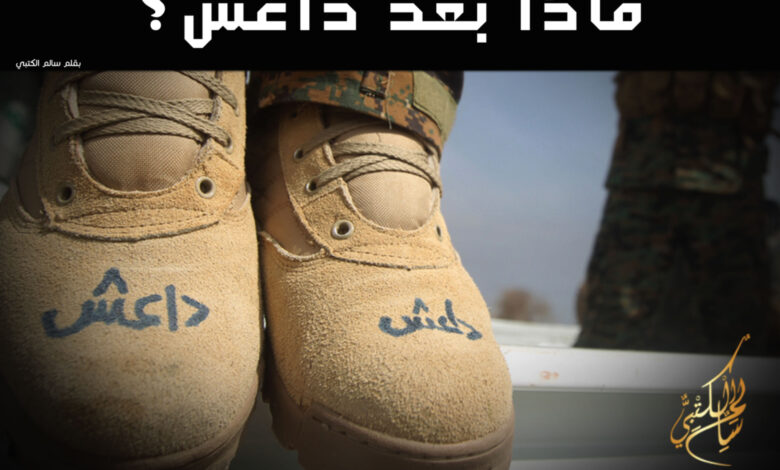
There are expectations that Daesh is almost defeated and that it will only remain for few more days in Iraq and Syria. These expectations were confirmed by Brett McGurk, US envoy to coordinate operations to free Mosul, who recently reported that Daesh militants who remained in the Iraqi city will die there, after the Iraqi forces blocked the last road out of the city, besieging the militants inside, thus ending the control by the organization over the second largest Iraqi city, which it has occupied since 2014.
It may be true that Daesh is about to disappear from Iraq and Syria, but the terror group would not have remained all those long years despite international coalition forces’ air strikes and fifty thousand Daesh members took control of a territory as wide as many countries – without external assistance.
Daesh was probably a tool to reestablish the strategic interests of the major international powers. The real question now is: What’s after Daesh? Does the end of Daesh mean terrorism is over?
The terrorist ideology will not end with the fall of Daesh. History taught us that the most dangerous phase of terrorism begins after the organization disintegrates, it transforms into new minor organizations with the same ideology and different tactics, or it adopts a different ideological approach after the failure of ‘Daeshism’ in maintaining the state it promised its supporters that it will continue to expand.
Terrorist ideology will never cease to exist. It works depending on the circumstances of its strategic environment. Not all conspiracy theories should be ruled out as a key element to reasonably explain what is going on.
We should not assume that Daesh will face the same fate as Al-Qaeda. Daesh still has significant financial and human resources and is able to change its tactics, while its godfather, Abu Bakr al-Baghdadi, is still alive. He may be the guarantor of the organization’s ability to further resist.
What’s after Daesh is one of the legitimate questions in the current stage. It is early to talk about the fate of the organization while the fate of liberated areas is still itself unknown. Any international struggle over these areas will be a chance for Daesh to exercise its influence under the banner of ‘resistance’.
As a researcher on terrorism and its historical roots, I think terrorism works in a continuous chain from generation to generation. Al-Qaeda was the second generation after the jihadist organizations formed in the eighties of the twentieth century in Egypt, Algeria and other countries.
After the disintegration and decline of Al-Qaeda, following the death of its founder and leader Osama Bin Laden in Pakistan in 2011, Daesh emerged as the third generation of terrorism, adopting a different understanding based on the establishment of the caliphate and the control of the world. After decades of debate between terrorist organizations about fighting their enemies, Daesh adopted a deadlier and more violent approach from Management of Savagery: The Most Critical Stage Through Which the Islamic Nation Will Pass. This book comes essentially from Al-Qaeda and Daesh applied it to the letter. The author Mohammed Khalil Hakayimah, who is ideologically and organizationally linked to Al-Qaeda, stated that the Muslim nation will go through three phases of development viz. vexation, chaos, and the establishment of the Islamic State through chaos management. At first, Iraq was the typical place to implement this approach, and then Syria was added to the plan when chaos hit the country.
Perhaps more sophisticated and aggressive terrorist generations will emerge, so it is important to realize that danger is not confined only to Daesh. There are other reasons that promote terrorism in general. Distinction should be made between, on one hand, the underlying causes of terrorism in the Arab and Muslim world, such as extremism, methods of education, poverty, corruption, unemployment and other factors. On the other hand, potential causes in the West are streams of Islamophobia which gain an increasing popular and official support. The phenomenon of Islamophobia grows and spreads alarmingly in many Western countries. There are hostile official attitudes against Islam and Muslims that in fact help these terrorist organizations to stay alive.