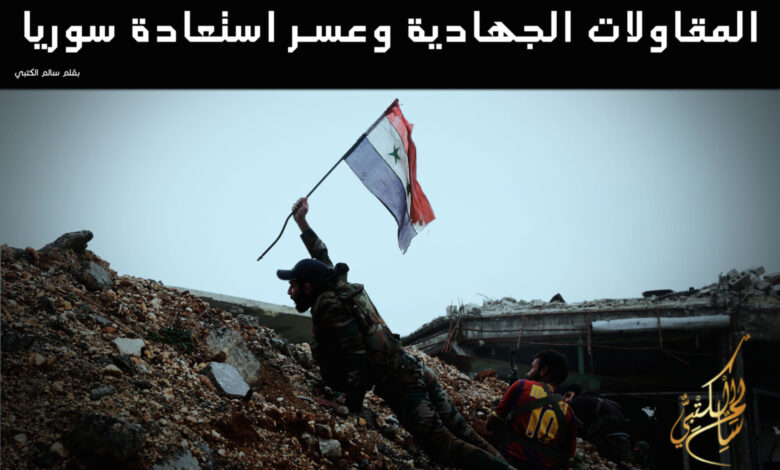
Will Syria that I know, as an Arab lover of this country with an ancient civilization, be back as it were one day? I do not find an answer to this question in light of the complexities of the current situation on the ground.
Recently, I read a media report drawing more pessimism in my mind and difficulties to answer this question. The report examines the number of mercenaries and security companies operating in the Syrian conflict, talking about a jihadist contracting military company, the first of its kind in the world. Citing Foreign Policy, the report speaks of a jihadist company called Malhama (epic), and has been called “the Blackwater” of Jihad.” Tthe report refers to the alarming spread in Syria of mercenary activity marketing and promoting fighting and training programs, which were described as hi-tech. these programs are well-known and popular among terrorist organizations.
Clearly, using the jihadist business in order to topple the regime of Bashar Assad has become very popular and profitable. The situation became a mixture of terrorism, politics, and conspiracies plans by regional and international powers. Syria became the place for illegal activities.
The bad news is that the report cites the leaders of these ‘business’ groups as saying that demand for their members has increased after the defeat of terrorist organizations in Aleppo, and that they are willing to offer their services to ‘oppressed Sunni Muslims’ everywhere. The report pointed that China and Myanmar are places where their ‘jihad’ can operate.
The report also says that the ‘Jihad Business’ has become a global phenomenon since years ago, but it did not have such spirit of ‘entrepreneurship’ before. New jihadist companies announce their need for coaches and young combatants. Their advertisements are seen across social networking sites, and include perks like in big companies, such as annual leave, weekly holidays, training and self-development.
Ex-combatants from the former Soviet Union are playing a vital role in fueling the conflict in Syria through their work as military and training counselors, contributing effectively to developing the skill sets of traditional terrorist organizations members operating in Syria. Their highly expensive exercises raise questions about the size of the financing for terrorist organizations in this conflict.
These companies now have online sites which publish free lessons in military exercises, bombings, manufacture of booby traps and bombs. Some experts expect a tremendous growth of its activities in the coming years, as part of a global trend known as the privatization of wars and conflicts.
In general, private companies are not a new phenomenon in the conflict. Studies indicate that mercenaries were an essential part of the armies since imperial Rome, Phoenician wars and then the Byzantine Empire. But this primitive style has now become private companies serving regular armies or even outsourcing or working with subcontractors. The British and the US armies relied heavily on them in Afghanistan, where the number of contractors with the US military in 2013 reached 85 thousand contractors, including about 20% providing security and training services, and the rest in the field of logistics. Globally, some estimates indicate that military contractors companies have exceeded half a million around the world with an estimated turnover of about 100 billion dollars a year.
In the presence of such large a quantity of jihadist and non-jihadist companies, working for other parties to the conflict in Syria, how can all of them be chased away from the country? Is there a way to control them and have them return to their original countries in the event of a solution to end this tragic conflict?
An estimated 47 thousand foreign fighters from the former Soviet Union are just in Syria, along Arab, European and Asian jihadists. Most of the fighters come from Chechnya and Dagestan, and have great combating experiences they gained during the years of fighting against Russian troops.
These companies in Syria, and before in Iraq and Afghanistan, pose a problem of security in the twenty first century. The commoditization of war and selling power is very serious in light of the proliferation of terrorist organizations and transfer of the security activities from private security companies to these organizations and to whoever can pay for whatever purpose.
When power turns into a commodity, security services into a business for those who describe themselves as jihadists, we are witnessing a threat to all countries and societies. In Syria in particular this phenomenon has become an imminent danger to the opportunities for the State to return to its original geographical and geopolitical context.