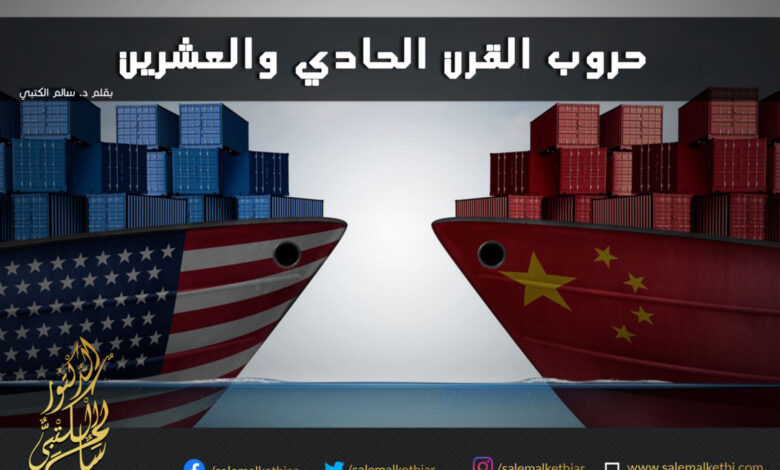
While the experiences of history do not always explain of all the events taking place in the world, what is currently taking place between the United States and China reveals a similar scenario to other conflicts between the great powers throughout history.
Trade wars are neither new nor fleeting in the history of international relations, although their effects, scenarios and limits of application vary. The trade war raging between Washington and Beijing is now a symptom of the struggle between the two powers for hegemony and influence over the next world order.
It is undeniable that the United States is the only superpower to be at the forefront of the existing world order. Its military power alone will make it a dominant force for decades to come, it can be said. But this is called into question when one takes into account the overall resources of the major powers, especially economic power.
It is true that economic power alone does not create a dominant global pole. But it is able to provide considerable support to any great power that aspires to compete with others. Military force alone is not enough to ensure that the poles will retain their place. Russia, successor to the former Soviet Union, has not been able to compete with the United States since the end of the Cold War for influence. But Russia came back when it was able to regain strength, and its economy recovered a lot. In doing so, it has secured the resources necessary for the global conflict, either by funding military development and weapons programmes, or by being able to withstand the reactions and policies of competing states, as in the case of sanctions imposed on it by the United States and the European Union on Ukraine.
China is now a pole in the making. It hopes to take the lead on the world stage alongside one or more powers, and perhaps even one day, by itself. There is no denying this legitimate strategic ambition. However, there are some who try to block it right from the start, or at least to slow down its rise.
For at least five decades, political literature and futurology on the sources of American power have emerged in the United States. Questions arose about the chronology of the possible decline and fall of American hegemony in the world. Most of these studies are based on insights from past experiences and the life cycles of major historical empires. They were trying to learn from the causes of their collapse to give the American Empire the ability to continue and go against the direction of history.
One of these lessons is to maintain the elements of a global power at the highest level of influence and optimal readiness by constantly developing military capabilities and ensuring superiority over all current and potential competitors. This requires the constant “creation” of the enemy, which in turn keeps the US in a state of readiness.
In the past, these studies have focused on eastern civilizations in general, including Islamic civilization, and have made them the menacing enemy. But it turns out that it is actually China that is experiencing the fastest growth and is the biggest threat to the United States. As a result, the Asia First strategy was born at the end of the era of former President Barack Obama. The US strategic interest has been reassessed, especially after the increase in shale oil production and the decline in the importance of the Middle East as a major energy supplier to US markets.
Today, the pace of competition between the United States and China has picked up for many years. China has shown unprecedented firmness and determination in its response to any US action against it. Since President Trump came to power, the conflict has raged like never before, and finally targeting Chinese telecommunications giant Huawei in a war many experts and specialists call a battle to shape the future.
China was not expected to take control of the global economy until the middle of the century. But the last few years suggest that its rise is taking place well before that. In fact, to avoid the effects of sanctions, China is being pushed to seek technological solutions.
Indeed, sanctions fuel global competition in technology and information. Competition gives rise to new strategic concepts such as the balance of technological terror.
Power is now for the best of modern technology. Tech warfare today involves the ability to limit the conventional and non-conventional military potential of adversaries, or even to paralyze them with precise electronic attacks from launch, guidance and control systems.