Since US President Donald Trump took office on the twentieth of January, research and thought institutions have made a multitude of studies not only about the future of President Trump himself in the White House, but also about the future role of the United States as head of the global world order.
Concepts such as “The new era” and “the post-West era” and “the post-American era” began to occur frequently among many researchers and politicians, and many believe that the positions and orientations of Trump paint new features to the United States, which are features of isolationism, not only towards the world, but also towards the values and ideas that have long been promoted within what is known as the American values model, or the Western, values model, based on the rejection of racism and the defense of freedoms and human rights, openness and integration in the sweeping tide of globalization. Those values are embodied in what is known as the American dream, which is one of the most important “exported elements” of America for hundreds of millions of people around the world. The idea of closing the doors and hunkering down behind the walls is completely against the idea of globalization. Moreover, how can the commander of the global system give up the driver’s seat, despite what the expensive strategic losses such a move entails? But what concerns me here is that the idea is already on the table and did not come out of my imagination.
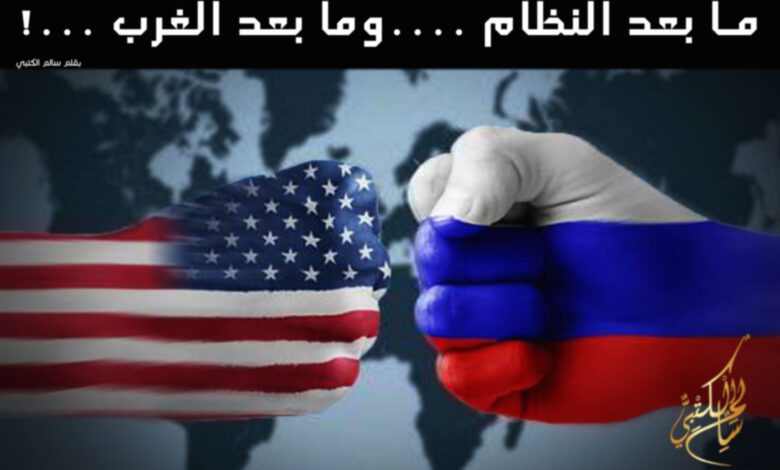
The after the West era is a relatively new concept in strategic science which recently came in the words of Russian Foreign Minister Sergei Lavrov on Saturday, February 18th in a speech to the Munich Security Conference. Lavrov said that the NATO is an institution of the Cold War, and that its expansion has led to unprecedented tension in Europe during the past three decades.
It is clear that the American President Donald Trump’s position on NATO, has enticed Russia to try to seize the opportunity and pounce on this alliance which is a symbol of hostility with it as the legitimate successor of the former Soviet Union, which NATO was founded to rival with it during the Cold War era. Russia still sees the expansion of the alliance as targeting it in spite of all the developments in the relationship between Moscow and Western capitals.
Lavrov says the Cold War is still burning in the minds of some Western politicians, and wars, as he says, begin in the minds first. He also says that his country “is not looking for a conflict with anyone, but is always able to protect itself”. It is clear that Russia strongly rejects the rules governing the existing world order, and believes that “the world cannot continue to be governed by an elite of countries,”
Conflict and tension between Russia and the West are not new, and will not stop within the foreseeable future, but what concerns me here is that there are common denominators that began to take shape between Russia and Western capitals about the existing world order identity. German Chancellor Angela Merkel said at the same conference, “We do not have yet a clear international system”. And it appears from the analysis of these words that the problematic relationship with Russia is an aspect of the absence of a global system. The United States, despite its leadership of the global system, could not yet develop a specific strategy to deal with the Russian influence.
The European Union is now heading to examine the problematic relationship with the Russian Federation more deeply, especially after the EU woke up on the possibility of the withdrawal of the American protection for Europe, according to President Trump’s remarks. Though realistically unlikely, such a possibility remains present in the strategic accounts, and it must be anticipated through the preparation of alternatives to address it whenever it occurs. This is why Chancellor Merkel says “we were unable during the past 25 years to establish stable relations with Russia, but Russia is our neighbor and is located on the external borders of the European Union”, where she spoke about the common interests in combating terrorism, and called for maintaining the work mechanism within the “Russia’s NATO” Council.
Although the US vice-president Mike Pence had tried to “soften” the position of President Trump, who had previously described NATO as a “defunct organization”, he repeated the call for European partners to allocate 2 percent of GDP of their countries for military expenditure, referring to the interdependence between the United States and Europe in the same values, speaking of values such as freedom, democracy, justice and the rule of law!!.
The Independent newspaper, for its part, published a report saying that the world is already on the verge of entering the post-West era, due to the atrophy of the European influence and the decline of American influence, which provides a rare opportunity for countries like Russia in the formation of a new world order. The report is based on estimates contained in the words of Wolfgang Aahinger, President of the Conference within a report published few days before the annual Munich security conference, and he considered that the Brexit referendum and the election of Donald Trump have caused the destabilization of the foundations of international institutions like the European Union and the United Nations and NATO. He predicted that the United States will turn from a global trade and security pole to a one sided foreign policy and perhaps a self centered foreign policy. He said that the current US administration is a strong catalyst for the emergence of “a world after the world order”. He added an important phrase when he said “We are probably about to enter the era of post-West, which is an era where players that are non-Westerners will take part in shaping international affairs, either in parallel with the same multilateral frameworks which were the cornerstone of the liberal world order since 1945, or in a way that represents a threat to these very frameworks.”
This political veteran put forward interesting ideas such as his saying that some of the most important pillars of Western liberal world order weaken, and that the enemies of open societies have taken the offensive, and that the faith of the citizens of democracies in the ability of their regimes to achieve positive results for them has become weaker and weaker, and that they now prefer national solutions and the closure of the borders over globalization and openness. As for the illiberal regimes on the other hand, they seem well grounded, while the will and the ability of Western democracies in the formulation of international affairs and in the defense of the liberal system based on the law is in decline.
This talk is very interesting and deserves great attention from specialists and researchers, because it means recognition from the West of failing to manage crises such as Syria and Ukraine and other crises. What concerns us in the region is that these debates may contribute to the generation of an unprecedented situation of a vacuum and perhaps strategic struggle to fill the vacuum created for the decline of Western influence and even bringing about a new world order. Here we can expect the endeavor of nations with strategic ambitions, such as Iran and others, to further stretch and test the will of the world and its ability to rein in their plans to take control of neighboring countries and regions, or for re-engineering the geopolitical situation regionally.