No one can deny that the Jordanian treasury bears a burden way beyond its ability in relation to hosting an enormous number of Syrian, Palestinian and Iraqi refugees. Jordan’s King Abdullah II was not exaggerating when he described the suffering of the people of Jordan, as a result of the tremendous developmental and economic pressures caused by the exodus of hundreds of thousands of Syrian refugees, as having reached the “boiling point”, as the country’s economy, infrastructure and utilities are all the way subjected to enormous pressure whose cruelty may be difficult to endure in the next stage. These pressures may cause the deterioration of the living conditions of Jordanians themselves, which puts the State in a difficult moral dilemma, and in the face of bitter humanitarian and political options.
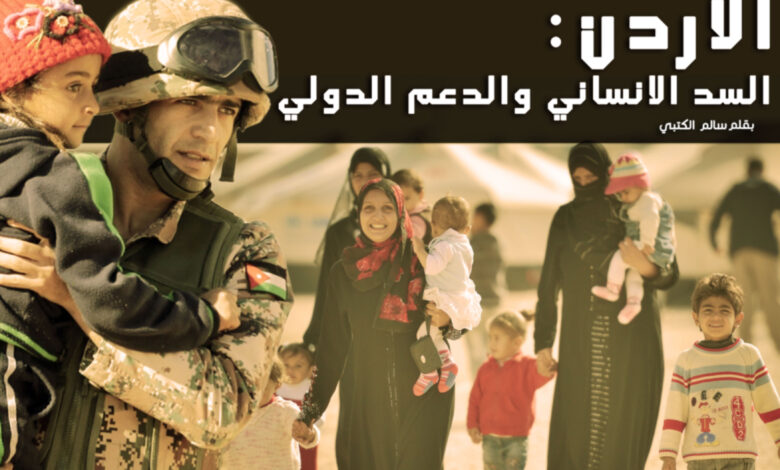
There is no doubt that the Kingdom of Jordan has saved the face of the whole of humanity, and the Arab countries in particular, when it opened its frontiers to this huge crowd of displaced Syrians, and before them, the Palestinians and the Iraqis. Therefore, it is not logical that the international community overlooks the consequences of this noble humanitarian position on the Jordanian economy and the Jordanian people, and it is not reasonable that the world leaves the economy of the Kingdom of Jordan groaning under the weight of the needs of this overwhelming human flood of refugees.
In order to understand the depth of the suffering, we have to review the positions of the European Union countries that made so much ado due to the entry of about one million of Syrian refugees to different European countries across the Greek borders, while the Kingdom of Jordan is hosting alone more than a million Syrian refugees, despite the depth of the economic and developmental troubles experienced by Jordanian people, and despite the fact that the Jordanian GDP does not compare to its counterpart in most EU countries. Suffice it to mention here some statistical indicators so that everyone knows the depth of the suffering of the Jordanian State due to its noble humanitarian position about displaced people and refugees from the Arab brothers, about 25% of the Jordanian budget allocations are spent on Syrian refugees, whose number is estimated at about 1.65 million refugees, in addition to the fact that the Jordanian State is living amid three raging regional crises in Iraq, Syria and the Palestinian territories, which caused the Kingdom’s economy to experience the “worst situation in its history,” as described by Abdullah Ensour, Jordanian Prime Minister.
Jordan’s economy does not suffer from refugees’ flows only, but it also bears the burdens resulting from other regional crises such as the Libyan and Yemeni crises. Indeed, the movement of medical tourism to Jordan has stopped, and the number of Arab students studying at Jordanian universities from these countries has fallen, and the commercial activity through Syria and Iraq has stopped, in addition to the massive decline in jobs and the widespread of unemployment among Jordanian youth because there is a tremendous amount of refugees who have enrolled in the local labor market and often accept lower wages and occupy any new jobs. These are mostly shocking indicators of the Jordanian economy, not to mention other burdens arising from the existence of this human flood spreading throughout the Kingdom of Jordan, such as security issues and other problems in light of the spread of terrorism and concerns about the spread of extremist ideology.
There is no doubt that these difficult circumstances and the noble human position of the Jordanian leadership and people towards Syrian refugees are exceptionally appreciated by the leadership of the United Arab Emirates, which recognizes the importance of Jordan’s vital role and strategic status in the regional security and stability, a conviction reflected by the UAE’s attitudes supporting the Jordanian economy in order to support this authentic Arab country in the face of crises. The UAE, which hosts about 200 thousand Jordanians brothers, who contribute to the development process of the UAE, and supply their country’s economy with a significant portion of foreign currency transfers, is well aware of its historical and national duties towards standing by the sisterly Kingdom of Jordan, in these difficult circumstances.
But objectivity requires to say that the enormity of the humanitarian responsibility on the shoulders of the Jordanian State in these exceptional circumstances, imposes on the whole world to understand that Jordan is a country with difficult economic conditions, even before the worsening of the Syrian refugee crisis, and therefore it is illogical that the world leaves the country alone in the face of the plight of refugees, and it also does not make sense not to deal with due diligence with the warnings of the Jordanian monarch, in which he said frankly, “The dam is going to collapse sooner or later, I believe,” despite the meanings of these warnings that are worth listening to by the leaders of major countries, specifically.
The world should realize that when the percentage of refugees is about 20% of the total population of the Kingdom of Jordan, and when the monarch considers his country as “the humanitarian dam” which prevents the flow of millions of refugees to the EU and the rest of the countries in the world, the world in turn must capture “the message” and understand the significance of the warning from the collapse of the dam and the potential dangerous consequences of such a catastrophic scenario for the entire world. And the international community must realize that solutions should not be limited to expressing sympathy, goodwill and nice words, because what is provided by Jordan for refugees is like a service to the countries of the world targeted by the waves of humanitarian asylum in recent years.
The European continent that rose up since the arrival of the first Syrian refugees to its southern shores coming across the waters of the Mediterranean, and the United States, which contributed with its failure to find a final settlement to the ongoing tragic situation in Syria, have to provide support to the Kingdom of Jordan in order to be able to fulfill their humanitarian duties about this large number of refugees, and everyone should be aware of the size of the humanitarian and developmental suffering caused by crises in the region, which imposes a need to search for fair final settlements for these bleeding crises.