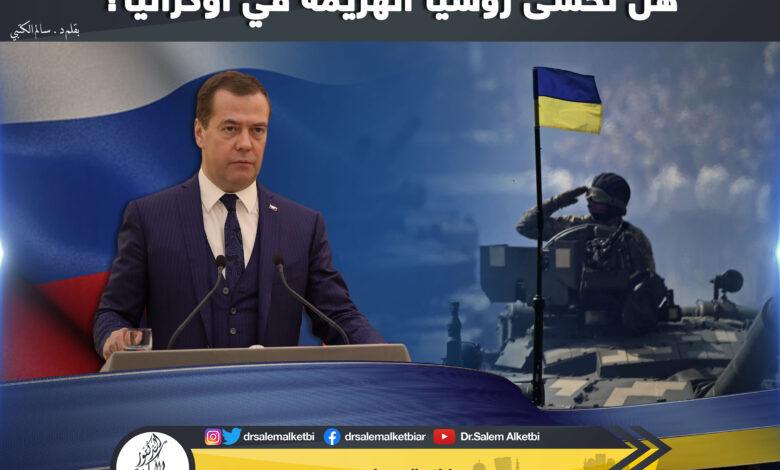
Dmitry Medvedev, Vice President of the Russian Security Council, warned that “the defeat of a nuclear power in a conventional war can trigger a nuclear war,” an allusion to Russia’s position in the Ukraine war.
Commenting on NATO countries’ military support for Ukrainian troops, Medvedev, a former Russian president and close friend of current President Vladimir Putin, said, “Nuclear powers have never lost major conflicts on which their fate depends.” This warning adds to a series of arguments about the possibility of a nuclear war triggered by the Ukraine crisis.
President Putin himself has spoken of such a possibility and warned against it. But Medvedev’s warning differs from President Putin’s, who noted that the risk of nuclear war is increasing and stressed that Russia considers nuclear weapons as a means of defense.
But he said, “We haven’t gone mad, we realize what nuclear weapons are.” He added: “Our strategy of using means of defense, and we consider weapons of mass destruction, nuclear weapons as a defense, it is all set up around the so-called retaliatory strike.” Medvedev’s statements were more direct, as he laid down the rule that the defeat of a nuclear power in a conventional war is a red line.
We are not talking about an attack that can be answered with nuclear weapons. But we are talking about a military defeat in a conventional war, as in Ukraine. The Russian leadership is aware that its forces in Ukraine could be defeated by increased military support from the West, which means they could resort to nuclear weapons.
The timing of Medvedev’s talks is important because he is meeting in Europe and before the conference to agree on increased military support for Ukraine. Several countries, including the US, have echoed Ukrainian President Volodymyr Zelensky’s call for more arms for his country.
The US announced a $2.5 billion package that includes armored vehicles and air defense systems. Several European countries have also pledged packages of their own, including the UK, which plans to supply Ukraine with hundreds of missiles. Some 50 countries are expected to coordinate their efforts to supply Ukraine with weapons.
Against this backdrop, Europe is increasingly determined to end the war in Ukraine’s favor. “It is time to turn the momentum that the Ukrainians have achieved in pushing back Russia into gains and making sure Russia understands that the purpose now is to push them back out of Ukraine,” said British Defense Secretary Ben Wallace during a recent visit to Estonia. He also announced a new US aid program that does not include tanks, as Ukraine would like.
According to US officials, this includes major military equipment such as armored personnel carriers, infantry fighting vehicles, ammunition and air defense systems, bringing Washington’s total military aid to Ukraine to $26.7 billion since February 2022.
According to some military estimates, the Atlantic side is preparing to bolster Ukrainian combat capabilities for a Russian offensive expected next spring to end this war.
But the US-led Atlantic side remains reluctant to send tanks to Ukraine, whether German Leopard or American Abrams, despite pressure from German Chancellor Olaf Schulz to take action or at least allow third parties with German tanks (such as Poland or Finland) to supply Ukraine with tanks, and Britain was the first country to supply tanks to Ukraine.
I promised to send 14 Challenger 2 tanks to the battle. Germany’s position is equally important for Europe and the Atlantic, whether as the world’s third largest arms producer after the US and Russia, or as the most important central power in Europe. Therefore, it can be expected to lead the European position on the crisis in Ukraine.
Berlin’s decision depends on the attitude of the US. It stressed that it will not send tanks to Ukraine if the US does not do so. Washington will not take such a position now because it will be seen as a dangerous escalation and could provoke a reaction from Russia.
Tanks could be a major factor in changing the balance of military ground power between Russia and Ukraine, which could lead to the defeat of Russian forces, or at least prevent them from advancing or holding their current positions. What worries experts is an indication that Russia is less and less able to replace the weapons lost in the war in Ukraine.
If they feel that failure could spell the end of President Putin’s political future, the likelihood of resorting to nuclear weapons increases. Western military assistance to Ukraine remains largely defensive. Atlantic partners are careful not to supply high-value offensive weapons that could open the door to an escalation of the war.
In short, Russia senses the difficulties of its military situation in Ukraine and is trying to put maximum pressure on the West to stop or reduce its military support to Ukraine so as not to get into a situation where it would have to resort to nuclear weapons to resolve the war and save face.
This is the repeated Russian rhetoric of political deterrence, which the Russian leadership currently sees as the only means of whipping up the fear of nuclear war that exists in the West.