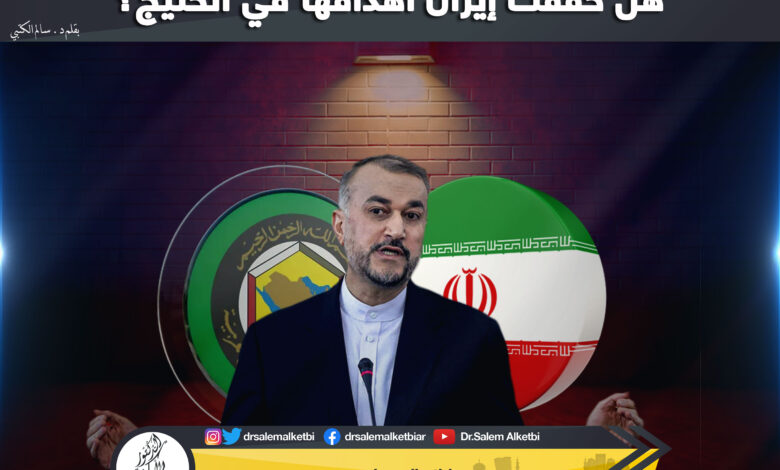
The recent Gulf tour by Iranian Foreign Minister Hussein Amir Abdollahian, visiting Kuwait, Qatar, Oman, and the UAE, raises questions about what Iran gained strategically from this. This tour followed a noteworthy visit by Saudi Foreign Minister Faisal bin Farhan to Tehran, after Iran reopened its diplomatic missions in Saudi Arabia in early June. It is expected that Saudi Arabia will reciprocate with a similar action after Eid Al Adha.
Firstly, it seems that Iranian diplomacy is swiftly moving towards building closer relations with its neighboring countries in the Gulf Cooperation Council (GCC). It is clear that Tehran is adopting a fresh approach to regional cooperation and tackling challenges, moving away from using threatening rhetoric and vague messages that have characterized Iranian policies in the past.
The shift in Iranian policies began with a major breakthrough in relations with the Kingdom of Saudi Arabia. The evidence shows that this trend will continue and deepen, considering the invitations exchanged during the recent Iran-Gulf meetings. HH Sheikh Mohammed bin Zayed Al Nahyan, the President of the UAE, received an official invitation to visit Tehran during his meeting with Iranian Foreign Minister Hussein Amir Abdollahian. Likewise, he extended a similar invitation to Iranian President Ibrahim Raisi to visit the UAE. The Saudi Foreign Minister, during his visit to Tehran, invited the Iranian President to visit the Kingdom of Saudi Arabia. It is expected that preparations will be made for a Gulf tour by Ibrahim Raisi, marking the culmination of Iran’s efforts to strengthen ties with neighboring countries.
Iran’s intense focus on fostering closer ties with the GCC nations was emphasized by Foreign Minister Hussein Amir Abdollahian, who stated that “continuing to build relations with neighbors is a fundamental principle of the government’s foreign policy doctrine.” He stressed the importance of addressing challenges through joint participation from regional countries.
It’s worth noting that Iran’s openness extends beyond neighboring nations and encompasses indirect talks with the US, facilitated by Oman. Multiple reports suggest that the two countries have reached a mutual understanding on various issues, including the nuclear program, US sanctions, and the situation concerning American detainees in Iran. Furthermore, Iran’s diplomatic maneuvers also involve other parties, like Egypt, where there seem to be reciprocal messages exchanged between the two countries on this matter.
A similar breakthrough also took place in Iranian-European relations after a meeting in Doha between the EU’s Nuclear Negotiations Coordinator, Enrique Mora, and Iran’s Chief Nuclear Negotiator, Ali Bagheri Kani. Furthermore, as mentioned earlier, the actions by the Iranian Foreign Minister followed a significant tour undertaken by the Iranian President in Latin America in mid-June, encompassing nations from the Bolivarian Alliance for the Peoples of Our America (ALBA) like Venezuela, Cuba, and Nicaragua.
These developments are interconnected and not pursued along separate paths. For example, it is hard to imagine the reconciliation between GCC countries and Iran without considering the diligent endeavors of the Biden administration to reach understandings with Iran.
Likewise, we cannot make sense of the shift in Iran’s approach towards neighboring nations without considering Tehran’s aim to counteract the consequences of normalization between Gulf states and Israel. This becomes particularly crucial considering the persistent efforts by the US and Israel to solidify the normalization agreements inked between Israel and several Gulf and Arab countries, by securing a similar agreement with the Kingdom of Saudi Arabia.
Undeniably, the developments in the Middle East signify profound geopolitical transformations — and these changes remain ongoing. They are expected to persist due to the continuous dynamics within the regional network of relationships, driven by varying calculations and assessments of the strategic interests of different regional actors.
For instance, Iran is driven by the calculations arising from Israel’s normalization with Gulf and Arab nations, as well as the positive shifts observed in Turkish-Gulf/Arab relations. Turkey serves as a regional powerhouse that balances Iranian influence, and Iranians cannot disregard its regional maneuvers and their impact on Iran’s role, influence, and interests.
Moreover, Iran aims to bolster its regional clout amidst the ongoing global power struggle to shape a new world order. Consequently, Iran seeks to elevate its role and broaden the scope of its regional actions to translate them into strategic interests within the process of defining rules and allocating roles on an international scale.
The underlying theme connecting all these movements is the collective regional approach towards deescalating tensions, prioritizing shared interests, and striving for development, economic cooperation, and investment.
Nevertheless, these professed intentions have yet to be put to the test by all parties involved, particularly because the challenge has never revolved around the willingness for economic collaboration, but rather the security and military strategies pursued by regional powers like Iran and Turkey. It is apparent that economic cooperation has not been completely severed between Iran and nations like the UAE, even during periods of heightened tension in Tehran’s relations with the region. Nonetheless, official cooperation has remained largely absent due to Iran’s widely recognized policies.
The bottom line is that Iran has managed to re-emerge in the realm of diplomatic reconciliation and has attained a substantial portion of its objectives, even at the diplomatic and procedural levels. However, these Iranian policies are anticipated to face trials, including their approach to contentious matters such as Yemen, Lebanon, and Syria.
Furthermore, Iran’s position regarding a potential peace deal between Israel and the Kingdom of Saudi Arabia, and its perception of ongoing bilateral collaboration between certain GCC nations and Israel in the context of the Abraham Accords, will be subject to careful scrutiny. Tehran, or at least certain uncompromising Iranian leaders, regard the reconciliation efforts with Gulf neighbors as a replacement for these countries’ cooperation with Israel.