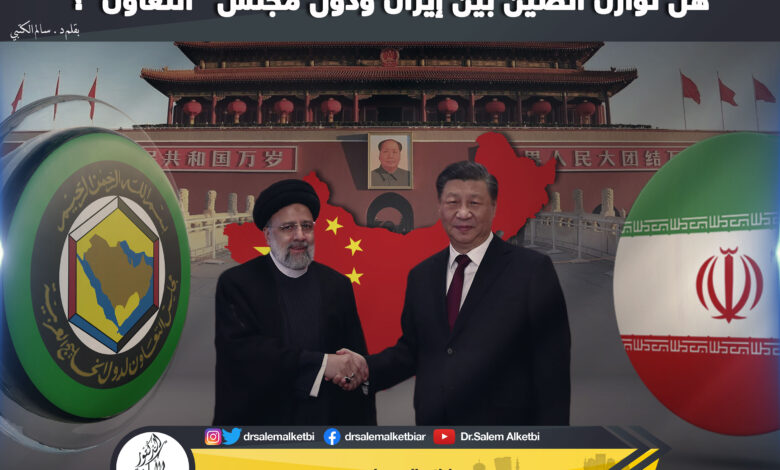
Iranian President Ebrahim Raisi’s recent visit to China is raising different expectations and opinions among observers and experts, some of which have to do with Sino-Iranian relations and Tehran’s position in China’s international alliance network. Others concern the impact of the growing Sino-Iranian partnership on the Gulf Cooperation Council, also an important strategic partner for China.
This is borne out by the signs and positions of China’s foreign policy. Raisi’s visit to Beijing, the first by an Iranian president in nearly two decades, already indicates that China is clearly focused on Iran’s role as a major energy supplier.
Tehran sees Beijing as an important linchpin in the Iranian regime’s implementation of its eastward strategy to escape increasing pressure from the West. This is especially true since there is no sign of lifting the sanctions imposed on Iran for its nuclear activities, and negotiations to revive the nuclear agreement have hit an impasse that will take time to break, especially after Iran’s role in propping up Russia in its war against Ukraine.
This role has led key European countries to side with the US on the Iran issue. One of Tehran’s forays eastward is Iran’s permanent membership in the Shanghai Cooperation Organization, which it officially gained late last year after 16 years of observer status.
Given the weight of the organization, which includes the three largest economies (China, India and Russia) along with the US, this is a big step, not to mention the fact that it comprises about half the world’s population and 20% of global economic output.
Objectively, however, it’s hard to say that the bloc is a complete alternative to Iran’s relations with the West, given the intertwined and complex nature of its interests. It is not readily expected that Iran will establish comprehensive economic relations with all countries that are constrained by Western sanctions, FATF requirements, and more.
Iran and China also signed a strategic cooperation agreement in 2021, described as a 25-year strategic roadmap. This agreement depends largely on Chinese investment flowing into Iran in return for guarantees to supply Iranian energy resources to China, or the oil-for-investment formula.
Beijing, Tehran’s largest trading partner, is no longer the number one investor in Iran, having recently been leapfrogged by Russia. This translates into clear diplomatic caution on China’s part in dealing with the Iranian issue. This is a very complex and convoluted issue.
To begin with, some analysts believe that China is defying US sanctions by buying Iranian oil. But while this is less of a challenge to the US than a bargaining chip in the ongoing strategic conflict with China, it is not in Washington’s realistic interest to completely dry up Iranian oil sources, so Chinese demand will shift to other sources, driving up prices and harming Western economies.
Therefore, the realistic equation Washington is pursuing is to turn a blind eye to China buying Iranian oil – in the mutual interest of Beijing and Washington. The oil is bought at lower prices while ensuring that China’s needs are met and Iran receives less revenue from the sale of its oil.
So this is not so much a matter of US softness or laxity in imposing sanctions, but rather a strategic alignment that ensures that all interests are achieved simultaneously.
One question that arises here is whether China’s relations with the Gulf Cooperation Council are affected by Beijing’s interests vis-à-vis Tehran? The answer is a categorical no. China is aware of the extent of its growing strategic interests vis-à-vis the Gulf Cooperation Council countries and is working to shape cross-Gulf relations according to a balanced policy that ensures the realization of interests without making exclusionary alliances against one side or the other.
A rising great power such as China is indispensable in striking this balance with all parties, especially since Iran’s position and strategic calculus enable it to accept Chinese strategic orientations even if it cannot fully identify with Tehran’s desires and aspirations, especially on issues such as the three UAE islands and other regional issues. In return, Tehran is eager to obtain Chinese support on other issues that Iran considers natsec-central.
These include the nuclear front, Western sanctions, and securing key outlets for trade in oil and other goods to ensure supplies to the Iranian economy and somewhat mitigate the impact of Western restrictions, which, in light of Iran’s position in support of Russia in the war against Ukraine, are continuing and may only grow in the near future.