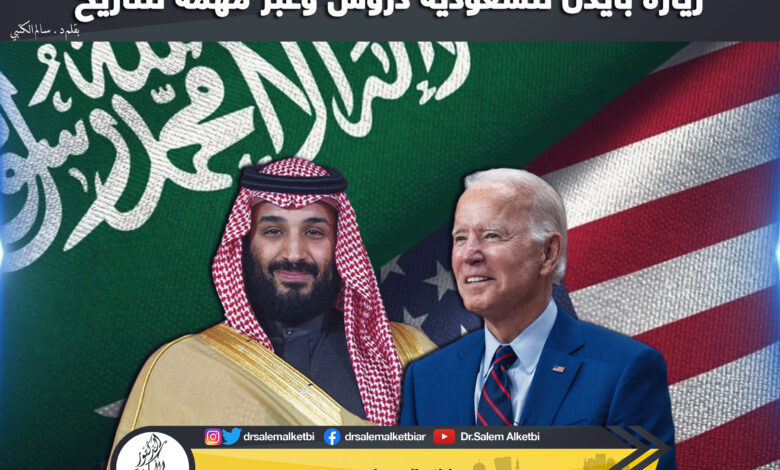
President Joe Biden’s trip to the Middle East, which includes visits to Saudi Arabia and Israel, is a historic step in terms of circumstance, timing and significance. This important tour has three dimensions that can be discussed separately: US-Saudi relations, US-Arab relations, and US-Israel relations, each with important intricacies and details that can be read in context.
The most prominent stop on President Biden’s Middle East visit is Saudi Arabia. This is not a personal conclusion. But it is only a follow-up to the prolific amount of articles published by foreign and Arab newspapers on this historic visit in all its implications.
Against the above background, I have no doubt that the whole world will be following the moment of the meeting between Saudi Crown Prince Mohammed bin Salman and President Biden. We have seen how the international and regional media followed the details of the young Saudi prince’s visit to Turkey, and how the details of the whole visit were monitored and analyzed.
We can expect intense global attention around the US President’s upcoming historic visit to Saudi Arabia. Far from delving into controversial issues, the visit is a sure translation of Saudi Arabia’s position and role not only in the world’s oil markets, but in the balance of power, energy security and the raging conflict between polar powers.
There is no doubt in my mind that the visit is a redefinition of the foundations of the strategic partnership between Saudi Arabia and the US, where it has become evident in recent years that the foundations of this partnership have been severely tested for almost eight decades.
Moreover, the “security for oil” equation can no longer withstand the changing times, leaving the two sides to discuss new definitions underlying their strategic partnership, as strong bilateral relations give the two countries enough space and room for maneuver to develop the foundations of the partnership.
The interests of states remain more important than any fleeting assessment, disagreement or opinion, especially if these things are the result of temporary sentiments or are linked to issues that have nothing to do with the interests of states, but which have almost turned into a roadblock hindering these interests and limiting their mobility and possibilities for development.
On balance, I can’t see much point in some describing the shift in President Biden’s policy towards Saudi Arabia, my belief being that the President has fallen victim to hasty positions in his campaign.
Even breaking down those positions and identifying with his country’s policies and strategic interests has become difficult over time. Even if the haste is on him, a veteran politician in the corridors of US decision-making when he was former Vice President Obama who’s well aware of Saudi Arabia’s centrality to his country’s interests in the Middle East and globally, but in the end, this is how it happened and now, the circumstances have allowed him to correct his position and try to get things back to normal.
In fact, President Biden is coming to Saudi Arabia without being at his political best, both internally and externally.
The man is caught up in the energy crisis, the war in Ukraine, the risk of failure in the negotiations to revive the nuclear deal with Iran, and the most important battle domestically, the mid-term congressional elections next November, as well as deep doubts and broad question marks about the US role in the Middle East.
But this is not about the president, it is about the US strategic vision of its relationship with Saudi Arabia and the rest of the GCC. So the visit is a historic opportunity for President Biden to answer a lot of questions, clarify things and set the record straight