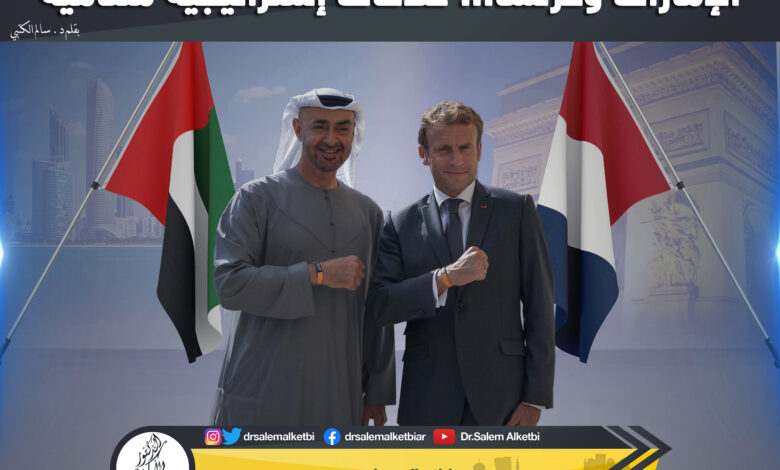
The recent visit of HH Sheikh Mohammed bin Zayed Al Nahyan to France is an important step towards building a strong partnership between the two friendly countries. The warmth with which HH was received during this visit reflects the depth and special nature of bilateral relations.
It drew the attention of the French media, which reported on the special receptions HH was accorded by the Head of State during his visit to the famous historic Palace of Versailles. The reception was attended by more than 100 guests from the world of politics, business, culture and science.
The occasion reflected the wide range of common interests and increasing cooperation between the UAE and France. Relations between the UAE and France have undoubtedly deepened over the years. The visit of HH Sheikh Mohammed bin Zayed Al Nahyan comes just seven months after President Emmanuel Macron’s visit to the UAE.
Ongoing dialogue and coordination between the two sides plays a stellar role in establishing common ground, which contributes significantly to mutual understanding of the positions and policies pursued by both countries.
This has recently been demonstrated by Paris’ understanding of the motivations behind the UAE’s stance on the Ukraine crisis, despite Paris’ and Abu Dhabi’s differing positions on the issue. The UAE, led by HH Sheikh Mohammed bin Zayed Al Nahyan, is committed to strengthening cooperation and partnership with all major powers.
The situation requires a balanced policy based on rational decision-making. In a telephone conversation with President Macron, HH sought to clarify his country’s position on increasing oil production ahead of his visit to Paris.
The UAE no longer has any room for unilateral decision to increase oil production as it abides by OPEC+ decisions. Therefore, the UAE tried to explain its position on the issue to Western leaders who are pushing for increasing supply in global oil markets in order to calm markets and lower prices.
What is clear is that relations between the UAE and France have matured to allow for differences of opinion on certain issues and questions. Both sides did not stop at the issue of increasing oil production. They started a comprehensive strategic energy partnership.
The goal of this partnership, as stated by the French government, is to identify joint investment projects in France, the UAE or elsewhere in the world in the field of hydrogen, renewable energy or nuclear energy, with the possibility of establishing a joint fund to finance green initiatives. The UAE has established itself as a reliable partner for France.
Conscious of the profound impact of the Ukraine crisis and the measures taken by EU countries to reduce dependence on Russian gas, the UAE is looking for various ways to support France’s strategic partner in these conditions without violating its international commitments.
This is also evidenced by the choice of Paris as the stop for the first official foreign visit of HH Sheikh Mohammed bin Zayed Al Nahyan since he took office in May. This reminds us of President Macron’s choice of the UAE as the first country to visit outside Europe after taking office.
It has a symbolic significance that cannot be neglected when trying to understand the foundations of the UAE-France relationship, which, as Macron described it, is tied to human values and ideals that transcend time and place. All of this was reflected in the creation last September of the Franco-Emirati Economic Council, launched on the occasion of HH the Head of State’s recent visit to France.
Its aim is to strengthen economic ties between the two friendly countries in the spheres of energy, transport and investment. The Business Council consists of 18 business leaders from both countries, selected based on their companies’ business opportunities and interest in strengthening economic relations between the two countries.
The Head of State, HH Sheikh Mohammed bin Zayed Al Nahyan, is keen on developing relations with Paris, continuing the UAE’s rapprochement with France since its establishment under Head of State Sheikh Zayed bin Sultan Al Nahyan, when relations were characterized by a high degree of specificity, appreciation and mutual respect.
In recent years, relations between the UAE and France have evolved significantly. They have grown deeper in the areas of military and cultural cooperation, especially after the establishment of the Louvre in Abu Dhabi, a milestone in the history of these relations.
Add to this the good personal relations between HH Sheikh Mohammed bin Zayed and French President Emmanuel Macron, and it becomes clear on what a deep basis the relations between the two friendly countries stand. The timing of HH Sheikh Mohammed bin Zayed Al Nahyan’s visit to France also adds a much profound dimension.
It reflects the UAE’s interest in supporting France as the circumstances of the Ukraine war have brought the energy factor to the forefront of both countries’ strategic concerns and priorities.
The UAE’s relations with France have become very special, both in terms of the diversity of the pillars of these ties, especially when it comes to the cultural sector, and in terms of the ability of the two countries to develop a common perception of issues that are at the heart of their foreign policy interests.