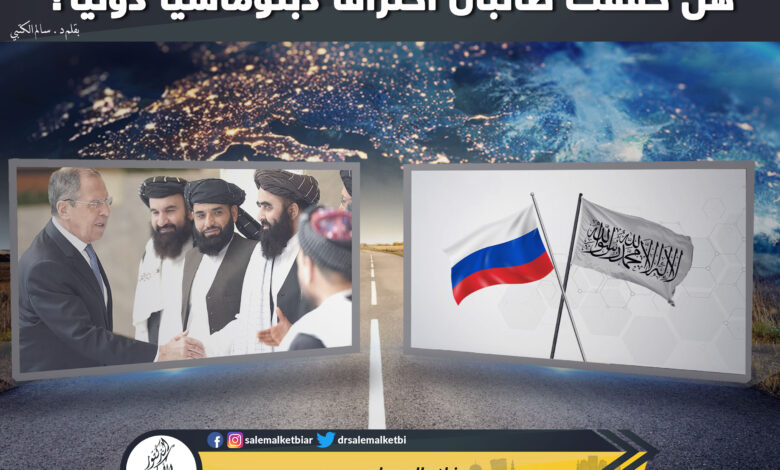
Many might not have thought that this would be the first influential international appearance by the Afghan Taliban since they took over Afghanistan in mid-August in Moscow, Russia.
But that is exactly what has already happened, as the movement participated in the Russian-initiated Moscow Formula Conference on Afghanistan, attended by Foreign Minister Sergei Lavrov and representatives of 10 regional countries, including India, Iran, China and Pakistan.
A high-level Taliban delegation was also present, including the ministers of economy, Qari Din Mohammad Hanif, culture and information, Khairullah Khairkhwa, foreign affairs, Mutaqi, commerce, Noureddine, and Kabul mayor, Abdul Rashid. The Russian foreign minister expressed “regret” over the absence of the US and the UN at the conference.
He said the Taliban must fulfill its obligations to respect human rights and political pluralism in order to be recognized as legitimate by the international community. The final declaration of the conference proposed a joint initiative to convene a major international donor conference under the auspices of the UN as soon as possible.
The final declaration also expressed serious concerns about the deteriorating economic and humanitarian situation in Afghanistan. It stressed the need for the international community to mobilize its efforts to provide urgent humanitarian and economic assistance to the Afghan people.
Parties participating in the Moscow talks on Afghanistan emphasized the need to work with the Taliban, but stressed that the movement must take steps to form a full Afghan government.
In the final statement, the participants stressed that “further practical cooperation with Afghanistan must be resolved taking into account the new reality of the Taliban takeover, regardless of the official recognition of the new Afghan government by the international community.”
This could be a recognition of the new political reality in Afghanistan, although it does not amount to an official recognition of the legitimacy of the Taliban government. But it is an important political breakthrough in achieving this important Taliban goal. The final declaration of the Moscow conference included conditions that can be considered a precondition for recognition of the Taliban.
The countries participating in the consultations called on “Afghanistan’s current leaders to take additional steps to improve the state administration system and form a truly inclusive government that adequately reflects the interests of all ethnic political forces in the country.” “This will be a prerequisite for the completion of the national reconciliation process in Afghanistan.”
They called on the current Afghan authorities to “pursue moderate and prudent domestic and foreign policies, adopt friendly policies towards Afghanistan’s neighbors, and pursue common goals such as strict peace, security, long-term prosperity, and respect for the rights of ethnic forces, women and children.”
Terrorism in Afghanistan, including Daesh, was not left out of the declaration. Participants expressed concern about the activities of terrorist organizations. They emphasized their willingness to contribute to Afghanistan’s security. In other words, Taliban cooperation and military support is needed to counter the threat of Daesh on Afghan soil.
This conference is also an important political victory for Russia. It aims to strengthen its influence in Afghanistan and the region and fill the strategic vacuum created by the withdrawal of US troops.
Russia has also succeeded in building a front by reordering the situation in Afghanistan and engaging India, China, Pakistan, and Iran, the most influential regional powers most connected to the Afghan issue. The Taliban came in second place in the conference’s list.
The movement’s first official appearance after its takeover of Kabul took place in one of the capitals of the major international powers and in the presence of other international powers that have influence over global decision-making, including China and India. Russia is sending a strong signal that it is ready to lead international efforts on the issue of Afghanistan.
In this sense, the absence of the US from the Moscow conference did not help. Instead, it tried to keep the door open to Washington and present a convincing excuse that the absence was coordinated with the replacement of the US special envoy to Afghanistan.
“We hope that the US remains ready to continue the work in Afghanistan,” he said, “and that the new special envoy joins the efforts, including those that will be undertaken after the Moscow formula meeting as part of the implementation of the agreements you will reach today.” Russia does not want to burn bridges in dealing with the Taliban.
But in return, it does not want to lose the initiative on this issue, vital to its national security. So the Kremlin is treating it with great caution, saying that Moscow’s contacts with the Taliban are aimed at understanding the movement’s medium- and long-term plans and intentions.
“In law, the Taliban is not recognized by world powers, including Russia,” the Russian spokesman said. “But de facto, the Taliban are the leaders in Afghanistan.”
“The hopes connected with the Republican camp, i.e. The former Afghan government of former President Ashraf Ghani, have not been fulfilled, and a new government is now in power. For these accomplishments, the Taliban bear a great deal of responsibility.” The implication: Russia’s recognition of the fait accompli and, to some extent, an implicit recognition of the movement itself.
Overall, Russia seems to want to help the Taliban implement a roadmap that will guarantee international recognition, or at least open the doors for them. The focus is on forming a broad-based government that shapes Afghan political and ethnic forces and provides rights, security, and stability.
With official reports predicting a worsening Afghan economic crisis and a major refugee crisis in Europe and Turkey, efforts to further support the Taliban and possibly gain international recognition could quickly escalate. A premise is that the movement must manage to comply with the demands of the international community without internal divisions and conflicts weakening its hold on the country.