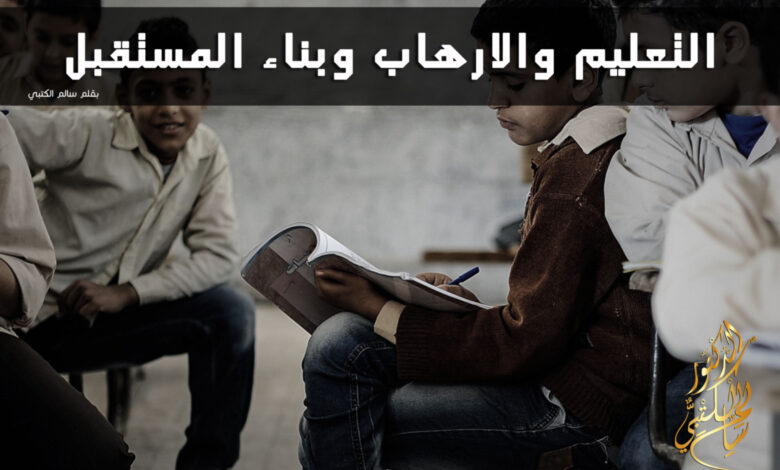
One of the most important approaches to combat terrorism and build a better society is the development of education. Good education creates a mindset capable to discuss and understand. The problem with terrorism is that it can easily target, recruit and mobilize young people to carry on its destructive agenda.
It is not only by education that we can defeat terrorism, but also by establishing a comprehensive social culture that is missing in most of our Arab countries, as they allocate small budgets to education in comparison with most countries of the world. Education is almost absent or not prioritized from the development agenda. As a result, university graduates complain that they are unable to write and read in their own language and other languages. So, how can such people reject any abnormal and extremist ideology or identify the evil purposes of terrorist organizations?
Elements of the educational process are connected, where the teacher is the most important and serious part in it and his role in the educational process is obvious. Advancing education in developed countries was not limited to the development of curricula; rather it included an integrated agenda where the teacher was central to the educational process and a channel to achieve educational development.
In Finland for instance, there is a wide and important research area about education. The teacher receives continuous training and has higher degrees in educational specialization. Schools assign teachers to devise their own curricula similar to the process in universities and higher education.
The teacher is able to evaluate pupils in the early stages of education without any psychologically challenging tests. Basic education in Finland begins at the age of seven, and focuses on playing, satisfaction of children’s needs, as well as socialization. Interactive approaches in teaching that are student-centered are adopted too.
Investing in education requires time and effort, not just funds. Arab countries, in their struggle with stagnant culture, emerging terrorism and increasing sectarianism, need time and determination to reach results from educational development plans.
It is unfair, one expert said, to compare an educational experience in a Middle Eastern country with Western ones; it is like putting a small car with a racing car and asking the small car’s driver to win.
Education in most Arab countries depends on tests and exams at the end of each year, while educationally developed countries have such tests only at the end of secondary school. Students in educationally developed countries spend years of their studies in learning skills and doing researches, rather than just receiving information to pass the exams.
We need to review our ideas of education, especially with regard to the management of the educational process. Some experts believe that educational systems in the Arab world are going through difficult problems such as the absence of a unified educational system, and in some cases the control of the private sector and businesses of the educational process. What is required is an educational output where financial means do not make a difference at the level of efficiency.
A Finnish expert said in an interview that society should know the goal of education. Is it to build a good economy and contribute to the labor market, to preserve values and traditions, or both? So, all members of society share the same goal. Although there is no correct answer to the question, but there is a common responsibility.
The expert said that the core aim of education in Finland is to build democracy, and that any other outcome, such as the supply of high-quality graduates to the labor market, should be a by-product. That is to say, the goal of education is to build a socially active citizen. This goal may be inappropriate for other countries, and therefore they have the right to set different goals and define social participation differently. However, it is important that educational strategies have a goal in every country.
I was excited about the Best GCC Teacher Award that was launched few days ago by His Highness Sheikh Mohammed bin Zayed Al Nahyan, Crown Prince of Abu Dhabi and Deputy Supreme Commander of the UAE Armed Forces. His Highness said that “we need a creative and an enlightened teacher”, as creativity is key to raise generations capable to build a strong society. The concept of the award reflects a high sense of responsibility by His Highness in the context of a comprehensive renaissance throughout the region and not just the UAE.