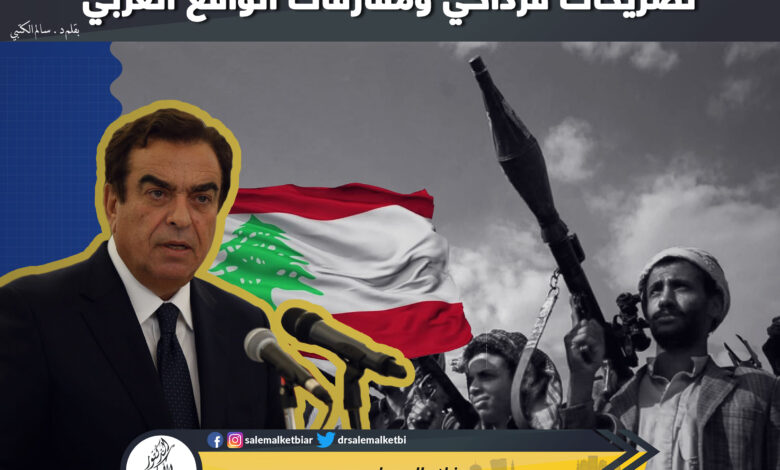
As if the Arab political scene needed a new crisis, like the one triggered by the statements of the Lebanese Minister of Information George Kordahi on the crisis in Yemen.
The evolution of this crisis and its consequences, which extended to the withdrawal of ambassadors, point to several things, including the inability of political leaders in the Arab world to separate the “public” from the “personal” in their functions.
And not only that, but also the level of arrogance and stubbornness that has dragged an entire state -Lebanon- into a crisis with two others among its biggest political and economic supporters. This is not a matter of gratitude, as some may hastily accuse me of claiming. Lebanon is no ordinary country in the calculations of the Arab regional order.
Rather, it is a state with great weight and deep historical and popular presence and attachment to its Arab regional fold. Therefore, the conversation about Lebanon should not be compared to any other. The situation in Lebanon has peculiarities that are known to all those familiar with Lebanese affairs.
I do not say this to segue into something else or to reveal something unspoken, but perhaps to set the record straight. The minister’s controversial remarks did not only negatively affect the climate and atmosphere of Lebanese relations with the GCC countries. They added to the concerns of the Lebanese instead of addressing the tough questions.
But it could have ended the moment it saw the light of day if they had been wise and able to assess things and measure the consequences, as politicians should normally do. Kordahi’s remarks may have been from before his appointment as minister.
Thus, clarifying this fact and aligning with the official positions of the Lebanese state, according to the requirements of the position, could have been done before the crisis flared up. But I don’t know why Mr. Kordahi insisted on separating his personal and official positions while officially representing the Lebanese state. He is not an ordinary minister and does not hold such a position.
He is the Minister of Information, the spokesperson for the state and the government and the most suited to express its positions. Someone who has enough experience to understand the implications of positions with political overtones.
He also understands the sensitivity of the Lebanese state in its vision, attitude and policy towards the Yemeni issue in particular. That is, the internal entanglements and external loyalties that lend this particularity to Lebanon’s position on what is happening in Yemen.
Therefore, he should have immediately taken the initiative to clear out the line between “personal” and “public” and not inflict further confusion on the Lebanese political scene, from which it has suffered enough. His talk of Houthi self-defense “in the face of an external attack” lacks foundation. It is simply untrue.
The Saudi-led Arab coalition did not go to Yemen to attack Al Houthi and his group who tried to hijack the entire Yemen to support the expansion plans of a regional power with well-known ambitions. The Iranian Revolutionary Guards’ support and funding for Al Houthi is as clear as day.
One need only recall the words of Iranian Quds Force Deputy Commander for Economic Affairs Rostam Ghasemi in April. “All the weapons and military equipment that the Houthis have, they owe to Iran’s help,” he said, “the IRGC is providing military training to the Houthi militias.”
This is an official admission that Tehran is using the Houthi militias as a cog in the wheel to implement its expansionist agenda and control the Gulf region from the north (Hezbollah and sectarian militias in Iraq and Syria) and from the south (Al Houthi militia).
In March 2015, the Arab coalition, with the help of the legitimate Yemeni government and with clear Arab military and political support, launched Operation Decisive Storm to counter the Houthis’ plan to bring the Yemeni state under its thumb for Iran’s interest.
So this is not about the Houthis’ self-defense or the coalition states attacking Al Houthi, as the minister is led to believe. Taking these events out of their political and temporal context seems to be an attempt to muddy the waters, if not to manipulate the facts. The Gulf countries that were incensed by his remarks did not interfere in Lebanon’s internal affairs.
They did not try to undermine the sovereignty of a country that is very much committed to its very sovereignty and dignity. He could have simply taken the initiative to de-escalate the crisis with a clarifying or appropriate political response, not by trying to tickle the emotions and play with the feelings of our Lebanese brothers in a delicate national moment like today.
Strangely, he downplayed the losses and damage caused by the almost daily Houthi attacks on Saudi Arabia and its people. Yet he did not bother to reflect on why the Houthi group rejects all efforts to resolve the conflict and all initiatives by the Saudi side or the UN to bring security and stability to Yemen.
One may wonder: shouldn’t those who are being attacked be responsive to peace efforts and seize any attempt at a solution, not impede everyone’s efforts and dismiss all initiatives with flimsy pretexts and obvious maneuvers? The answer is obvious.
The Houthi position could not care less about the suffering of the Yemeni people or the harm that the behavior of this contract militia is causing to millions of people, as long as it does not receive the green light from Iran to negotiate. The Yemeni people, whom the Houthis claim to defend, do not fit into the mullahs’ calculations, except as a means to implement its dark agenda.
The crisis sparked by the minister’s remarks was not only an opportunity to reveal positions and intentions on the Lebanese scene. It was also a new occasion for the éminences grises to play politics on a state and its people – those who boast of external loyalties to the “Vali-ye faqih,” even if it means dragging Lebanon into needless disputes.