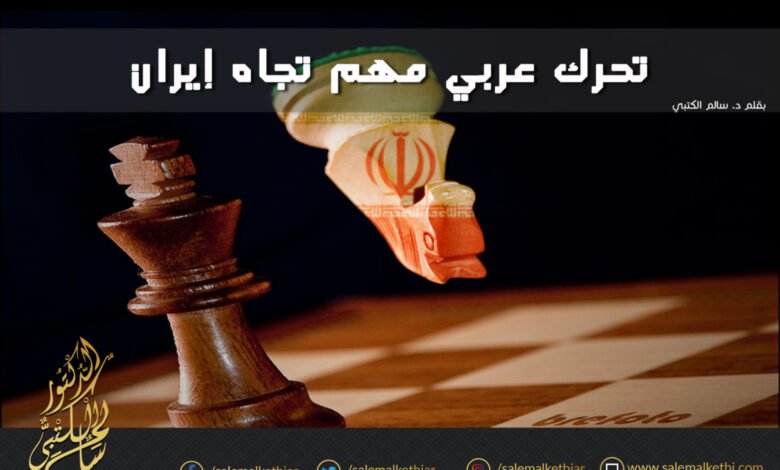
The emergency meeting of the Arab foreign ministers, held in Cairo recently, is important because of two main considerations. First, the Arab collective action has restored a great deal of political vitality and its ability to move internationally after years of inaction following the chaos and unrest in the Arab region since 2011. The outcome of this meeting was an Arab vision that can be developed internationally in dealing with the Iranian threats in the Middle East.
Several important points came out of the Arab ministerial meeting, the most important of which is the mandate of the Arab Group in New York to address the Iranian violations of UN Security Council Resolution 2231 regarding the development of the ballistic missile program and its offensive nature and the threat it poses to Arab national security. The mandate also calls upon the President of the Security Council to address Iran’s violations of Security Council resolution 2216 by supplying arms to terrorist militias in Yemen, and to consider launching an Iranian-made ballistic missile from Yemeni territory towards Riyadh as an aggression by Iran and a threat to national and international security and peace. It also calls for the Security Council to assume its responsibilities towards the maintenance of international peace and security.
This Arab mandate represents an important step in terms of what is strategically known as “building a cause” in international circles. It is not enough for Arabs to act individually in the United Nations and the Security Council; they must work collectively and employ all available pressure cards to build an Arab cause to add to the UN agenda and discussions over the next few days.
The Arabs have strong pressure cards and a great ability to move effectively in international diplomacy. There was an urgent need to unify efforts and to coordinate a move in the UN and the Security Council.
The meeting, which His Excellency Anwar Gargash, UAE Minister of State for Foreign Affairs, described as “historic”, guaranteed including the issue of Iranian interventions in Arab internal affairs on the agenda of the Arab cooperation forums with the international and regional actors and requesting the Secretary General of the League of Arab States to follow up the implementation of this resolution and report, in the next session of the meeting, on the measures taken.
The Arabs agreed on condemning the targeting of Riyadh by an Iranian-built ballistic missile from Houthi-controlled Yemen, the Saudi right to defense as stipulated in Article 51 of the Charter of the United Nations, supporting actions to be taken against Iranian violations within the framework of international legitimacy, and condemning all terrorist acts carried out by Iran in the Kingdom of Bahrain, including the latest bombing of a Bahraini oil pipeline, as an act of terrorism by an Iran/IRGC-backed group—a clear message to Iran that it cannot divide the unity of Arab countries.
The meeting also stressed its condemnation of Iranian occupation of the three Emirates islands (Greater Tunb, Lesser Tunb and Abu Musa) and its support of all peaceful measures taken by the United Arab Emirates to restore sovereignty over its occupied islands in accordance with international law. The meeting opposed the sectarian policy of the Iranian government and its ongoing interference in Arab affairs, urging Iran to stop supporting the groups taking part in regional conflicts, especially in the Gulf region. A demand was made to stop supporting and financing militias and armed parties in Arab countries, stop supporting and arming the militias in Yemen, a threat to navigation in the Strait of Bab al-Mandab and the Red Sea in a blatant violation of Security Council Resolution 2216.
The meeting criticized the Iranian interference in the internal affairs of Arab countries by supporting terrorism, training terrorists, smuggling arms and explosives, inciting sectarian strife through statements made at various levels, as well as establishing, funding and training by the IRGC and Lebanese Hezbollah of terrorist groups operating in Saudi Arabia.
Iranian officials’ hostile statements were denounced and the Iranian Government was asked to desist from such hostile rhetoric and provocative actions which threaten regional stability. It was decided to ban satellite channels financed by Iran, which air on Arab satellites, considering them a threat to Arab national security and as inciting sectarian and ethnic groups. In the final statement, the Lebanese Hezbollah was named a terrorist organization.
Although no consensus was there between all Arab countries as far as the Iranian threat is concerned, Arab central powers capable of influencing the Arab joint action during the current phase were present and participated in the Cairo meeting. This underlines the importance of its resolutions without minimizing or reducing the role of other States.
In general, this meeting is an initial step to establish effective collective action to address Iran’s threats internationally yet peacefully. It paves the way for putting the dossier on the table of the Security Council later if necessary.