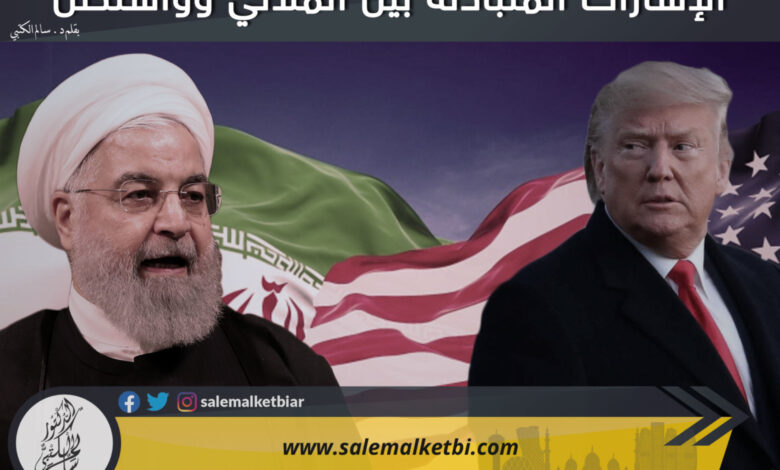
There is clear evidence that Iranian-American relations are in a period of calm or hiatus, as the administration of President Trump is worried about the President’s impeachment. House Democrats accuse him of abuse of power and obstruction of Congress.
However, there are indications that the parties are willing to maintain a minimum capacity to engage in direct dialogue on contentious issues between the two sides. The latest of these signals came from the exchange of prisoners between Iran and the US.
The mullahs’ regime declared its openness to the exchange of more prisoners, although it had earlier confirmed that the exchange was not the result of direct negotiations with the US. Prisoners exchanged included Masoud Soleimani, an Iranian scientist who has been arrested in the US since 2018, and the Chinese-American Xiyue Wang, imprisoned in Iran since 2016.
The mullahs’ regime insists on denying negotiations with the American side on the prisoner swap deal.
“This was just an exchange… We are ready to move on exchanges,” government spokesman Ali Rabei said. “But there were no negotiations.” After the return of the Iranian scientist after his release in the US, Foreign Minister Jawad Zarif tweeted, “After we got the hostage back this week, we are ready for a comprehensive exchange of prisoners. The ball is in the US court.” According to the Iranian version, the latest exchange came despite the US rejection of an offer by the Iranian regime last year to exchange prisoners, and Tehran had received a letter months earlier from a “former US official” saying that Americans were ready to exchange.
To be sure, this exchange has nothing to do with the vision of President Trump’s administration of Iranian threats or his belief that pressure should be exerted on the Iranian regime to comply with calls for dialog and engage in direct negotiations with the US. But it is also sure that this exchange is closely linked the Trump administration’s flinch from a military conflict with Iran.
The issue here is not just related to President Trump’s concern for Congressional investigations. But also because he has already begun his last presidential year, in which it is difficult to take a very vital decision such as the decision to launch a war against Iran, amid the sharp disagreement that exists with the Democratic-controlled House of Representatives.
The Trump administration may see steps such as prisoner exchange as an opportunity to explore how to deal with the mullahs’ system, learn about their negotiating patterns, and levels of rigor and flexibility in their dealings.
This is where President Trump’s praise for the very fair negotiations that the American delegation had with the Iranians, either directly or through Swiss intermediaries, is of great importance.
Such measures may contribute to crystallizing President Trump’s view on the issue of negotiating with Iran. He may be excited to take new negotiating rounds with the mullahs, whether about prisoners or about strategic issues and controversial topics.
President Trump is much more inclined to accept the challenges at the negotiating table. He likes to engage in any negotiations that may end with political deals, regardless of the content of the negotiation or the subject matter. He is mainly fond of the issue of victory through negotiation, and proving the validity of the idea he is trying to establish: his prowess in concluding deals and extracting concessions from opponents through negotiations.
On the other hand, it can be speculated that the mullahs’ regime, which has read President Trump’s approach well, is trying to achieve its strategic objectives by gaining time until President Trump’s first term ends.
A Democratic president may win and reassess the situation with Iran, with the potential for a return to the 2015 nuclear agreement. Even if President Trump wins a second term, he will have reason and strength to make a new deal with the mullahs’ regime free from pressure from Israel and the pro-Israel Jewish lobby in the US.
In both cases, the wait seems to be in the interest of the Iranian regime. Iran’s regime claims to adapt to tough US sanctions and may see sanctions as less bad than a US military strike.