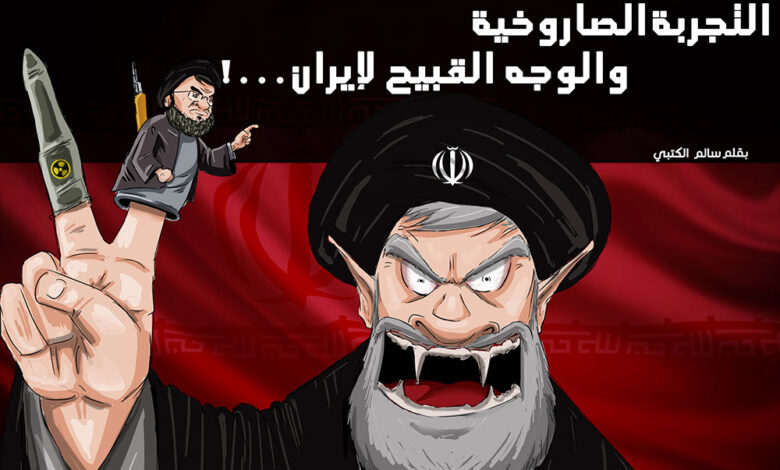
Iran’s possession of a program to develop ballistic missiles was not obvious to the political and security circles in the US before signing the nuclear deal. Still, the White House did not expect the mullahs would embarrass it that quick. Last week, the Iranians decided to launch a ballistic missile test, codenamed Imad, which in turn puts the US administration in a very awkward position, having tried to convince everyone that Iran is on its way to change.
The US and Western powers replied timidly. Tehran had in fact put them in a tricky situation, after two years of negotiation. The missile test expressed a defiant message and not a ‘dramatic’ one as described by some in the West. Apparently, the test violates UN Security Council resolution No. 1929 issued June 9, 2010, stipulating in its preamble that Iran must abide by the IAEA and international resolutions in regards to its nuclear program and that UN Security Council is keen to convince Iran to curb its efforts to develop sensitive technologies to support its nuclear and missile programs.
Paragraph 9 states ‘that Iran shall not undertake any activity related to ballistic missiles capable of delivering nuclear weapons, including launches using ballistic missile technology, and that States shall take all necessary measures to prevent the transfer of technology or technical assistance to Iran related to such activities.’ This text is unequivocal and unambiguous. It prohibited Iran from holding nuclear activities linked to ballistic missiles capable of carrying nuclear warheads, including all launch operations and missile tests. The resolution was still in force as the final agreement on Iran’s nuclear program was not yet concluded. The final report of the IAEA should be released later this year or early next year to measure Iran’s commitment to the obligations of the agreement. Carrying missile tests at this point represents a flagrant violation of UN Security Council Resolution No. 1929, so all the reluctance of major Western countries is not necessary. They found themselves in a difficult position after they jogged towards Tehran to reap the benefits of the agreement, while everyone else is waiting their turn for the uncalculated scrambling.
Iran found that the time has come to demonstrate its influence and show power in the region, after the signing of the nuclear deal which has been passed to the Congress, and the frequent visits of Western officials to Tehran, alongside the escalation of tensions between Iran and Saudi Arabia and the aggravating situation in Syria. Iran sent a message that it is in the process of a strategic shift of roles, and that everyone should accept what is dictated by Tehran now.
The major embarrassment was faced by the White House, which completely overlooked the Iranian nuclear and missile threat, instead focusing on ensuring the political glory of President Obama, who wanted to make history through openness to two bitter rivals, namely Iran and Cuba. Tehran did not give him the opportunity, though, deciding to immortalize him instead as the US president who gave the go-ahead to the Iranian hegemony in the Gulf.
Washington was well aware of Iran’s intentions and cognizant of expansionary sectarianism-driven ambitions even before the signing of the nuclear agreement; but President Obama was and still believes that the agreement will change Iran from within, either by forcing the Iranian theocratic regime to gradually open up, as was the case in China, or through an agreement that would lead to dismantling the Iranian State ideology and consequent collapse of the regime, as what happened with the USSR in late 1980s. It was his all-in bet, and the Iranian regime was aware of that. Supreme Leader Ali Khamenei warned, in his last speeches, of the American ‘infiltration’. Consequently, Tehran wants to impose its vision on the Western powers—even though it had swallowed the poison of temporarily halting the nuclear program—and is committed to achieve its objective behind the program i.e. regional expansion and eliciting international legitimacy, and that is a matter that may not be objected by Western countries.
The recent missile test is an expression of the ugly chameleonic face of Iran and its resort to diplomatic Taqiya. Almost synchronously, the rocket test concurred with the revelation of a military underground facility containing a rocket arsenal. The commander of the base Gen. Amir Ali Hajizadeh said that this base is not the only one in Iran, and that it hosts missiles ready for use at any moment, threatening what he described as the enemies with their repercussions, apparently referring to Saudi Arabia. A few days ago, Brigadier-General Morteza Qurbani, the head of the Revolution and Defense Museum, threatened Saudi Arabia, saying that ‘two thousand missiles are set to strike Saudi Arabia if the Supreme Leader ordered so’.
That is the ugly face of Iran that everybody recognizes, including Western leaders who do not know that taming an ideological system such as the Iranian regime has unfortunate consequences that they will have to face before everybody else. Bullying in the region, Iran violated all laws and international norms and conventions, reflecting the aggressive intentions of Tehran in ways revealing of bad intentions, while telling those who call for dialogue with such a ‘good neighbor’ that a powerful Iran is an added value to the Muslims around the world. This political satyr or silly talk about good neighborhood is irrelevant to the volatile and complex present situation that was, in the first place, caused by the policies of Tehran.