Does Hassan Rouhani believe there is someone in the world who believes that Gen. Qassem Soleimani can act in order to combat terrorism?
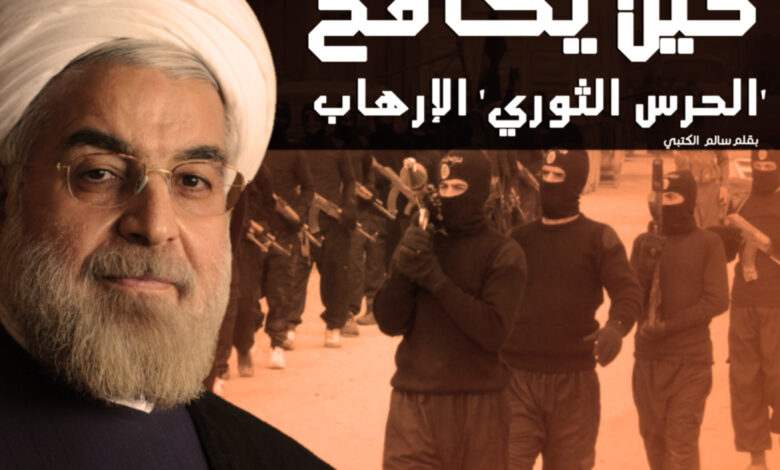
Iranian President Hassan Rouhani, recently said in a speech that Iran’s military is “the main force to fight terrorism in the region, which should not rely on superpowers”. I would have perhaps believed this speech if president Rouhani did not cite, for the sake of proving the sincerity of this talk, what the Iranian army did in Iraq and Syria. He went on saying “in Iraq and Syria, at the request of their governments, we helped their armies to fight terrorism.” Rouhani does not stop at this point but goes on to say, “If the terrorists are expanding in other countries in the region, the only hope would be the army and the Revolutionary Guards and the Basij forces of Iran.”
I do not want to slip into repetition by reminding the Iranian President Hassan Rowhani and Iranian politicians, of what the Revolutionary Guards did in Iraq and Syria. What happened is still under way and present in the memory, therefore, talking about fighting terrorism in Iraq and Syria on the part of Iran is only a way to sow confusion, to fool the gullible minds and to falsify irrefutable facts.
The first fact about dismantling these allegations is that the Iranian presence in Iraq has preceded the existence of terrorist organizations. The Iranian interference in Iraqi affairs has been achieved since the US invasion in March 2003. The Iraqi territory turned into an arena for settling accounts on the part of the Iranian Revolutionary Guards, who rushed with all their might towards the territory of Iraq and played a prominent role in the foundation of sectarian and confessional division of the Iraqi people. This Iranian presence was even one of the pretexts upon which relied the terrorists who led the bloodshed, murder and slaughter in this country, starting from Abu Musab al-Zarqawi to the so called Abu Bakr al-Baghdadi, the Amir of the terrorist organization Daesh.
The second fact that everyone knows and that is still running across the cyberspace is that Iranian leaders have boasted in front of the whole world that they are in control of four Arab capitals, Baghdad, Damascus, Beirut and Sana’a, which means that the matter is only an abhorrent Persian attempt to colonize Arab centers of civilization on the pretext of fighting terrorism.
The third fact is that the Iranian presence in brotherly Yemen was not motivated by fighting terrorism or countering the threat of “Al-Qaeda”. No bullet was fired from Iran’s agents, the Houthis, on “Al Qaeda” over the recent bloody conflicts, in which the Houthis pounced on the constitutional legitimacy and controlled Sana’a and were about to devour the whole State of Yemen had the coalition supporting the constitutional legitimacy in Yemen, led by Saudi Arabia, not thwarted their plan.
Perhaps the Yemeni example specifically confirms that the idea of the Iranian interference in the Arab countries does not target the eradication of terrorism, which is a malignant disease gnawing Yemen body many years ago, but is aimed primarily at dominating and occupying and encircling the Sunni Arab states via the centers of influence subordinate or loyal to Iran in Yemen and Lebanon, Syria and Iraq.
The fourth fact is the ethnic cleansing campaigns ferociously waged by the Shiite popular mobilization forces, militarily backed by the Iranian Revolutionary Guards, against the unarmed Iraqi Sunni Muslims in different regions of the country during the conflict with Daesh. There are documented reports proving such acts, including a report by Amnesty international, which accused the Iraqi government and the Shiite militias of the mobilization forces in the middle of last June of committing ethnic massacres against the Sunni Arabs in Diyala province. The senior advisor of the organization for crises, Donatella Rovera said “the heinous crimes committed by the organization of the Islamic State were met with growing sectarian attacks by the Shi’ite militias, who retaliated from the organization for its crimes by targeting Sunni Arabs.” Amnesty also accused Shiite elements of committing crimes of burning and looting and racial cleansing in northern Iraq. It is difficult to deny the Iranian Revolutionary Guard commanders’ responsibility for those ethnic crimes, as these crimes were committed in the documented presence of photos of Gen. Qassem Soleimani during his tour in the areas of the military conflict against Daesh in Iraq.
The fifth fact is related to the history of the Revolutionary Guard commanders and the forces of the Iranian Basij, which have a documented history of cooperation with international terrorist groups and organizations throughout the world, including Latin America and Europe, not only the Arab countries. To those who want to learn about the history of relations between the Iranian Revolutionary Guards and bombings and acts of violence and terrorist organizations and the mafia, there is a lot of evidence on the subject. There is no single terrorist organization in the world that has no cooperative relations or contacts with leaders of the Iranian Revolutionary Guard, which completely undermines the idea that the Iranian Revolutionary Guard and the Basij are suitable tools to fight terrorism and to install the foundations of security and stability in the region.
The sixth fact, which will not be the last one, is that Iran possesses an expansionist and dismantlement project aimed at redesigning the map of the region according to Iran’s interests and alliances and strategic objectives. The implementation of this obnoxious expansion project relies on dismantling several Arab countries from the inside using sectarianism and the tools of Iran, which is able to deal with inside agents of the Revolutionary Guards such as Hezbollah in Lebanon and the Houthi group and some Shiite groups in Iraq and others.
If Iran is serious in the fight against terrorism, it must first be a good neighbor and to prove that it is a responsible country that acts according to international legitimacy, and is keen to adhere to the rules of regional security and stability and to abandon the logic of imposing control or rather regional bullying it has been practicing over the last years, particularly since the outbreak of the so-called Arab spring.
The fight against terrorism cannot be achieved through the involvement of elements of the Revolutionary Guards and the recruitment of traitors, among agents in Arab capitals. It is only achieved by demonstrating goodwill and commitment to good neighborliness and genuine cooperation in accordance with the framework of international law and international legitimacy in the fight against terrorism, on top of that comes the adherence to not stirring sectarian hatred and prejudices between peoples and minorities.
Does Hassan Rouhani believe there is someone in the world who believes that Gen. Qassem Soleimani can act in order to combat terrorism?
And does Rouhani believe the Basij forces who carry a heavy legacy of sectarianism and factionalism disasters can be a force of peace, stability and prosecute terrorism and terrorists?
Demonstrating goodwill and trust-building measures are really the keys Teheran always shies away from using in its relations with other countries.