There is no growth and development in any country without a solid foundation of security, safety and stability.
This magical trio is the common denominator of all successful development experiences throughout history.
The founding leader, Sheikh Zayed bin Sultan Al Nahyan, recognized, through his strong instinct and innate strategic awareness, the foundations and pillars necessary to build a unique unitary experience.
The establishment of security and stability requirements has been one of its main priorities since the creation of the Union on 2 December 1971.
It all began with a rigorous constitutional construction, the establishment of the Shura Council and its institutions, the development of plans to use resources for the benefit of the people of the Union. Subsequently, it was necessary to build strong federal armed forces to protect and preserve the country and to establish balanced international relations with the various regional and international actors.
These principles and foundations continue to be the backbone of the experience of developing the Emirati model.
Our leaders have always been aware of the value of maintaining stability.
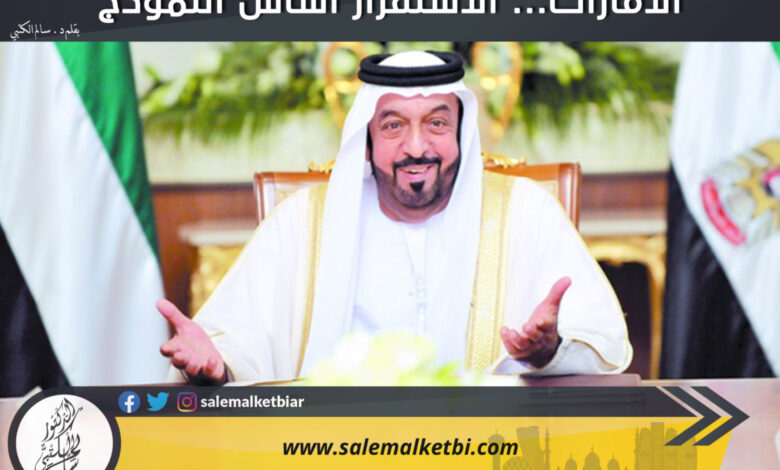
The renewal of the confidence of the Supreme Council of the United Arab Emirates in His Highness Sheikh Khalifa bin Zayed Al Nahyan, President of the Supreme Council of the United Arab Emirates for a fourth term, was an affirmation of the importance of maintaining and achieving the goals set at this stage, whose progress is well on track, as shown by the UAE 2021 project, and of continuing to prepare for the celebration of the Emirates’ centenary in 2071.
The United Arab Emirates has, during the empowerment phase, accumulated many achievements at all levels of development.
The country has risen to the top of the global competitiveness indicators in most areas.
Dream of its founder, may God bless his soul, to reach space, the first Emirati and Arab astronaut, Hazza Al Mansouri, has successfully completed his journey into space, a success that reflects the progress made in the UAE and on earth and in space exploration.
In fact, the greatest success of the empowerment phase is the successful bet on the UAE national’s abilities.
Investment in people has been, and continues to be, at the heart of all development objectives.
One of the priorities of the founding of the Union as a driving force for development and the main driving force behind its development has been education.
The education sector has seen enormous breakthroughs.
Since the creation of the State, in less than half a century, the figures have shown the evolution in this sector.
Following the founding of the United Arab Emirates University in 1976, the country now has an integrated university system that includes dozens of universities, eight of which maintain a significant presence among the 800 best universities in the world.
Symbol of this system and its latest achievements, the Mohammed Bin Zayed University of Artificial Intelligence was created last June, becoming the world’s leading university for advanced studies in artificial intelligence.
In economic terms, for example, the figures probably illustrate the enormous development of the era of empowerment led by His Highness Sheikh Khalifa bin Zayed Al Nahyan.
GDP increased from AED 379 billion at current prices in 2004 to around AED 1 520 billion at the end of 2018, an increase of more than 300%.
This is not limited to quantitative growth, but there have been qualitative leaps in growth in terms of diversifying the economic base and reducing dependence on oil, resulting in increased dependence on other non-oil sectors.
We are moving towards the service and knowledge economies by fostering a culture of innovation and modern technology and increasingly relying on information technology as a new source of income.
Non-oil exports in 2018 amounted to approximately MAD 212 billion compared to MAD 10.6 billion in 2003, an increase of more than twenty times during this period.
Figures and statistics are perhaps the best indicator of enormous achievements in all areas of development.
It is not only the economy, but also what is called quality of life, indicators that measure the level of reflection of growth on people’s lives.
The Index of Happiness and Confidence in the Future, which ranks the United Arab Emirates first in the Arab world, and close to the top in the world, is a good indicator of development success at the time of His Highness Sheikh Khalifa.
Another example is the empowerment of citizens to contribute to national accountability and decision-making.
The first electoral experience in the country was carried out by announcing the empowerment programme in 2005, on the occasion of the Federation’s 34th National Day.
Half of the members of the Federal National Council (Parliament) were elected and women had the right to vote and run for the first time in the country’s history.
This programme continued until the President of the United Arab Emirates ordered an increase in the proportion of women in parliament to 50 per cent, making the United Arab Emirates one of the countries in the world with the highest representation of women in parliament.
Externally, the UAE has become one of the most influential regional powers in international decision-making.
The country has an economic status and a balanced, capable and effective foreign policy.
The United Arab Emirates has a good reputation and plays an influential global role in the field of humanitarian aid and relief, thanks to which it has been able to play a very important global role in alleviating the suffering of millions of people around the world without distinction of colour, race and ethnicity,
The country has become a platform for tolerance and coexistence among human beings in one of the safest and most stable countries in the world.
The renewal of confidence in the mandate of His Highness Sheikh Khalifa is a renewal of confidence in the ability to continue to make progress and reap the benefits of development in order to strengthen the status of the UAE and deepen the prosperity of its people.
Stability will continue, with the will of God, and will consolidate the elements of the United Arab Emirates model, which has become a source of inspiration for all countries of the world seeking success, progress and development.