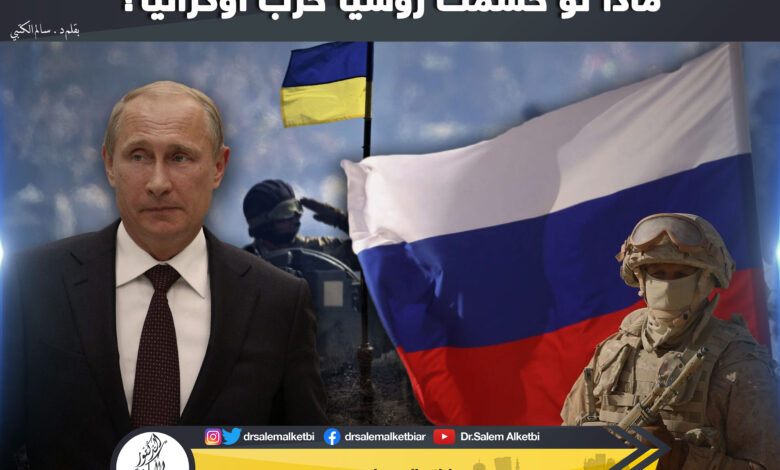
Many official reports and media accounts speak of heavy Russian casualties in the Ukraine war, both economic and military, especially in terms of the estimated number of Russian army casualties, which the New York Times in a recent report, citing US and Western officials, puts at nearly 200,000 Russian soldiers; these losses, incurred in only about 11 months, exceed US losses in Afghanistan by a factor of eight over two decades. Other reports address Russia’s economic and strategic losses.
An objective analysis suggests that the losses in their totality, if true and despite the severity of the numbers claimed in this context, should not mean much to the Russian side. It is difficult to compare the US and Russia in terms of the impact of the losses on decision-making because the political systems of the two countries differ. In the West’s relentless drive to break Russia’s will in the Ukraine war, its plans from the beginning have focused on a number of objectives, including the need to defeat Russia. In this context, a number of statements and positions by Western politicians and officials are worth noting. The President of the European Council, Charles Michel, said in March 2022 that Russian President Vladimir Putin must be defeated, pointing out that this is a matter of security for the future of Europe and the world.
Former British Prime Minister Liz Truss said that her strategy is to defeat Russian President Vladimir Putin in Ukraine. Many other Western positions and statements echo the same sentiment. Meanwhile, former US Secretary of State Henry Kissinger advised the West to stop trying to defeat Russian forces in Ukraine. He argued that doing so would have serious consequences for the long-term stability of Europe and warned the West not to give in to the “mood of the moment,” i.e., the idea of defeating Russia. He argued that the West’s negotiating goal must be a return to the status quo ante before the outbreak of war, a recognition of Russia’s annexation of Crimea. In my view, much of the motivation of the United States and its NATO allies to defeat, or at least weaken, Russia in the Ukraine war is related to the long-term confrontation with China, not far off.
An important part of the struggle for influence and dominance in the coming world order revolves around making headway in wooing Russia, both from China and the West. The West, certain of the failure of efforts to partner with Russia over the past decade, has embraced the idea of weakening Russia, especially after seeing the war in Ukraine as an opportunity to achieve this important goal. In fact, it seems very difficult to defeat Russia in the Ukraine war for several reasons. Not only because President Putin and the Russian elite firmly and absolutely reject the idea of defeat, even if it leads to the use of nuclear weapons. But even the Western instruments Russia faces in the Ukrainian arena are not sufficient to achieve this goal. Economic measures and sanctions have not achieved the desired goal, either in Russia’s case or in others. Western military support for Ukraine also does not appear to be sufficient to bring it closer to a complete military victory over Russian forces.
Therefore, it cannot be ruled out that the war will be decided in Russia’s favor strategically rather than militarily. That is, Russia’s goals in this conflict have been achieved: the recognition of Russia’s control over Ukrainian territory and the achievement of other goals such as the neutralization of Ukraine and the prevention of NATO expansion toward Russian borders. This would be a strategic victory for Russia in the ongoing conflict with the West, regardless of the economic and human losses that might occur on the Russian side. This is the most likely scenario to occur, and it will have significant negative implications for the West, not only in terms of possible new strategic positions in the post-Ukraine order, but also in terms of managing the strategic conflict with China, which in turn is watching events in Ukraine very closely. Many experts believe that Ukraine and Taiwan are similar cases; the Western intervention in the first case will show possible limits for the intervention in the second case, if there is a conflict with China. Although I believe that there are radical differences between the two cases, Ukraine and Taiwan, the existing similarities cannot be denied, at least in military terms. To put it in a nutshell: A military or strategic victory by Russia (the achievement of its goals, even if it is not a decisive military victory) would have enormous consequences for the West and especially for Europe.
It will help draw a new political map for Europe, both at the level of political parties and blocs and at the level of the cohesion of the European Union itself. And it will lead to a massive erosion of American influence and hegemony, and faster than in recent years.
Moreover, the resolution of the conflict in favor of Russia will lead to the repetition of the same scenario in other parts of the world. It can be expected that other regional and international powers, such as China, Iran, and North Korea, will behave similarly, as the tendency to resist Western influence and the trend toward the use of force in international relations will categorically increase in the face of the possible collapse of the currently still existing, albeit nominal, mechanisms for maintaining global security and stability.