The recent statements by the Iranian regime’s leaders have an undertone of arrogance to them. Although vanity is a typical feature of the mullahs’ worldview, their ethnic and nationalist arrogance has grown in recent times. Underlying this is an inaccurate assessment of the sequence of events that have occurred in the Gulf region lately.
The mullahs believe that Trump’s administration did not react to the attack on the American drone for fear of the fallout from it. They see it as a success of their policy to establish a new balance of terror against American military might. A rather absurd idea. The imbalance of military power between the United States and Iran is formidable.
The real explanation: President Trump wants an unheard-of victory using economic sanctions alone and without firing a single shot. They know that well, the mullahs. They also know that the impact of sanctions, which they describe as a destructive economic war, far exceeds that of hard power. They are therefore conducting propaganda to show the cohesion and strength of the regime in the face of sanctions, although their strained reactions suggest that Trump’s strategy is working wonderfully.
One of the problems of the mullahs’ regime is that there is confusion in the roles between the politicians and the military. For instance, Ali Larijani, who is chairman of the Iranian Shura Council, threatened to target US military bases in the region in response to any attacks against Iran. He said that these bases could well become a target for his country.
Such a declaration of military import could have been made by one of the Revolutionary Guard warlords. Obviously, the role-playing game is widely practiced by the mullahs in their relations with the outside world.
“The enemy is trying to hinder Iran’s economic development because it is a powerful force in the region, to prevent its progress,” Larijani said. Quite a talk. Obviously, economic development is hardly an issue of strategic planning for the mullahs’ regime. The regime has plunged the country into a state of poverty, corruption and widespread environmental, social and economic degradation of unprecedented proportions.
Everyone knows, including the Iranians, that Iran’s real problem with its regional and global powers comes from its foreign interventions and the financing of terrorist activities. The problem also lies in its constant quest for influence, hegemony and control over several countries in the Middle East. It was really only fair that those who represented the Iranian people (the Chairman of the Shura Council, the Iranian Parliament) tell the Iranian people the truth, not unrealistic fantasies about the roots of the regime’s problem with the world.
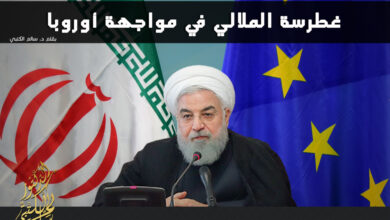
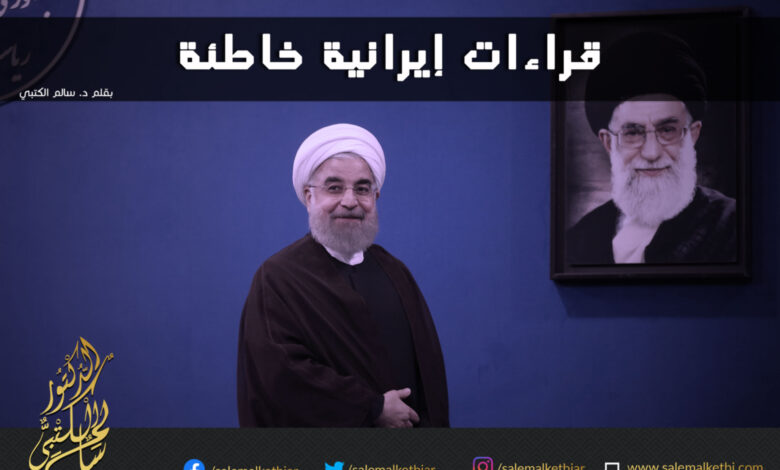
Another error of judgment was made by President Hassan Rouhani. He recently stated that “peace with Iran is the foundation of all peace and war with Iran is the mother of all wars.” This statement shows that the ego grew to have so much hold over Iran’s political mentality. The mullahs can only see themselves.
Added to this is the feeling of arrogance that has recently built up, like I just said.
This mix is extremely dangerous because it goes against any political approach with all the flexibility, realism and positive interaction it requires. Rouhani wants what he describes as “paving the way” for the negotiations: to apologize to the Iranian people and completely lift economic sanctions. However, he did not make a single positive gesture that could indicate a willingness to move the political process forward and get out of the crisis.
It is normal for each party to impose its own conditions, however strict they may be, before any negotiation process. In return, however, it must show signs of goodwill that confirm its seriousness in seeking a political solution.
President Rouhani spoke at his recent meeting at the Iranian Foreign Ministry with Minister Mohammad Javad Zarif about what he called “fair negotiations.” “If you want security, your soldiers in the region to be safe,” he said, “security is in exchange for security; you cannot compromise our security and expect security for yourself. Peace for peace, oil for oil, strait for strait. The Strait of Hormuz cannot be opened to you while the Strait of Gibraltar is not so to us.”
The negotiating rules mentioned by the Iranian President are, in fact, contrary to the principles of the United Nations and international law. A strait is not an exclusive sovereign right of a coastal State.
International law exists to regulate its control and sovereignty. No State has the right to do this and to make free navigation in the Strait subject to its own security. A State has no right to block the passage of oil exports to several countries to allow its oil to pass through.
Iran’s position takes the world back to the law of the jungle, where there is neither law nor legitimacy for the rules established by international cooperation after centuries of bloody wars and military conflicts.