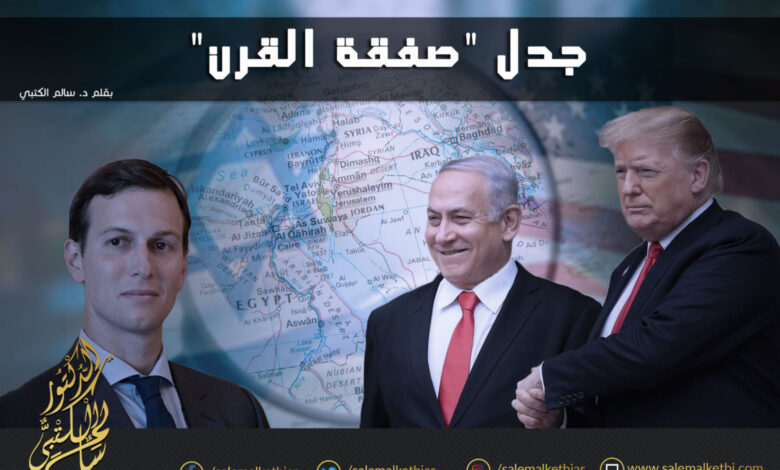
The controversy over the content of the “deal of the century” has intensified in recent days. The media have reported on specific clauses of the deal that involve taking a portion of Arab territories. According to most media leaks, though, the deal will not be announced at least until this June.
US President Donald Trump is putting all his stakes in the Middle East at concluding the deal, as it could help him to win a second term in office, at least according to those around him, like his son-in-law, Jared Kushner.
“If you can’t produce peace in the Middle East, nobody can,” Trump had said to Kushner at the beginning of his term. Trump believes in Kushner’s ability to do the business. Alongside Kushner, US envoy to the Middle East Jason Greenblatt and US Ambassador to Israel David Friedman are in charge of arranging for the deal.
Much information was leaked on the content of the plan, some of which was reported by high-profile politicians, researchers and journalists. But every time, the US administration denies the rumours. US officials who have not disclosed their identities have confirmed that the deal was twofold, with a political and economic component. They said that its actual content, particularly the political component, has been shown only to very few administration officials. Most of the leaks focus on the economic part.
The authors of the deal have deliberately kept their political agenda under wraps, even from the Arab leaders who have visited Washington D.C. in recent months. Some of the Arab leaders were reported in the Western media to be dissatisfied that the details that concern their countries were not shared with them.
What is happening now is more like a PR campaign to prepare the world to buy into the conclusions of the Kushner team.
Accordingly, leaked political and media reports and mixed statements are being pushed as trial balloons. The deliberate ambiguity is basically a psychological operation designed to ensure increased support for the proposed deal. Ambiguity is therefore an essential element of Team Kushner’s tactics.
Interestingly, American officials have intentionally dismissed or ignored media reports about the terms of the deal, without this implying the truth value of the reports.
The whole thing is still a marketing and publicity campaign. For instance, some reports indicate that the US plan for peace in the Middle East involves the annexation to Israel of 10% of the West Bank but that Israeli Prime Minister Benjamin Netanyahu has asked Trump to annex 15% instead.
Kushner said that the Palestinian and Israeli sides will have to make “concessions.” This is an established negotiating principle. But the underlying problem is that the concessions are subject to a biased understanding in favor of the Israeli side by which Israel will get the land in exchange for peace.
The exchange is the opposite of the Arab Peace Initiative, which is based on a different perspective of the principle of land for peace, where the occupied Arab land will be freed in exchange for the consent of the Arabs to peace and the normalisation of their relations with Israel.
It is now clear that Israel’s departure from Arab lands is not in the minds of the people behind the deal of the century.
The reality is that Trump decided to recognize Jerusalem as Israel’s capital and Israeli sovereignty over the occupied Syrian Golan Heights, and Netanyahu reportedly wants 15% of the West Bank.
The Trump administration’s approach shows a total bias towards Israel. Peace is not viable through such an attitude. Excluding the principles of conflict resolution from any dialogue and proposing a settlement formula for everyone to accept seems quite unrealistic.
The Palestinian question is so complex that no solutions can work if justice is not ensured to all.
True, creative solutions are required, but not at the expense of legitimate rights and long-standing principles that guarantee the support of all parties concerned for a comprehensive and just political settlement.