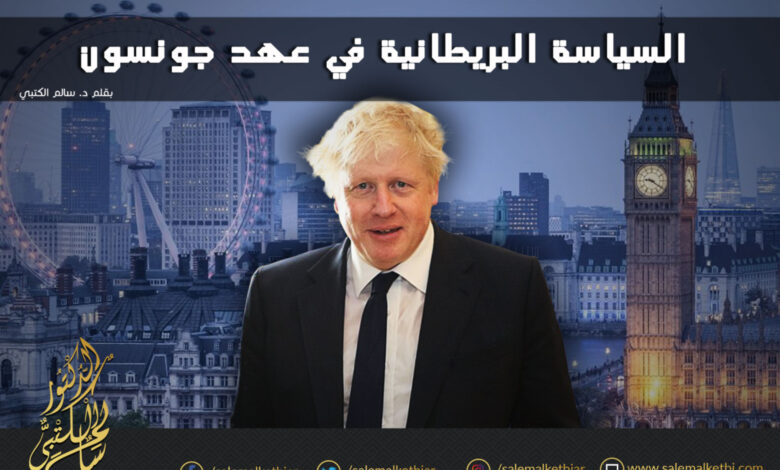
In recent days, political and media circles have been concerned about Boris Johnson’s arrival as British Prime Minister to replace former Prime Minister Theresa May. There is great interest in comparing the characters of Johnson and U.S. President Donald Trump, and how the consensus between the two leaders will affect Middle East issues.
U.S. Ambassador to the United Kingdom Woody Johnson said relations between the two countries will be “sensational” after Boris Johnson has moved into Downing Street. President Trump himself encouraged the British to choose Johnson as prime minister. He was the first to congratulate him on winning the position and welcomed his arrival in power, saying that he would do “a great job.”
There is great convergence in UK-US relations, which has been around since the disclosure of the diplomatic cables sent by former UK ambassador to Washington, Sir Kim Darroch. But this convergence mainly arises from common interests, not from personal relationships or similar interests and orientations between Johnson and Trump.
The new British Prime Minister is determined to pursue the Brexit plan, with or without agreement, he said. He needs the support of the White House in the next phase. A free trade deal should compensate for the UK economy’s exit from the European bloc.
As for the similarities (some analysts call it “Trump Brittany),” they are not quite perfect. In 2015, during President Trump’s visit to London, then Mayor Johnson said that Trump’s comments, who said that some areas of the city were “inaccessible,” were “a terrible ignorance” and that the president was “unsuitable to be president.”
It is true that the statement had little impact on the relationship between the two men. Boris Johnson nevertheless has a special admiration for the US President. But politics only understands the language of interests.
Some Arab analysts bicker about the friendship of Western politicians with Israel and their hostility towards Arabs every time someone comes to power. Everyone knows the political dynamics of Western countries and the factors that govern and influence them. The new British Prime Minister, who was recently described as anti-Arab, anti-Muslim and pro-Israel, had criticized the military campaign in Gaza in 2014. He also endorsed the US support for a UN resolution condemning Israel for building settlements.
Before judging too quickly, it should be remembered that British policy in the Middle East has not changed much with successive prime ministers over the past 20 years. Johnson’s period, which some believe will not last very long, is no exception to this rule. British policy has become clearly linked to American policy in recent years.
After Brexit, this link will only get closer. The UK is expected to orbit around US policies, at least in the early years after Brexit. This will last at least until the UK can get over the fallout from the exit.
Boris Johnson also came to manage the very complex Brexit file; he will not look too hard at other files so much as to make drastic shifts.
In terms of the British policy towards Iran, Johnson seems to be more willing to support the US position. He will not provide free support for the positions of the other two players in the EU trio (France and Germany) vis-à-vis Iran. European policy on several issues, including Iran, does not suit him. Johnson will be more inclined to support President Trump’s policy on the Iranian issue.
Johnson will not be more aggressive in the face of Iran’s oil tanker crisis. But he will have to treat it in different terms from Theresa May’s policies. His political speech is rooted in the desire to promote the glory and history of Great Britain. He will not leave aside the politics of the Iranian mullahs and their desire to take advantage of the political confusion that has been running rife in recent weeks in British politics.
Another thing to keep in mind: the Brexit folder is not so easy. Reaching an agreement has become very difficult. Johnson rejected the current Brexit agreement concluded last November.
EU leaders still refuse to renegotiate the agreement and European Commission President Jean-Claude Juncker insists that it is the only possible agreement for the EU. Concluding a Brexit without an agreement is an uncalculated adventure, especially if Scotland decides to remain in the Union.
Following his decision to renegotiate the Brexit agreement, France and Ireland issued a warning to the new British Prime Minister. Dublin accused him of setting up “collision course” EU clash.