The Western research circles have been debating the idea of the death of democracy for many years. Many specialists and researchers have come to the conclusion that democratic mechanisms are not a magic wand for dealing with all political crises.
Sometimes, democracy is the crisis itself.
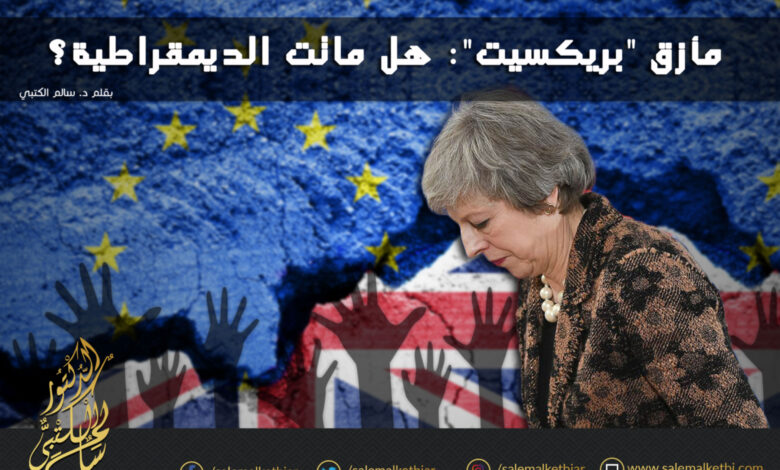
The analysis in this article does not glorify democracy, nor does it attempt to challenge it. The point is to put into perspective what the global research community is debating. The notion of the death of democracy has once again gained prominence with Prime Minister Theresa May’s plans for the UK to leave the European Union.
After the British House of Commons has repeatedly rejected May’s plan for a soft Brexit, pressure was building in Britain as April 12, the deadline the EU leaders gave May to propose a solution to the British exit, was approaching.
If May had received parliamentary support for her project, she would have obtained a European extension until 2 May. The British Prime Minister had until 12 April to request an extension of the deadline to prevent a no-deal. The nightmare scenario has raised political and economic concerns.
Almost 1,000 days after the British vote in favour of Brexit, Teresa May failed to reach a deal. Even her career as Prime Minister and leader of the Conservative Party is almost over.
The question now is whether this impasse means that democracy cannot find a way out if Brexit was already scheduled for 29 March. Does this mean that democracy sometimes turns from a consensus building mechanism to an obstacle to political plans? Some researchers say so.
Researchers cite situations such as the political impasse facing some countries due to their inability to reach a political agreement capable of forming a government backed by parliament.
Of those who believe that the British case bears witness to the “death” of democracy is Donald Trump Jr., the son of the US President Donald Trump. In an article published in the Daily Telegraph, Trump Jr. said that the ongoing Brexit crisis and its possible delay suggest that British democracy is dead.
Trump Jr. did not coin the term. Many have discussed the subject before. US magazine Foreign Affairs, for one, published an article on the end of the democratic era and what it called the global “resurgence of autocracy.”
The article featured several studies and articles examining the evolution of democracy around the world. Experts such as Farid Zakaria have contributed to the discussion. The overall work focuses on how the governance models in several countries have led to the demise of democratic liberalism.
The British case is quite separate from these discussions, but it is set in the context of the decline of democracy.
Democracy is declining for its inability to resolve political differences and for other reasons. It can weaken with the rise of the far right in Western politics with all the ideological and political biases against the liberalism and democracy that have brought it to power.
Moral and religious controversies, such as same-sex marriage, are also among the challenges facing Western democracies.
In the Arab world, some argue that the experience of democratization has brought radical religious organizations to power, much as the ballot boxes had brought the Nazis to power.
In their book How Democracies Dies, Steven Levitsky and Daniel Ziblatt noted that Western fascist and authoritarian regimes in the early historical stages had also come to power through democratic elections.
My view is that the acceleration of the waves of globalization – and the resulting waves of refugees and migrants, combined with the tremendous technological revolution – are hampering the application of the rules governing relations between the majority and the minority in the democratic tradition. The majority-minority relationship is a cornerstone of the electoral process and its political implementation.
Therefore, the world has already entered the post-democratic phase, not in a neoliberal sense. The shift, however, is subject to change. No one is sure about its scope or course of development. The new phase does not mean the end of the era of ballot boxes and votes. What the West is experiencing is just another chapter of history.
The debate on democracy intensifies when its institutions are weakened, but that does not imply that the idea itself is weak. Such institutions are not only parties and parliaments but also other components of the political system, such as the media, the judiciary, civil society organizations and other institutions that protect the democratic tradition.