There are foundations for security and stability in all countries, the most important of which is to build state institutions or affirm their role in political and social life.
In the event of armed conflict or control of a coup d’état, the institutional role must be restored.
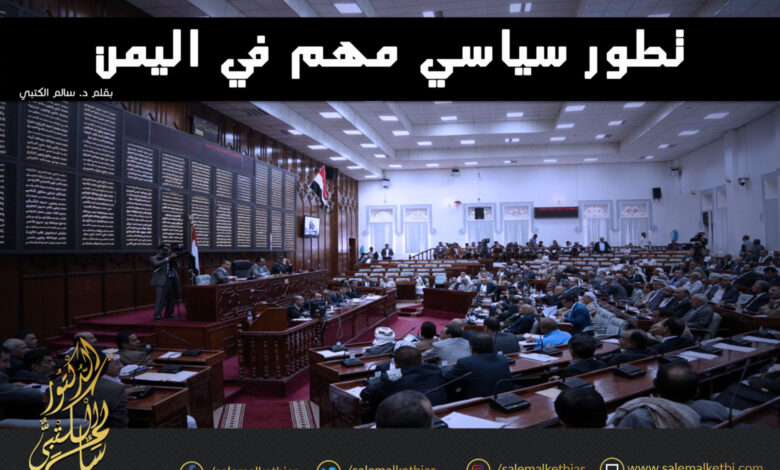
The convening of the first session of the Yemeni Parliament since the beginning of the Houthi coup d’état was a key contribution to the empowerment and legitimization of the Yemeni State institutions facing the Houthi coup d’état.
Despite all the campaigns questioning the significance of this move, the convening of the parliament in Sayoun, Hadramout province, made the case that legitimate institutions can reunite the Yemeni people and restrain the Houthis in their zones of control.
Restoring parliament to its rightful place as a symbol of the Yemeni State gives the people of Yemen hope in their country. The parliament’s presence paves the way for the final defeat of the coup d’état led by the Iran-backed sectarian militias.
The resumption of the Yemeni parliamentarian’s work is not only important domestically. Parliament essentially provides the Yemeni people with a new platform to speak out abroad about what is happening in the country.
Within hours of its first session, Parliament received the support and confidence of the international community. The US “congratulates the Yemeni deputies who met for the first time since 2014,” the US State Department confirmed in an official statement. Many other states have done the same.
The international community agreed that the convening of Parliament was an important step towards resolving the crisis within the framework of the decisions of the National Dialogue Conference, the Gulf Initiative and the relevant United Nations resolutions.
The convening of the Yemeni Parliament signals the isolation of the Houthi coup d’état and confirms the strong ties between the countries of the Arab alliance and the Yemeni people. At the first session of Parliament, the President-elect of the Parliament, Sultan Al-Barakani, appreciated the UAE and Saudi support for the Yemeni people and for their legitimate government.
Meanwhile, the Houthi militias, who do not want peace and stability for Yemen, continue to carry out the Iranian project. They reject all political settlement efforts set out in the Stockholm Agreement or the open hand extended by President Hadi in his speech to the first session of parliament.
“The legitimacy did not want war and did everything in its power to avoid it,” said Hadi. “Isn’t it time to lay down our arms and start peace?” Hadi told the Houthis. “We reach out to the Houthis because we care about Yemen.”
Hadi also sent an important message to the wise people among them, if any.
“Do not bet Yemen’s present and future on the country’s enemies,” he said. Because the Houthi militias do not understand the language of peace or respond to any call for dialogue, all parties spare no effort to rid the rest of Yemen of their grip.
While some are trying to question the importance of the restoring parliament, the reality is that it is a significant step forward from what has happened over the past four years.
The Houthi militias and their Iranian sponsors believed that the Yemeni state had fallen apart and its institutions had been destroyed. But restored strength of the army, security and police, the resumption of the work of Parliament and the limitation of the influence of the Houthis in certain areas confirm that legitimacy is winning and advancing. The governorates of Aden, Abyan, Lahj and Shabwa have been liberated. If it were not for the consideration of civilians, the city of Hodeidah and the rest of Yemen would have been liberated as well.
It is only natural that progress is gradual and slow. Restoring entire institutions is no easy task. Without the support of the Saudi-led Arab Coalition, the situation would have been different and the legitimate Yemeni state would have been a thing of the past.
The project of the Arab Coalition has undoubtedly achieved many of its objectives.
Most importantly, Yemeni State institutions are being rebuilt and strengthened to enable them to manage the country’s economic, military and security affairs.