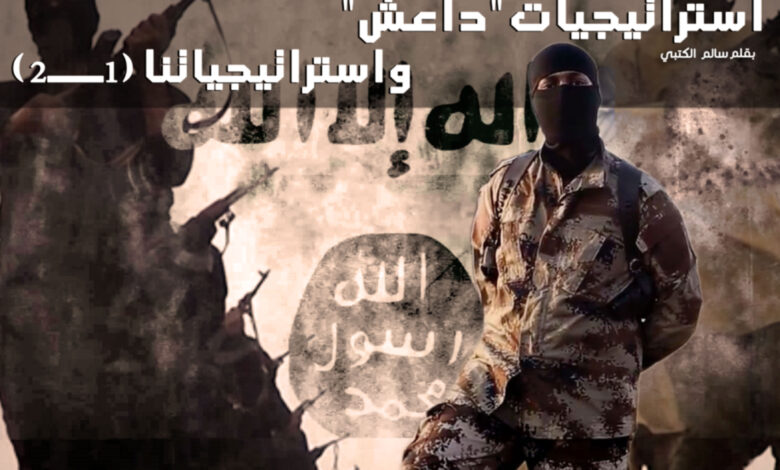
I recently read a report in the London Life newspaper on the role of the psychological factor in the recruitment of terrorist elements in “Daesh”, and found in this report what supports my view that “Daesh” is not organized randomly or based on emotional and religious aspects in the promotion of its ideas and in attracting elements of all nations, but relies on in-depth psychological studies in the misleading of youth and adolescents specifically,
as scientific studies have confirmed that the organization exploits the human need to have a purpose and meaning to one’s life, then the organization seeks to fill this psychological void that has a deep influence in the life of the individual, and provides sufficient inducements so as to make the target elements or candidates to join its ranks feel self-fulfillment, especially in terms of giving them the impression that they would turn into “owners of a message” and leadership elites that seek to achieve ambitious goals, such as fighting evil and seeking to build the Caliphate, and other glamorous slogans that certainly attract many segments that feel the weakness of their role in life or a weak sense of belonging to their communities and countries, and those who suffer marginalization and exclusion, and other catastrophic symptoms to whose dangers many states and communities do not pay attention.
From the understanding and study of the tactics and strategies of recruitment and polarization applied by the organization “Daesh”, we find indeed that the organization runs through important social strata. It is no longer like the previous generations of terrorist organizations relying on specific societal segments recruited through direct emotional propaganda and enthusiastic and mobilizing religious discourse, but “Daesh” developed mechanisms of polarization and recruitment and abandoned the traditional style, which explains the multiplicity of social classes engaged in the organization and the multiplicity of nationalities and educational levels. Unlike what was common in previous periods, terrorists no longer come from certain societal layers or from specific educational and cultural levels, but the “terrorist membership circle” has widened to include new communities and segments thanks to “Daesh” strategies and the proficiency of its specialists in the modern techniques of social networking, and their ability to communicate and reach out to all segments of society.
Tactics of recruitment and polarization applied by “Daesh” seem to me closer to the tactics of the Muslim Brotherhood terrorist group since its beginnings in the third decade of the twentieth century, as the group relied, and still relies, on in-depth educational methods of persuasion and polarization and on ensuring blind obedience and blurring personal identities and melting them down in the Community framework, as well as on the exploitation of selected members’ need to belong to a group or entity that provides them with a sense of self and fulfills this powerful psychological desire. The difference between the tactics of the Muslim Brotherhood and “Daesh” may lie in the significant development of the “Daeshi” thought and its considerable flexibility in accommodating the contemporary changes technically and scientifically and in making use of them with a crowd of followers and supporters and sympathizers, and in building a wide virtual world through which the organization can perform its work in mobilization and recruitment, which is different from the traditional method of mobilization and recruitment and polarization that was and still is practiced by the Muslim Brotherhood terrorist group. And this difference stems mainly from the difference in leadership style between the two terrorist groups. The Muslim Brotherhood is a numbing group soaked in the past, sticking to its heritage and does not exercise self-criticism or doctrinal and organizational renewal, while the terrorist group “Daesh” had set off from reality variables and used them well, and exercised its criminal mission in mobilization and recruitment via the internet specifically through elements that received a good education, indeed most of these elements have received their education in the West, therefore, there seems to be a huge difference between the generation of “Daesh” and previous generations of terrorism and terrorists.
This kind of psychological studies is absent from the Arab and Muslim world, which is revolving around the renewal of religious discourse and putting the blame on the religious factor and religious texts in spreading terrorism, while the issue seems much more complicated than that. Although earnest scientific efforts at the level of the renewal of the religious discourse and jurisprudence seem to be limited or non-existent, so to speak, and despite the importance of any earnest effort that could be made at this level, this does not negate the fact that there are aspects completely absent in dealing with the phenomenon of extremism and terrorism, first and foremost, in-depth psychological studies which can illuminate different aspects of the worsening terrorist scene.
Western psychological studies say in this regard that the organization “Daesh” exploits young people’s need for a so-called “cognitive closure”, and the need for the individual to get away from the uncertainty in regard to his life and his future. Psychologists connect between this situation and extremism and terrorism, as terrorists exploit it with excessively heavy propaganda to give conclusive responses and answers that contribute to the removal of the individual from the state of uncertainty that causes him stress, anxiety and depression. And despite the fact that this propaganda is misleading and false and disastrous for the future of the individual, it provides him with temporary solutions that help him to escape from the devastating tension and concern he endures.
These psychological Western studies indirectly suggest in their content the real problems in many Arab and Islamic societies, including education and socialization based on the command and obedience inside the family and at school without building an independent personality capable of critical thinking, dialogue and debate, an education that provides personalities susceptible to recruitment and polarization by terrorism. And this problem specifically may be linked to specific environments and does not account for the success of the organization in attracting members of different communities in the West. There are also scientific references that explain the effectiveness of terrorist polarization in the West, including weakness of belonging and marginalization.