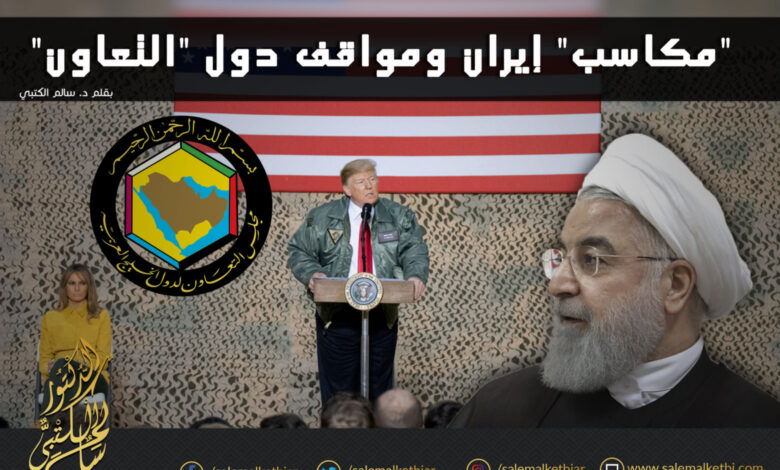
Many analytical views explain the decision of US President Donald Trump to withdraw US troops from Syria, saying that this decision is in the interest of three main parties – Iran, Russia and Turkey – as well as the Assad regime. Turkey, for example, recognized through Foreign Minister Jawishoglu that relations with the United States had overshot the previous difficult days and that the minister was keen to limit the accusations related to the recent deterioration in the value of the Turkish currency in the United States, and called not to link the problem with the United States only, but said there were still some unresolved issues including the extradition of Fatahullah Gulen, and cutting off support for Kurdish forces in Syria, and felt that the final question would be outdated in the case of the withdrawal of US forces. He stressed that President Trump “has respect for President Erdogan, has a deep friendship with him, is a lover of Turkey and shows it in his telephone conversations and bilateral meetings”. These are signs of a deep understanding reached between the two parties about global differences and common files.
The United States objectives in Syria were not only limited to addressing the “Daesh” organization, but and as everyone knows, there was a parallel desire of the United States to address the role and influence of Iran in Syria, and a strong desire to remove Iranian militias from Syria. In a previous period, the withdrawal of American troops from Syria was subordinated to the withdrawal of Iranian militias from Syrian territory.
The fact is that the decision to withdraw US forces from Syria seems different to the current US administration’s guidelines after the decision to dismiss the US Secretary of Defense was taken, given that the US Secretary of Defense was against the withdrawal of US forces from Syria, and Trump’s decision on troops supports Iran’s position and encourages it to strengthen its presence and role in Syria, and even encourages it to continue its plans for regional expansion in the Middle East, how can this decision be iunderstood in the administration’s policies vis-à-vis Iran?
Has Washington abandoned its strategic goal of withdrawing Iranian troops from Syria? Has it also abandoned its goal of participating in the shaping of Syria’s future independently of President Assad?
Certain Western strategic circles have placed Iran at the forefront of the winners from President Trump’s decision, which is indisputable: the presence and role of Iran in Syria is not limited to that country but extends into many countries in the region, including Iraq and Lebanon, indeed, Iran has allies and sectarian “arms” in these two countries, and has an expansionist project that goes from Syria to encompass the entire region.
In an attempt to understand Iran’s gains from President Trump’s decision, two different scenarios can be developed: the first is based on the idea of withdrawing US forces from Syria, Afghanistan, Iraq and all areas of the Middle East conflict to form a military alliance to lead an attack on Iran. And this is somewhat likely, despite the lack of sufficient evidence to date, but President Trump’s positions on Iran suggest that this goal can be achieved despite its low probability given the signs observed on the regional scene and World.
The second scenario is based on the strategic calculation of US profits and losses, in other words, President Trump has decided to abandon his country’s role in Syria and abandon his objective of seeing Iran withdrawing from Syria, a very important goal for the United States and Israel, its strategic ally in the region in exchange for the restoration of alliance relations with Turkey and the exercise of pressure calculated on other allied countries of the Middle East, including some GCC countries, reflecting his vision that allies should bear the expense of the US military presence in crisis areas, or pushing those States to bear the responsibility of filling the void created by the withdrawal US troops from Syria.
In my opinion, there is another weak vision, which is that President Trump dared to withdraw his troops to give way to Israel to attack the Iranian militia in Syria and to prevent US forces from engaging in retaliation against any Iranian militia.
It may be difficult to be sure that one of these scenarios will happen, but it is certain that Iran has a close relationship with this decision and that the US Secretary of Defense, who will succeed Matisse, will definitely be a hawk and complete the hostile circle hostile to the mullahs in the US administration,
In light of the above, what is the position of the GCC countries on this evolution? Will the Arab countries continue to monitor developments in Syria closely? The reality is that there is a strategic consensus between Saudi Arabia, on the one hand, and the United States, on the other, on the need to counter Iranian influence in the region. It is clear, therefore, that there is a consultation on the impact of the decision to withdraw American forces from Syria on such a vital objective of both parties. With regard to the Arab countries, and in the light of the media and political trend and the clear solution provided by the Arab collective position vis-à-vis the Syrian regime, and given the differences between the Arab States in terms of the Syrian regime, it is difficult for these countries to adopt a position based on the refusal to withdraw US forces from Syria. On the other hand, it is difficult for any Gulf or Arab State to ask the United States to keep its troops in Syria because the response of President Trump’s administration will be swift and will consist in calling these countries to bear the cost of this presence. and to participate if possible, not least because the US President is particularly sensitive to what he calls the financial burden of the US military role in the Middle East in general.