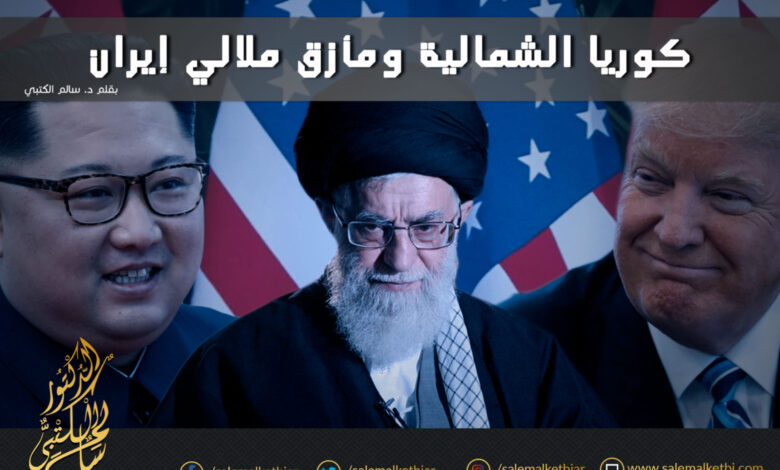
Iran was the only country in the world concerned about the outcome of the recent Trump-Kim Singapore Summit. The success of the summit troubled Iran’s mullahs deeply. Before the meeting, Tehran had issued strange warning messages to the North Korean leadership. The messages did not have an impact on Kim’s well studied steps. Days before the summit, he did remove many officials. The move reflected Pyongyang’s desire to further dialogue with Washington.
Kim did not show a will to consider the mullahs’ advice. He was aware they were following his steps in dealing with the US and international laws. Tehran was not qualified to issue advice to a model it follows. North Korea and Iran deal differently with the US and the existing world order.
North Korea’s nuclear tests and its hostile rhetoric have long troubled its neighbors – South Korea and Japan. But Pyongyang has never been bent on exporting its crises abroad as does Tehran. Iran has long deployed its Revolutionary Guard militias in many regional countries, creating chaos and unrest in Iraq, Syria, Lebanon and Yemen. The mullahs’ regime has always interfered in the internal affairs of other countries, such as Bahrain.
Iran’s mullahs claimed that President Trump does not keep his word. This is untrue. Since he took power, Trump has pledged to withdraw from the nuclear deal signed with Iran. He said he was not convinced of its effectiveness and doubted its efficiency to meet US’ strategic interests. Despite all the discussions that took place between him and his Atlantic allies, the American president scrapped the Iran nuclear agreement. A president who keeps his promise is worthy of signing an agreement with Kim. The mullahs may have another political point of view. Signing an agreement with President Trump has great chances of success. Since he took power, Trump has proven ability to achieve his goals regardless of the constraints. Are not these qualities and guarantees enough for Kim to get a historic deal?
The North Korean leader has inherited a political savvy from his father. He always acts according to a strategic plan to make his country open to the world and ease the economic pressure on North Korea. He moves in accordance with several tactics, ranging from escalation to flexibility according to a specific timing. The mullahs master popular stubbornness and are not aware of how to be flexible in negotiation and politics. They think the world can bend in response to their demands, wishes and expansionist ambitions.
Tehran has lost a strong strategic ally. The North Korean regime knows all the Iranian deep, dark secrets. Pyongyang has long supported the mullahs’ regime, both politically and militarily. For decades, Iran had bet on the US’ preoccupation with the North Korean threat as a strategic priority. Washington had been concerned with the danger Pyongyang represented to its allies in East Asia, especially South Korea and Japan. The mullahs realized that eliminating this threat will provide the US with more time to remove the Iranian threat and reestablish stability in the Middle East.
Iran also became aware that Trump’s hard power played the major role in pushing Pyongyang to speedily resort to negotiation. North Korea’s possession of nuclear power and its conviction that it did not need more missile tests were not the main reasons to have it sit down at the negotiating table with the American side.
Iran must understand that military power ought to be translated into political power and strengthen negotiations among States. Military strength should not be used to attack others and implement expansionist ambitions that do not meet the interest of the people. Such wrong use of power reflects the colonial nature of such backward regimes.
After being an inspiration for Tehran during previous years, Pyongyang has offered a new model: concessions are a way to escape international sanctions and get free from destructive isolation. Imposing the strongest sanctions in history on Iran will have it make true concessions. The mullahs have to re-examine the North Korean model instead of wasting time clinging to their ambitions.