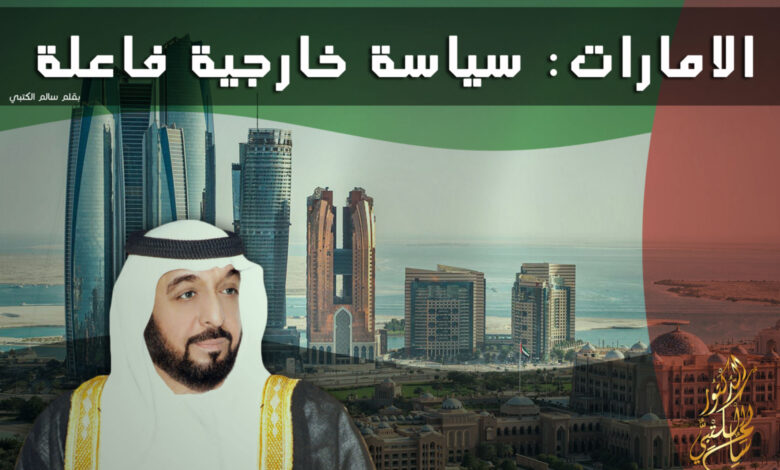
Since the founding of the union by Sheikh Zayed Bin Sultan Al Nahyan, the UAE has been committed to a set of international principles and human rights. The foreign policy of the UAE centers on moderation and thoughtfulness and is based on respect for international law, adherence to the Charter of the United Nations, mutual respect of international relations, non-interference in the internal affairs of other States, as well as adopting peaceful methods and dialogue to resolve conflicts. The United Arab Emirates is also committed to supporting justice and promoting international security and stability.
These pillars constitute the foundations of the Emirati role, both regionally and internationally. The UAE adopts liberal values of cooperation and dialogue in international relations and seeks to complete its unique development model that is different from the majority of Muslim and Arab States.
Under His Highness Sheikh Khalifa bin Zayed Al Nahyan, the UAE has embarked on the development process. Utilizing natural resources, it has moved from the establishment stage to the empowerment phase since 2005. The UAE has strengthened its external openness and moved to reinforce its moral and humanitarian model in order to crystallize the idea of the model State. The UAE depends on the soft power of moderation, tolerance and coexistence and has achieved great progress in this respect as more than 200 nationalities work in the UAE side by side under the respect of the law. The UAE is keen to enshrine co-existence through systematic legislation against violence, extremism, hatred and incitement, promoting respect for religions, cultures, civilizations and ethnic groups.
The UAE has a unique humanitarian model where dozens of countries, particularly those in conflict and natural disasters are provided aid, making the Emirates the number one in international donors for development assistance in terms of national income; it ranked first in 2016 for the third time (after 2013 and 2014) with total official development assistance (ODA) estimated at 15.23 billion AED, that is 12.1% of the UAE’s Gross National Income. The UAE has played a vital role in maintaining international peace and security through numerous peacekeeping forces in Somalia, Kosovo, South Lebanon and Afghanistan, as well as in reconstructing and demining in post-conflict areas.
The UAE’s foreign policy is based on the spreading of generosity, overall welfare and openness to all countries of the world.
The participation of the UAE in the Arab alliance to support the constitutional legitimacy in Yemen advocated rights and justice against injustice and aggression and desecuritization/destabilization. The Houthi movement alongside the ousted President Ali Abdullah Saleh incited by regional countries including Iran, sought to control strategically and politically the State at the national and regional levels. The Saudi-led Arab coalition was established to save the Yemeni people, stop injustice and try to put the political process back on track.
The UAE’s role in Yemen is not aimed at achieving economic gains. It is enough to point out that the UAE has provided during two years, specifically the period from April to March 2015, aid that amounted to about 7.3 billion AED (roughly USD 2 m) of construction projects carried out to support the Yemeni people. More than 60 Emirati troops lost their lives in Yemen, a figure that may be small for countries with high population, but represents an expensive human cost to the UAE.