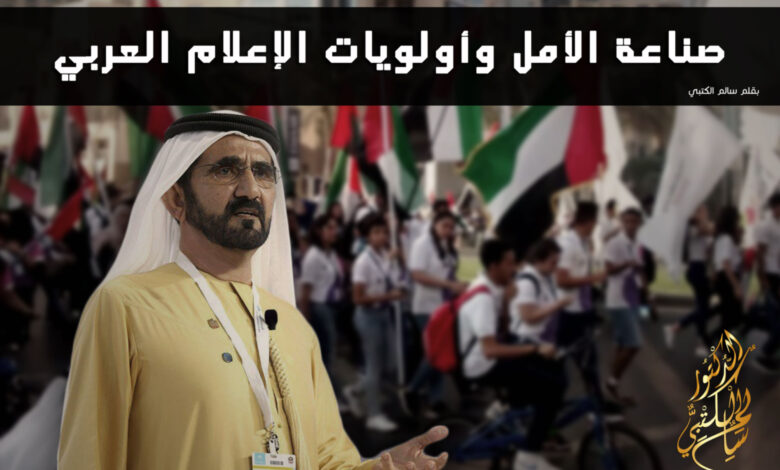
I thought His Highness Sheikh Mohammed bin Rashid Al Maktoum, Vice President and Prime Minister of the UAE and Ruler of Dubai, would award the Arab World Hope Makers prize to one media personality, but I was surprised when he awarded five people that are completely absent from the Arab media scene.
This choice was wise because he was keen to achieve the goal of the award, and set the example for future generations, choosing personalities that we did not know had a great impact in society in the most noble and human ways and were completely shadowed by the Arab media.
The five candidates who reached the finals were success stories that were absent from the media. They are Moroccan-Italian Nawal Soufi, who helps the refugees fleeing to Europe, having contributed to the rescue of more than 200 thousand refugees; Hisham al-Zahabi from Iraq, who provides street children in Iraq with housing, and psychological, health and educational assistance; Maali Assoussi from Kuwait, who emigrated to Yemen 10 years ago to carry out many humanitarian initiatives there; Magda Gobran, or Mama Maggie of Egypt, who devoted herself to serving the poor of Egypt, and the White Helmets, the Syrian Civil Defense Organization, who are working to save the victims of bombing in Syria.
More than 65 thousand hope makers have been nominated to participate in the prize, the largest Arab initiative to honour impact makers in the Arab world. His Highness Sheikh Mohammed bin Rashid Al Maktoum gave the prize to five participants, reviving hope in even more hearts in the middle of the overarching regional turmoil.
I do not doubt for a moment that the hope making will have a tremendous impact on young people. The Arab world needs new energy to get out of the trap of frustration and failure. This energy should outweigh the negativity brought about by the failures in the ecosocial development sector in many Arab countries.
His Highness Sheikh Mohammed bin Rashid Al Maktoum has expressed a great will to launch serious development work and not to slip into the cycle of slogans that no longer guarantee nor nourish the hunger of millions of young people who have almost lost confidence in everything around them . Their main concern is to sail the death boats to the shores of dreams in Europe, so they may find a new opportunity for life.
I fully agree with His Highness that “there is no better power in life that improves societies than the power of hope.” I also strongly support His Highness’ call to create new hope for millions of Arab youth to play real roles in their societies.
Hope making in our region is a historical responsibility not only for leaders and officials, but also for misguided media nowadays. The media is divided between government-controlled poor quality outlets and imported materials that do not relate to Arab societies.
When the media in a society drowns in the quagmire of “consumerism”, it turns into a major producer of negative energy, spreading rumours, controversies, divisions, and sometimes superstitions. Society becomes in the face of a great danger, which may outweigh even conventional threats. It destroys the most precious of this society and its youth. It destroys their dreams and spreads despair and frustration.
The fact that many of us do not know who won Arab Hope Makers winners despite their great human and community roles raises an important question: If these real stars are absent from the Arab media coverage, how can we believe that our media is seriously seeking to help develop our societies?
The stars in Arab media are limited to certain categories. These media no longer plays a social role, but it plays purely commercial roles. The media people strive behind certain categories and names without standing for a moment to think about goals, other than entertainment.
When we talk about combating extremism, terrorism and violence, we hold hundreds of conferences, seminars, workshops, lectures and other media and research activities, and we look at ways of renewing religious discourse, but no one is thinking of real mechanisms far from theorizing, which we have been doing for many years. This is not useful in dealing with radical thought.
Yes, there is a need to renew the religious discourse, but there are many other needs. Playing with words and relying on different sources will not succeed in fighting extremism unless there are real efforts to bring hope for a better future to millions of young people who want to be functioning members of their societies. Our region needs real-life role models in order to build corruption-free communities.