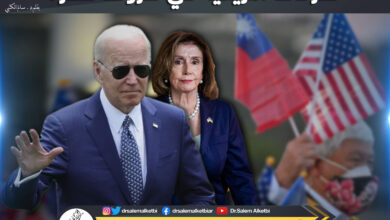
Talk of the rapidly evolving relationship between Saudi Arabia and the US seems to have become a topic of discussion in the media and political circles at the regional and international levels. This is due to a number of considerations, most notably the impact of the alliance between the two countries on the regional security and stability system and on the weight that the two countries have in international relations, such that any movement in this relationship has implications for other international and regional equations as well as energy prices, etc.
I think that despite a recalcitrant visit to the Kingdom last July, the relationship between Saudi Arabia and the US has not moved far from the goals outlined by President Biden in his election campaign.
The visit failed to address the problems underlying the historic partnership between the two countries, as tying reforms to meeting US demand for increased oil production exacerbated the situation.
The timing and conditions chosen were inappropriate to meet this demand. They were at odds with Riyadh’s commitment to membership of the OPEC+ alliance and inconsistent with Saudi Arabia’s strategic interests and energy price pegging policies in general, as well as other political calculations aimed at using oil and oil prices to pressure Russia in the ongoing struggle for influence and hegemony between it and the West.
Leaving aside the discussion on the reasons for the blatant deterioration of relations between Saudi Arabia and the US, the most important question is what “consequences” US President Joe Biden had in mind with his comments on the OPEC+ decision and the accusations that Riyadh was siding with Russia in the war against Ukraine.
Does this mean that the curtain is closing on the historic alliance between Riyadh and Washington? Some experts believe that the current deterioration in relations is more severe than it was after the September 11, 2001 attacks, when large sections of American policy makers tended to separate the Saudi leadership from the causes that led to the involvement of Saudi elements in the attacks.
But Washington is now targeting the policies of the kingdom’s crown prince, who enjoys widespread popular support for his reforms and ambitions. Shaping a better future for the kingdom and its people should receive the widest possible American support if policymakers have a long-term strategic vision and do not merely pursue tactical targets that have strained bilateral relations.
Unilateral alliances no longer fit the reality of today’s intersecting and complex web of international relations. However, this does not mean that Saudi constants have changed. Rather, it reflects a changed strategic environment.
With the collapse of the former Soviet Union, ideologies have collapsed and a new era has emerged. It is one of mutual interests and the rules of international trade, of which the West has become the main proponent and defender in the context of “globalisation.” This can be seen, for example, in the volume of trade exchanged between the US and China, which, according to China Customs, was about $246 billion from January to April this year, about 11% more than in the same period last year, despite the great tensions we are creating. Daily on air.
So it could be argued that Riyadh’s support for OPEC+’s decision to cut oil production is not a “hostile act” as US Democrats say, but a purely economic exercise based on a review of market trends and supply and demand indicators. Given the interconnectedness of business and politics, it seems natural that interests sometimes coincide and sometimes conflict.
This is something the American side needs to understand. The stability of global energy markets requires constant coordination between Washington on one side and Riyadh and other major producers on the other. What US lawmakers need to understand is that energy security is almost indistinguishable from that of producing countries.
Taking a chance on this issue at an emotional moment is an incalculable gamble with the stability of major economies, especially the US economy. The evidence suggests that the deterioration in Saudi-US relations is linked to several factors, including the outcome of the mid-term congressional elections in November.
Democrats directly linked this election to Saudi Arabia when they accused the country of being responsible for the rise in energy prices and even being behind OPEC+’s decision to cut production.
Given the difficult position of the Democratic candidates in this election, it is safe to assume that relations will continue to deteriorate or at least maintain the status quo until the end of President Biden’s term in two years. But this is not just about Biden’s personal position, but also about Riyadh’s relationship with democratic presidents in general.
One could conclude that the importance of this relationship is no longer as highly valued, or at least that attempts are being made to manage it differently than before. This is evident both in the policies of former President Obama and the current Joe Biden. This conclusion is by no means generalisable.
Biden could make it his business to move relations away from the partnership and alliance formula that has existed since the 1940s. On the other side, Saudi Arabia is not pushing to end the coalition relationship.
But it is pushing for a restructuring aimed at creating a mutually beneficial partnership commensurate with the enormity of the shared strategic interests that bind Saudi Arabia and the US. I think that interests could end up being a powerful drag that keeps Biden and other Democratic lawmakers and politicians from going too far into anti-Saudism.
All that is being waved through as leverage is about American interests before Saudi ones. Huge arms sales to the kingdom are a case in point. American arms companies, despite their influence in US decision-making circles, cannot agree to any direction to reduce these sales.