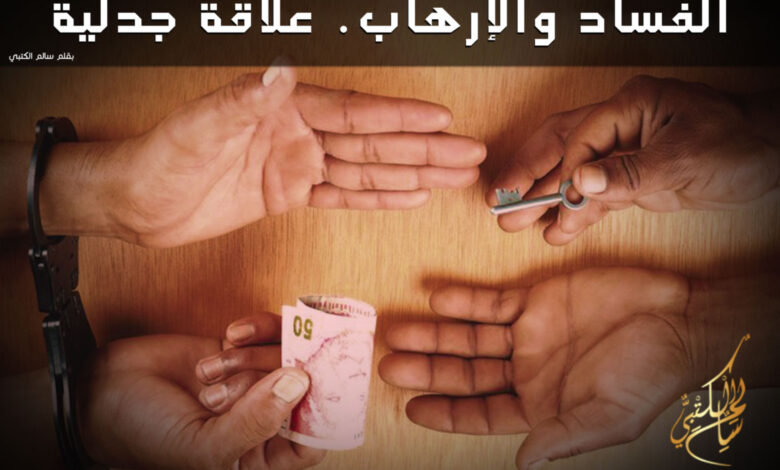
Recently, many discussions addressed the supposed interrelationship between corruption and the global terrorism and its impact in various parts of the Arab world.
Transparency International sparked the controversy in a recent report that the widespread corruption in many countries feeds and encourages terrorist organizations such as Daesh and helps them recruiting many people dissatisfied by the present conditions. The report points out that corruption also leads to weakening the State institutions, making them unable to deal with extremist organizations and groups.
This report not only warns of this correlation between corruption and terrorism, but says terrorism cannot be defeated under such circumstances, as corruption helps terrorist organizations grow.
The report has a political dimension though, as it hints to specific Middle Eastern regimes. Still it has its merit in exposing the link corruption and terrorism have.
The report accused Western countries of ignoring the impact of corruption as a major catalyst that leads to the spread of terrorism, especially in the Middle East, calling these countries to make pressure in order to ensure accountability with respect to military budgets.
This is a hidden dimension of the report, because no strong relationship is there between defense budgets and the issue. Rather, corruption is mainly present in middle and lower levels. It impacts jobs, livelihood, infrastructures, development of roads, healthcare systems, education and such budgets, yet there is corruption on high levels of power and governance, which is even more catastrophic.
In the report titled The Big Spin, TI notes that Daesh exploits corruption to spread extremism and present itself as an alternative. This is true to some extent, but it is also necessary to say that the effectiveness of terrorist organizations plans of recruitment are not linked to a single social variable but rather an environment involving an ensemble of factors favorable to terrorism. These include the confusion in religious issues and lack of effective roles by religious jurists and institutions. These institutions are instead involved in disagreements with political and ideological movements that took their place in the media and public scenes. There is also poverty, unemployment, and poor education, the spread of ignorance, the lack of role models, and the lost role of the media that turned into a profit-seeking agenda-serving business.
It is true that corruption is devastating. Its impact far exceeds the impact of terrorist organizations recruiting young people. Thank God, not everyone affected by corruption joins Daesh; otherwise its members would be counted in millions.
Nonetheless, recruitment and attraction are not exclusively due to corruption. Some members of the group come from social classes not impacted by corruption. There are also nationals of Western countries who, for different motives, joined the terrorist organizations. A comprehensive and integrated approach is needed to understand the issue.
Corruption is a complex phenomenon present in many communities. It has implications and manifestations that are seen in the public work as well as the activity of terrorist organizations. Just as there are corrupt officials, there are also corrupt militia leaders. They do not respect people’s financial rights and their dignity. Corruption is a lethal virus originating from certain practices in State as in terror organizations.