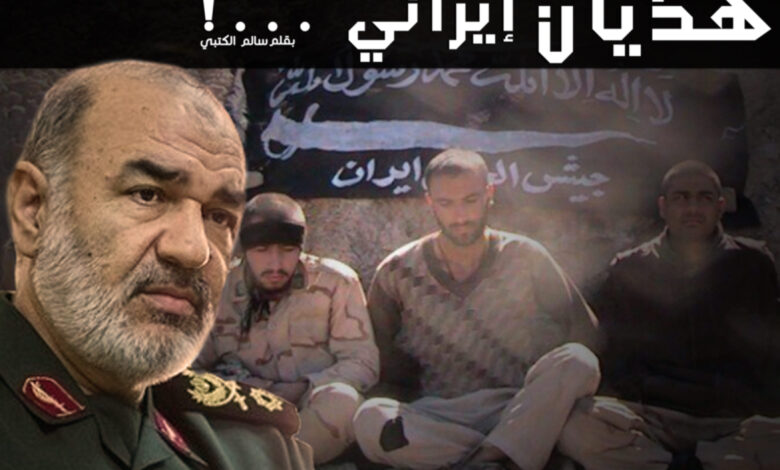
In a recent Iranian official ‘absurdity’, Brigadier General Hossein Salami, deputy commander of Iran’s Revolutionary Guards said that his country does not recognize borders when tracking down its opponents, and that its Modafean Haram (Holy Shrine Defenders) forces will destroy them wherever they are.
Modafean Haram is the name Iran used to refer to its militia operating in Syria, but it later used it for all the Basij (popular Shia militia) forces subordinate to the Iranian Revolutionary Guards, inside and outside Iran. Provocatively, Salami boasted that Iran’s militia does not have red lines when it comes to punishing opponents of the Iranian regime. He cited several assassinations of opponents of the Iranian regime in several Western countries.
In his recent speech to the Basij forces in the Western Iranian city of Orumiyeh, the deputy commander of the Revolutionary Guards further boasted: ‘You see how our borders expanded to reach the Red Sea and eastern Mediterranean.’
These statements reveal the intentions of Iran’s aggressive expansionist plans, and that its regime does not seek security and regional stability, nor engages in the fight against terrorism the world is carrying out. The Revolutionary Guards official has openly stated that his country’s militias goes after opponents of the Iranian regime, and did not address terrorism or other issues. He made it clear that Tehran cracked down on its opponents in various countries around the world and assassinated some of them, without any concern for accountability before the international criminal court, and accusations of sponsoring terrorism. While Iran makes such threats, some Western countries accuse GCC countries of supporting terrorism.
When a senior Iranian military commander flaunts that his country does not recognize international borders in tracking down on its opponents, it is certainly geopolitical chaos. The man says his country disregards international law, and his regime can be accountable for such irresponsible statements.
Salami’s unprecedented and arrogant statements are condescending of international laws and the UN Charter. They do not target international terrorism nor organizations and individuals posing serious threats to world peace and stability, but opponents of the Iranian regime.
I do not know if this delirium may draw the attention of the leaders and officials of the major powers, whether or not they see Iran as a partner regionally and internationally. However, regionally, these official positions should be reported to the international community to take position. Iran is trying to spread chaos and turmoil in the Middle East and no one is doing anything to stop it. It sees itself in a position of power, or assumes that the nuclear agreement with the 5+1 group gives it a mandate to do anything it wants in this sensitive region of the world.
More than a year ago, many Iranian officials have talked about the occupation of four Arab capitals. The Arab coalition countries, led by Saudi Arabia, succeeded in countering Iran’s plans in Yemen, which was aimed at tightening the strategic siege on the GCC. The Iran commander now returns to talk about extending the influence and the expansion of the Iranian border to the Red Sea and the Mediterranean, in reference to the presence of Iran in Syria directly and through agents on the ground in Yemen, in addition to having direct military sea presence in the Arabian Sea and Bab al-Mandab.
Clearly now, Iran’s audacious expansionist plans are no longer ‘the elephant in the room’. No plans to defend the oppressed and the harmed as alleged previously by Iranian leaders. The objective is strategic, purely expansionist and uses a sectarian smokescreen to deceive the gullible followers of unrealistic sectarian slogans.
Implementing these malicious intentions, Iran last week announced the formation of a new militia called Gordan-e Fateheen (‘Conquerors Brigades,’ note the connotation of the name). Its main mission is the defense of the ‘Vilayat-e Faqih’ (Jurist’s Guardianship) i.e. the Supreme Leader Ali Khamenei inside and abroad. This provocative act has several connotations. First, the financing of Iran’s military plans is increasing as Tehran retrieved funds released recently in several countries to implement the nuclear deal. These funds will be used to support Iranian expansionist schemes and compromise regional security and stability, as political observers and experts have previously warned. The West, however, overlooked these warnings to achieve strategic goals regardless of the regional unrest and perils underlying this policy.
The international community should also realize the seriousness of leaving free rein to Iran. Doing so would put the security and stability of the Gulf region in jeopardy. The lack of international response to the idea of ‘non-recognition of borders’ according to the Iranian deputy commander undermines the foundations of security and stability regionally and internationally, and violates the Charter of the United Nations. Headed by power-obsessed leaders, no one can know for sure what this expansionist state is capable of doing.