There is no doubt that what happens in Egypt affects the rest of the Arab and Islamic world; Egypt is the heart of Arabism and the bearer of the banner of its defense and preservation. This is a truth corroborated by facts and events, not historical slogans, and there is no room here for bidding and bargaining, and so it is not surprising that we – as Arab analysts, observers and researchers – follow Egyptian affairs with great interest. And if we add to this the deep love we have inherited in the United Arab Emirates for Egypt and its people, a love instilled in us by late His Highness Sheikh Zayed bin Sultan Al Nahyan, “God rest his soul”, this interest turns into a unique state of emotional link with this ancient Arab country and its people, with what is going on inside it and what affects it positively and negatively alike.
Perhaps this was a necessary prelude to my first article on “veto”, a site that enjoys significant mass spread. It is not as much a preamble to my article as it is an attempt to build bridges of communication and understanding with the dear readers of the site, and to anticipate any questions about what is behind my interest – as an Emirati researcher – in Egyptian affairs.
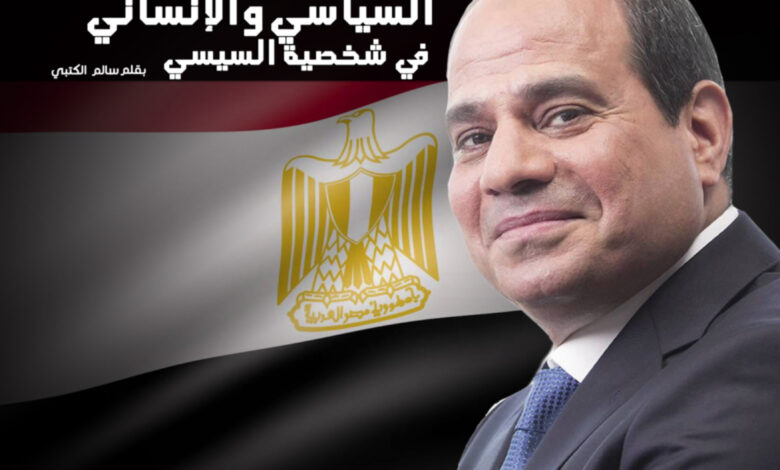
At the heart of the subject, I say I am following the performance of Egyptian President Abdel Fattah el-Sisi since the beginning of his reign, and equally also follow the president’s popularity indicators, not for a reason that is related to the Egyptian President himself, whose wide popularity is known to me in both Egypt and the Arab world, especially in the UAE, but because part of the my research interests in the field of strategic studies consist in measuring personal performance effects on popularity rates of leaders and presidents.
Hence, I found that President Abdel Fattah el-Sisi’s performance has traits and characteristics deserving close scientific study. What drew my attention from the outset is that President el-Sisi performs in his political speeches and media comments in a certain way that reflects him as well as the dimensions and attributes involved in his personality, without paying too much attention to the views of some critics of this performance. If he had responded to many of these views, he may have lost this enormously positive feature.
President Abdel Fattah el-Sisi was able to uniquely blend the political and human aspects in his rhetorical performance. The political performance was not in isolation from human traits, which produced over time a “personality” that has a distinctive imprint, as evidenced by the large amount of controversy and discussions that follow any speech or remarks coming from him. And the issue here is not measured by who wins in any debate or even a conflict on Facebook or Twitter, but relates primarily to the personality’s ability to mobilize the energies of supporters and opponents alike, and this feature reflects the magnitude of the impact, whether the majority agreed with him or some disagreed.
When President Abdel Fattah el-Sisi spoke recently about his relationship with his Presidential office, he was able to reach the hearts and to express his innermost thoughts and feelings with simple political and human words able to build a state of communication with the audience, prompting a bit of controversy about the content and objectives of the words, and this is beyond the scope of this discussion. But what interests me here is that no one would disagree that the same words came to all with differing degrees, levels and goals of “reception, which is certainly subject to the accounts of “the recipient” and its objectives, culture and pattern of thinking, while the “sender” cannot have much control on that.
Perhaps it is striking that what most disturbs the main opponents of el-Sisi is his performance itself, despite the amount of arrows they direct to this performance. They understand the mass effect of ” personality building ” and sustaining, especially that a segment of these opponents belong to ideological organizations fully aware of the “Leadership charm”, its appeal and dominant impact on the audience, and then they have repeatedly tried to raise confusion and controversy in different ways and through the use of the means of social communication and new media tools in order to undermine the “stereotype” and its human dimension, but their efforts failed, and then they moved to cast doubt on the political side and its effectiveness!!
I am not analyzing the personality itself or the size of its impact, but I discuss the effects of stereotype with both its political and human sides, as the ability of leaders to build a kind of human communication with their people interests me. Those leaders belong to a prestigious school that has its early historical pioneers that got an unmatched popular support and a continuous general backing for their policies, and among those leaders at the Arab level is the founding leader of the United Arab Emirates, late Sheikh Zayed bin Sultan Al Nahyan, who owned a unique “charisma” that made him – and still – a father figure to the people of the UAE, and a historical symbol to the State. There is also Egyptian leader Gamal Abdel Nasser, whose speeches and positions stimulated the enthusiasm of tens of millions of Arabs from the Atlantic to the Gulf.
This ability to blend the “political” and the “human” among the leaders, is clearly available in few politicians and leaders, including His Highness Sheikh Mohammed bin Zayed Al Nahyan, Crown Prince of Abu Dhabi and Deputy Supreme Commander of the Armed Forces of the United Arab Emirates. He has inherited these unique leading traits from his late father, and he can stir the feelings of his people by his sincere words, in which everyone can sense the resolve and strength of the leader, coupled with a human heart that beats with love to his country and his people.
In sum, when a leader speaks to his people or even to the outside world, his rhetorical credibility and influence are linked to other aspects and dimensions, in the forefront of which are honesty with oneself, seriousness in giving and dedication to work.