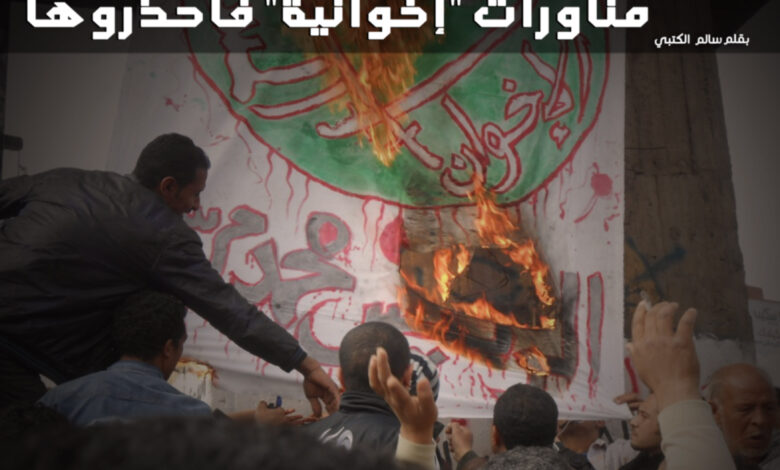
Lately, the discussions and the steps taken by the branches of a terrorist group, the Muslim Brotherhood, in several Arab countries, made the news. These ‘intellectual revisions’ centered entirely on the idea of separation between da`wa and politics of the group’s activities, which were described as reformist or revisionist. Some considered that the group witnessed organizational splits and cracks related to the desire of a wing of the Muslim Brotherhood to redistribute the cards and get away from violence and terrorism.
What these rapid changes have in common is that the Muslim Brotherhood terrorist group now senses the size of popular rejection and ostracism and is trying in every way to address this historically unprecedented dilemma. That is because the group surpassed decades and years of similar predicaments through self-victimization and claiming being subjected to injustice. Now back in the political arena, the group was not successful in all attempts to clone a similar scenario, because the tricks of the group to hide its involvement in violence and terrorism are no longer popularly credible
The Muslim Brotherhood is politically maneuvering to overcome the current societal ordeal. The maneuvers aim at promoting the idea of the separation of da`wa from politics in their activities, and the Tunisian Ennahda Movement confirmed this trend in last May during the 10th conference. Rachid Ghannouchi said the movement will ‘move from political Islam into Muslim democracy’, which is the same direction expressed by some leaders and symbols in the Egyptian Muslim Brotherhood.
The last move has followed important developments that did not draw much attention. The most important step was by the group’s Shura Council in Jordan in mid-February which canceled the affiliation of the group to the international organization of the Muslim Brotherhood and to the Egyptian branch. The spokesman for the Jordanian group considered that the relationship with the rest of the branches abroad were based on coordination rather than regulation and that the Jordanian group’s decisions are independent from those of the international organization. This is the second step taken by the group as a maneuver to achieve salvation from the historical dilemma. The Jordanian branch was not the only one to seek independence; the Palestinian movement, Hamas, confirmed the split from the mother organization in Egypt.
Before interpreting these developments, the implications of the disengagement with the international organization should be noted. Such publicity shows another deceptive practice by the group. Over the past few years, the leaders and figures of the group constantly tried to deny the existence of an international organization, claiming that the talk about this entity stems from ‘mental illusions’. Today, they returned to declare the separation from the ‘imaginary entity.’
Sure, there are confusing points in the relation between the Egyptian Muslim Brotherhood and other branches in the Arab world. If there was no organizational relation, why the disengagement was announced? If it was a matter of relations of coordination, as claimed by some branches of the group, what is the difference between coordination and organizational relations especially that the organizational structures of each branch in every country is separate from the rest? Are ‘coordinating relations’ separate from national principles and loyalty?
The most important aspect in the recent developments is the politically-deceptive separation between da`wa and politics. Strangely, the media have fallen into the trap of promoting maneuvers masqueraded as intellectual revisions, whereas what is happening has nothing to do with such a thing. We never heard about contemporary critique of the works of Hassan al-Banna and Sayyid Qutb, nor brand-new intellectual projects calling for the da`wa–politics separation. Instead, we only heard ‘tactical’ calls to escape the impasse over the variegated tricks to return to the societal scene, overcome social ostracism and then re-invention into the political arena.
The Muslim Brotherhood terrorist group is based on ideological tenets, including the relation between the notions of ‘the Nation’ and ‘the Umma’. The Umma is the most comprehensive framework in which national loyalty remains subject to the conditions and principle put forward by al-Banna at his own whim. The recent discussions of the ‘renaissance’ movement and the public figures of the group in Egypt revealed discrepancies, proving that the current group still isolates itself inside intellectual stagnation. It is still barricading itself with the ideas of Hassan al-Banna, which are not relevant to the da`wa-politics distinction.
The recent actions of the organization do not stem from intellectual revision, but rather an attempt to ride out the storm or political Taqiya. The group is pretending to accept the status quo in order to overcome societal pressure and clean up its reputation of violent crimes committed throughout the recent years.
Introspection is a positive step per se, provided that it is done with seriousness and out of good intentions to correct errors. Re-inventing one through formal procedures and catchphrases to deceive the public opinion is risky, however. The deceptive approach confirms the ill intentions and the absence of any direction to correct mistakes and learn from the lessons of the recent past. To keep da`wa apart from politics, clear intellectual principles should be observed. The decisions of the group’s leaders and representatives cannot be undone by the stroke of their pen.
The issue is not limited to decisions, even those issued unanimously by the guidance offices of the group, known as the consultative councils of the group. The group should cease inciting people and using different platforms for political purposes. It should not allow its members working for the da`wa to intervene in political matters and issue political fatwas. Only by doing so we can speak of a separation between religious da`wa and political work. Only then we can say that there is a change. Until then, the scene is open to empty chatter and maneuvers designed to deceive the minds.