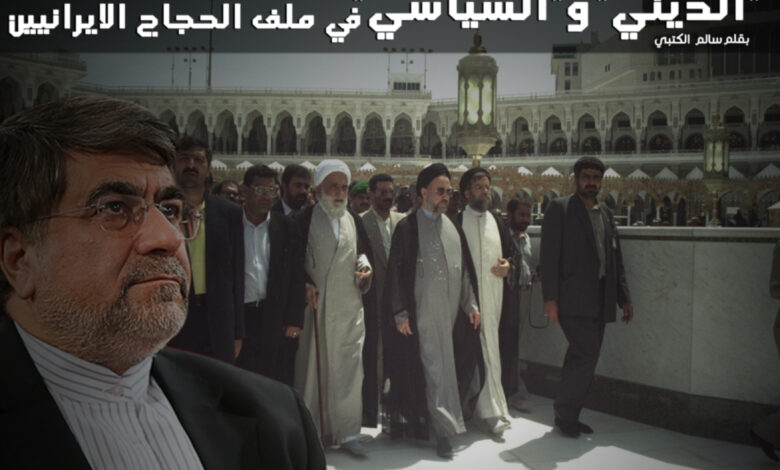
Iran’s mullahs strive in wearing the minds of observers and analysts involved in Iran’s affairs. There are behaviors that are difficult to interpret, and others that are not explainable at all. The occasion of this talk is the mullahs’ management of the file of the Hajj season this year. The Iranian Minister of Culture and Islamic Guidance, Ali Jannati, announced recently that Iranian pilgrims are prevented from going to the Holy Land to perform Hajj this year, placing responsibility on the Saudi side, which is to be expected.
Although the real reason is that the talks between Iranian and Saudi sides to reach an agreement failed because of the intransigence of the Iranian Hajj and visit Organization Mission, and its rejection of signing the minutes of the Agreement on the special arrangements for the pilgrimage.
And because I am closely observing this scene particularly for a while, I have noticed that since the arrival of the Iranian delegation to negotiate on the Iranian pilgrims procedures, this delegation deliberately provoked problems and nitpick and friction in order to achieve a moment of rejection and confrontation, which means that the visit of this delegation to Saudi Arabia was only a formality for invoking rejection and trying to place responsibility on the Saudi side only, no more no less.
The fundamental problem in this contrived crisis from the Iranian side is that Saudi Arabia, and it has every right, refuses politicizing the pilgrimage and trading with religion in this exclusive religious occasion, an issue that is not to the liking of Iran, which awaits the annual pilgrimage occasion to make crises and cause problems with Saudi Arabia specifically.
According to official sources, Riyadh and Tehran had agreed on issuing a visa in electronic version from inside Iran, under a mechanism that was agreed upon with the Saudi Foreign Ministry, and they also agreed to transport pilgrims equally between Saudi Arabia’s national carrier and Iran’s national carrier, as well as to approve the request of the Iranian delegation to be diplomatically represented through the Swiss embassy to take care of the interests of the Iranian pilgrims, which reflects the flexibility of the Saudi authorities and their understanding of the needs of Iranian pilgrims and their willingness to work for their wellbeing, but what it is strange is that this flexibility was met with suspicious persistence on the Iranian side on conditions that do not fall within the accepted rituals of Hajj, since the Iranian delegation insisted on including in the Minutes of the Hajj arrangements specific sectarian rituals, such as “Camille Prayers” and “Ceremonies of Innocence” and the “Zaer bulletin”, which are rituals everyone understands as political par excellence, and not related to the religious pilgrimage rituals.
Objectivity requires saying that Saudi Arabia has the right to obtain sufficient guarantees for the non-recurrence of the deliberate contention that happened, and that threatened the lives of millions of pilgrims from all countries of the Islamic world. It is also interested in avoiding accidental contention that offends Saudi Arabia’s global image, and reduces the enormous efforts it makes throughout the year so that what happened during last year’s Hajj season does not occur again.
And when Riyadh handled this file rationally and in accordance with the dictates of the teachings of Islam and its known obligations, Iran was surprised by the willingness of Saudi Arabia to legalize this topic and to deal in a civilized framework that ensures the right of both sides and prevents the repetition of political abuses by Iranian pilgrims.
What happened this year on the part of Saudi authorities occurred too late, and this delay caused the turning of the pilgrimage season into an annual event for political display by Iran’s theocratic regime, but dotting the i’s and crossing the t’s on this subject is a very important step even if it was late.
Iran wants to exploit the pilgrimage season this year to stir up problems with Saudi Arabia and to settle existing political accounts with Riyadh, and that is an unpleasant and an unacceptable issue because it damages the entire Islamic world, turning a religious spiritual duty into a platform of dialectical political slogans, at a time when the mullahs were supposed to transcend putting the political dispute with Saudi Arabia within a framework of a religious file.
Saudi Arabia does not need to transform a religious event in which about three million Muslims participate into a Circus for clowning and political blackmail, which empties the religious duty of its spiritual content, not to mention a high probability of throwing Shiite militias able to provoke insecurity amid the huge number of pilgrims in order to embarrass the Saudi authorities in front of the world and accuse them of repeated organizational failure for the pilgrimage season.
That is a rooted tendency in the mullahs. To them, religion is only a means to achieve purely political goals, just like the terrorist Sunni organizations and groups such as the “Muslim Brotherhood” and “Daash” and other organizations of terrorism and armed violence, which hide behind Islamic masks and slogans, while they have nothing to do with Islam, its eminence and moderation.
The problem of Iran is that it has become focused on becoming a global center for Shiite Muslims, an idea that jumps on national loyalties and undermines the foundations of states and nations, because the Iranian practice in this regard is of a political nature, not a religious one. Iran is not Qom, but a state with expansionist ambitions, so loyalty is not due to the mullahs of Qom, but to the mullahs that are sitting on the seat of government in Tehran.
The truth is that the regional behavior of Iran has become a disturbance factor in the region, as the mullahs do not leave a chance without exploiting it for political purposes, and the Hajj season has unfortunately entered within these accounts, it represents an “ideal” opportunity to plunge thousands of militia members to create chaos under the pretext of pilgrimage. And the position of Saudi Arabia in this regard is very sensitive and embarrassing because it is about a religious obligation, and there is no room to prevent a Muslim from the performance of such a religious duty, and here the Iranian opportunism is manifested in its worst form.
The idea of a principles agreement ruling the behavior of the Iranian pilgrims during the Hajj season is a civilized initiative to deal with this thorny subject, but it seems that Iran’s mullahs want the continuation of evading any obligation, so that they act in accordance with their plan or rather plot to subvert the next pilgrimage season.