Ever since the whole commotion with the Russian “Wagner” group kicked off, I’ve held back on hastily scribbling down my analysis of the situation, its paths, and its outcomes. Deep down, I’ve been certain that the “secretive” side of these events surpasses what’s visible to the public. What we witness and read in terms of statements and positions might just be the tip of the iceberg. However, now that the dust has settled a bit and the media frenzy has quieted down, we can draw a few conclusions from what transpired.
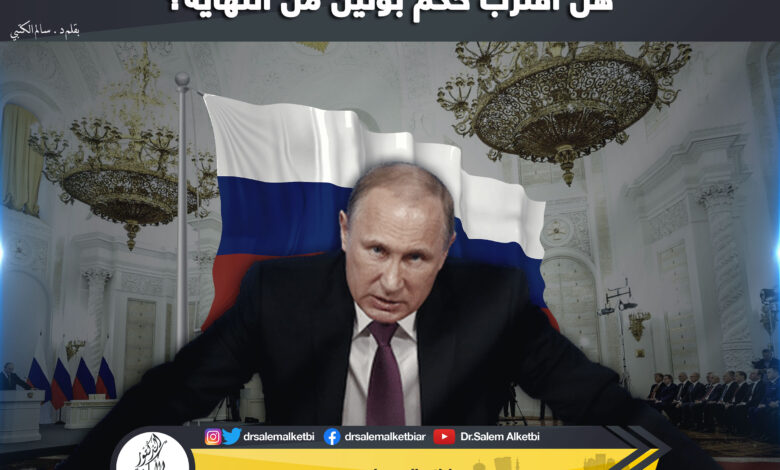
First and foremost, I’m not one of those who leapt to the conclusion that Russian President Vladimir Putin’s rule is about to meet its demise, or that the man has come out of this crisis in a weakened state, with his wings clipped. The truth of what happened remains concealed from all except those within the inner circle of the Kremlin. Therefore, opinions range from it being a “botched coup” to it being “carefully orchestrated.”
There’s a third bunch who believe in a Western plot, or maybe even a secret pact between Russia and the West, using the rebellion as a smokescreen to end the war in Ukraine. Also, I don’t buy into the quick analyses that portray Russia as a country whose governing systems have crumbled under the pressure of rebel factions. Some folks have even drawn parallels between Putin and Gaddafi, suggesting he fears a similar fate.
Admittedly, I am not exactly singing praises about the strength of President Putin’s regime. But, on the flip side, I can’t fathom the idea of his reign caving in like a house of cards just because of a militia of around 25,000 members.
Sure, there’s talk about the astonishing distances covered by this force, without any resistance or showdown, as they march toward Moscow. But there are still plenty of unanswered questions. There’s a lot of uncertainty, enigmas, and gray areas that I’m pretty sure won’t be explained anytime soon.
In the middle of it all, one thing is crystal clear: Russia is no banana republic, neither some weak-kneed state. At least when it comes to security, that is.
What exactly went down behind the scenes in this whole shebang is hard to say aloud. Whether it’s to uphold the Russian state’s prestige or to hush up any sneaky breaches or “treasonous” acts that might’ve taken place within the security apparatus, one thing’s for sure: they’re keeping it under wraps.
In both scenarios, sweeping things under the rug seems like a natural instinct. Let’s not forget that President Putin himself, in his televised speech once the rebellion was squashed, labeled it as a “criminal adventure,” a “grave offense,” “treason,” and “terrorism and extortion.” But, on the other hand, we have to take into account that the alleged mastermind behind all these “crimes” managed to saunter off scot-free to Belarus. Let’s not even mention how charges against the Wagner group honcho, his associates, and his soldiers were conveniently dropped.
This gives rise to a slew of other unanswered questions that, at least for the foreseeable future, remain shrouded in mystery: Was there a deal that put an end to the rebellion? And does this alleged agreement have any ties to a potential shift in Russia’s power structure? Furthermore, could it be connected to the looming conclusion of President Putin’s reign (given that the next Russian presidential elections are slated for March 2024)? Is there some sort of arrangement for a graceful exit for the president, ensuring he walks out of the Kremlin’s widest gates, steering clear of dragging the nation into internal conflict amid the ongoing Ukraine war?
The truth is, as an observer, I can’t affirm that President Putin came out of this crisis weakened, contrary to the claims made by former US President Donald Trump. I don’t get the feeling that the end of President Putin’s rule is right around the corner. The rationale behind this is not some unwavering confidence in the strength of his regime, as the visible evidence doesn’t paint a clear picture of such fortitude. However, the lack of a concrete scenario can primarily be attributed to the blackout of information and the absence of detailed accounts that could allow for a strategic assessment based on factual evidence and closer to sound reasoning, steering clear of mere analyses and wishful thinking.
The predicament is crystal clear for everyone: President Putin might look “feeble” in the eyes of the elite, ordinary Russians, and the global community, unless the Kremlin puts forth rational and compelling justifications that debunk the prevailing notion of weakness on the Russian stage — when Putin spoke of a “deadly threat to our state” — and prove that the matter at hand has no bearing on his control or his ability to quell the rebellion without making substantial concessions. To some extent, all of this hinges on the fate of the rebellion’s leader, Yevgeny Prigozhin, and his intentions to stay in Belarus.
The plain truth, in my opinion, is that the assurance of another term for President Putin is no longer a done deal, as it was around a year ago or so. The catalyst behind this shift is not the Wagner Group mutiny, but rather the silent schism that emerged within the Russian elite due to the Ukraine war, be it on the fundamental decision to launch the military operation or to persist with it.
On top of that, we can’t overlook the vulnerabilities and substantial losses, both in terms of human lives and resources, endured by the Russian army. These losses undeniably took a toll on the Russian economy, even though it managed to maintain a certain level of cohesion and resilience in the face of harsh Western sanctions. Furthermore, it eroded confidence in Russia as a competent global military and strategic power.