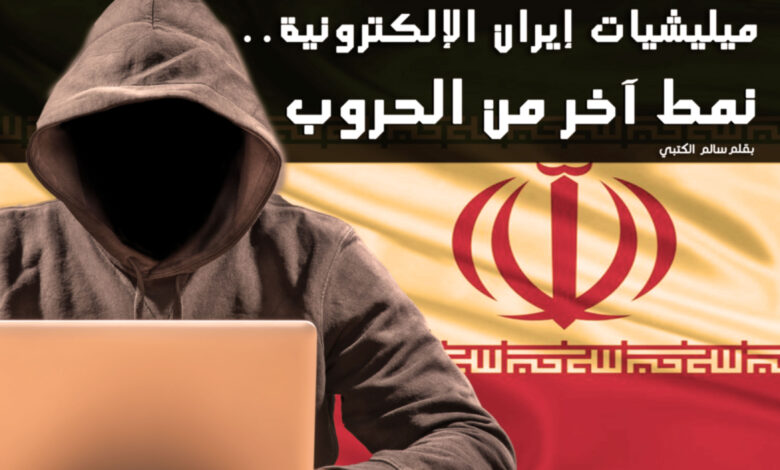
Among the things that draw my attention the most in the world of the Internet and websites is the intense and orderly existence of electronic battalions loyal to Iran, and their comments, which are well known to every observer of opinion articles that discuss the tension in relations between Saudi Arabia and Iran.
The idea of electronic battalions is not new of course. It is used by some States and terrorist organizations with high efficiency, first and foremost, “the Muslim Brotherhood” group, which invests a lot of human and material capacity to launch cyberattacks against its political opponents from countries, individuals and organizations.
Those who subject the Iranian situation in the region to research and study know that Iran also invests huge sums of money in the media with its various traditional and new uses. In addition, Tehran funds vast networks of electronic armies subordinate to its agents in several Arab countries, in the forefront of which are Lebanon and Iraq. There is no doubt that the use of the media on the part of Iran in wars of influence taking place regionally is an obvious issue, as the media is a significant soft power among fourth-generation warfare tools.
Electronic armies in the field of media differ of course from cyber armies, where Iran has made a significant qualitative progress, although it was a victim of one of the most serious attacks in the short history of cyber wars so far, when the “Stuxnet” virus attacked its nuclear facilities in 2010. At that time, Iranian officials pointed the finger at Israel and the United States as the source of the dangerous virus, which was said to be infiltrated to about thirty thousand computers in Iran. The virus was looking, in the devices in which it was infiltrated, for a special program developed by the German company Siemens, which controls pipelines and oil platforms at sea and power plants and other industrial plants. This unprecedented electronic attack has contributed to the disabling of Iran’s nuclear program and the reducing of its uranium enrichment process.
Some believe that my talking about electronic battalions loyal to Iran online involves some degree of exaggeration and hype, but I am confident that the information we have about the size of the funding and recruitment in Tehran’s plans in this regard is much less than what is really going on. At the electronic level, whether in the media or cyber wars, we can say with certainty that Iran puts this area at the top of its priorities and is betting heavily on it to achieve its goals. It has established a higher council of cyberspace since February 2004, and then it has developed its capabilities in this area since 2010, after having been attacked by “Stuxnet”, so much so that Iran itself boasts that it has an electronic army occupying the sixth rank in the world in this area.
What concerns me here is not the electronic armies in the conventional sense, but the electronic battalions of Iran on media sites and social networks, which are funded elements spreading in several Arab capitals and working to disseminate lies and attacks on any Arab writer or researcher trying to dismantle Iran’s strategic plans in the region. These battalions or electronic militias practice a kind of intellectual or media terrorism against anyone who criticizes Iran or exposes its policies toward the Arab states. The attacks of these militias often involve a lot of insults, provocations, personal and national humiliation, and racist and sectarian insults, in order to intimidate the opinion owner to push him to abandon his opinion and his ideas for fear of such attacks.
What is striking in the performance of these militias and electronic battalions is that they expose themselves, as any newbie researcher can build tentative conclusions on them through simple content analysis tools that lead to a “general line” in their comments, which include a kind of identity “fingerprint”, some of whose features are reflected in the vocabulary, concepts, and the targeted focus points in the comments.
The electronic comments battalions are gaining significance from two important considerations. First, they work to steer the comments in a certain direction and then impose control and prevent the opinions of others (pro) from appearing, and suggest to readers that the general trend is opposed to what is stated in this article or report. They also exploit theories of psychology to divert attention from the main idea or ideas contained in any article and build an argument around them between supporters and opponents, in an attempt to undermine the foundations of these ideas, or at least to question their credibility and realism. The second consideration is the psychological effect on the owner of the anti-Iran views and the intention of pushing him to give up on this trend under the pressure of curses and insults, directed by the electronic battalions in their comments, so that the writer becomes fearful of repeating his experience and prefers to stay away, a tactic similar to “Daash” style called “shock and awe” translated by “Daash” through slaughtering, killing and burning, which sends shocking fear messages to the peoples and armies involved in military operations against “Daash.”
Certainly, the electronic battalions of Iran are not the only ones that spread extensively online and play their role in the media clash across the well-known media and social networks sites. There are “Muslim Brotherhood” battalions and battalions loyal to other religious institutions belonging to countries and organizations, and this is difficult to control after the Internet has become an arena for conflicts that cannot be identified in all their dimensions.
What I am personally interested in about Iran electronic battalion’s practices is that they are among the most widespread, exposed and active as well. They are blatant in their hostile racial and religious style, and operate according to a quasi learnt glossary of racist insults against Arabs and GCC specifically, as the comments of these electronic militias reveal a deep racial Iranian hostility to the peoples of the GCC countries, which is expected and clear in Iran’s foreign policy, and then it does not seem surprising in the performance of electronic elements funded by Iran, regardless of their location, whether in Lebanon or Iraq or other countries.