International relations expert cannot disagree on China’s sensitivity to the Taiwan issue. The US is well aware of it. They are addressing it according to their goals and strategic vision.
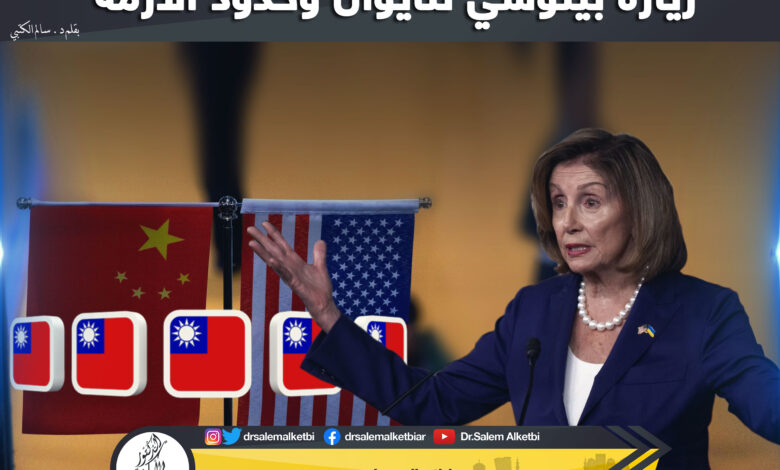
So, the recent visit of the Speaker of the House of Representatives, Nancy Pelosi, to Taiwan is not a coincidence. It cannot be seen within the scope of movement offered by US lawmakers. Pelosi is a Democrat for whom politics and parliamentary work are nothing new.
She is one of the heavyweights in American politics, especially in recent years, and is third in the hierarchy of American power after the president and vice president. Pelosi is already known for her very tough stance on China.
I think Pelosi’s visit to Taiwan is seen with more ease than her visit to China in 1991, when she deliberately visited the famous Tiananmen Square, such a touchy place for Chinese Communist Party leaders. In addition, there are many other positions that reflect her hard line attitude towards Chinese politics. But her recent visit to Taiwan is different.
Today’s China is not like the China of past decades, in which Beijing would take in behavior that incurred its wrath. The US itself no longer occupies a supreme perch in the world order that allows its politicians to do whatever they want toward other countries.
The timing of the visit itself seems very surprising because the US cannot afford to escalate tensions with another international power besides Russia. Beijing and Moscow are in agreement, if only tactically, to counter Western pressure led by the US. Pelosi’s visit to Taiwan, the first by a senior US official since the mid-1990s, raises many questions.
President Biden suggested nearly two weeks ago that the Pentagon did not think the visit was a good idea. So Biden himself has not supported his Democratic ally’s plan to visit Taiwan. But he could not convince her to back off.
This helped contain Chinese reaction and anger, as the visit was not in line with the White House position or US foreign policy in general. The main issue here is China’s position and the scope of its possible response. Beijing used crude political language on Pelosi’s planned visit to Taiwan hoping the House Speaker backs down.
Beijing even waved the PLA card as part of a possible response to the visit. But in reality, the visit itself turned into a showdown between Washington and Beijing.
The White House, which had criticized the visit, did not do enough to coax its Democratic ally to cancel or even postpone the visit, apparently out of a hidden desire to exploit the space between the legislative and executive branches and along the idea that the visit would be in Biden’s interest, to maximize pressure on Beijing at no political cost while avoiding responsibility for a potential crisis in China-US relations.
US officials are likely to view the visit as a preemptive stocktaking of China’s response to any future military assistance to Taiwan. For its part, Beijing has seen through the White House’s calculation well. It knew that Biden will publicly criticize the visit without bothering to defuse the potential crisis that could result.
This explains Beijing’s pique at the political maneuvering involved in the visit. China is unlikely to let this visit go unanswered. At stake now is China’s international image and the credibility of its threats, which are usually made in a carefully calculated manner or because it wants to send a strong message about Taiwan to US officials as well.
It knows that the visit will eventually be a watershed moment in relations with the US. The timing of the visit, whether picked thoughtfully or by chance, will be one of the deciding factors in the outcome of the global competition for status and influence in the future post-Covid and post-Ukraine world order.
Nancy Pelosi’s visit, in my opinion, marks an escalation of tensions between China and the US. But the limit of escalation still hinges on other US positions and policies, as well as Beijing’s strategic calculations on how to respond to the visit, and the scope of the expected impact of any move on Beijing’s immediate and future interests.