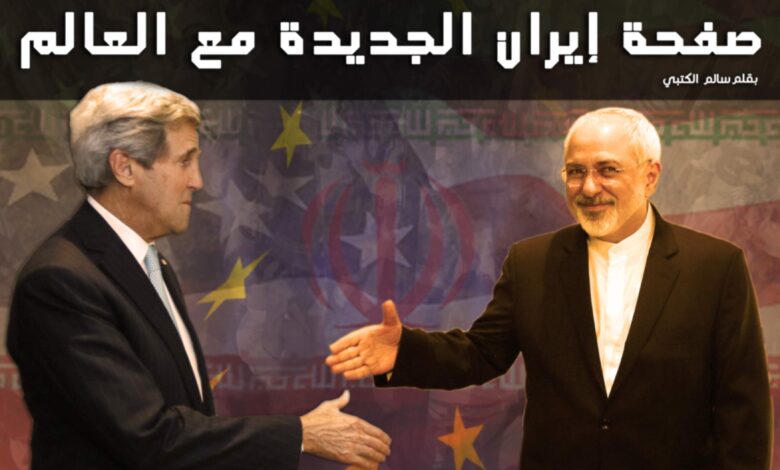
Few hours after the International Atomic Energy Agency had announced that Iran honored its obligation to reduce nuclear activity provided for in the nuclear deal with the Great Powers in July 2015, President Hassan Rouhani declared that his country “opened a new page” in its relation with the world. In fact, this is the logical result of the latest developments after all these years during which sanctions of Western Countries make the Iranian economy suffer a lot.
Obliviously, after all these years of conflict with western powers, Iran has given up its nuclear program, which deprived the Iranian people from the right to have a decent life and benefit from the potentials of its country (international sanctions costed Iran $ 160 billion of lost oil profits since 2012). These profits were either frozen in the framework of sanctions or used by the Iranian regime to militarize the country and mobilize proxies in several neighbor countries to realize its agenda and go beyond its borders, though in a disguised way to hide the sectarian nature of this agenda.
Now, sanctions are lifted, according the declaration of Western leaders, and Tehran claims to turn the page in its relation with the international community. This trend seems to be a good thing, but still it urges us to ask some questions concerning the Iranian behavior in the future: Is Iran going to be a regional power promoting security and both regional and international stability as the UE has claimed? Has Iran really renounced its nuclear arms ambitions totally? What if Iran has a plan B to make its first nuclear bomb using the enriched Uranium it has managed to hide from the inspectors of International Atomic Energy Agency?
International supervision on the Iranian nuclear facilities is sterile practice pragmatically speaking as it consists of analyzing the information submitted by the supervised country itself (!). Consequently, the decision of International Atomic Energy Agency about how much a country is really committed to its obligations is invalid, legally speaking. The level of reality reflect by this type of supervision depends primarily on the capacity of the supervised country to abscond, maneuver, hide and avoid. At first glance, technology seems to be useful in identifying and monitoring the nuclear activities of countries like Iran. Still, it is not quite useful taking into consideration that rogue states that has being engaging for many years -and may be still engaged- banned nuclear activities like Iran, North Korea and Israel use their own technology and strategies to avoid supervision.
Lifting sanctions means that Iran can have access to billions of dollars in assets and export its oil is, in a way or another, a test to the real intentions of Iran. Here comes one important question: Is the Iranian leadership going to behave wisely and give up its policy that has threatened regional peace for a long time? Will Iran Inject those billions of Dollars in its Treasury for the benefit of the Iranian people and economy or will give them to proxies and militias implementing its plan in the region? (Reports are talking about $100 billion in frozen assets, while British “Telegraph” newspaper says that only 10% of the Iranian frozen Assets equals eight times what Iran gives to Hezbollah each year.)
Frankly, I believe that the second hypothesis in my question is more probable than the first one, as Iran is very keen to extend its borders. This intention is openly declared by Iranian Leaders like Ali Younossi, President Hassan Rouhani advisor. One month ago, he said that his country aims to establish the “Iranian Union” in the region, explaining himself in the following way “by “union”, we do not mean elimination of borders, rather all the countries near to the Iranian plateau must get closer to each other, because their security and interests depend on each other” adding “I don’t mean that we want to invade the world, but still we want to restore our status and historical awareness. In other words, we want to think globally and act nationally and regionally”. Such declarations may seem vague to some, but to some other they are quite clear. Iran’s intentions are translated by its acts recently. It has tried to besiege GCC countries through its proxies in the North (Iraq, Syria and Hezbollah) and the South (Houthi Militias) and constantly abetting Shiites in these countries and setting itself as their lawyer.
The White House seems to be happy with the nuclear deal, considered by President Barack Obama as his gateway to make history and remake President Nixon’s experience with China in the seventies. However, the Congress seems very anxious and skeptical about this deal. “The pioneer country in supporting terrorism may use the money (Iranian frozen money) to finance terrorism”, said Speaker of the U.S. House of Representatives Paul Ryan. Regardless of the motives for which the White House and the House of Representatives do not adopt the same position towards Iran, there is one thing we are all sure about. We are all sure that some American politicians still do not trust Iran when it says that it will turn a new page and give up the ruffian behaviors it has been showing decades now.
The Guardian newspaper said that may be the Supreme Leader of Iran Ali Hosseini Khamenei make the strategic decision to give up the nuclear program of Iran, whose economy is wearied by international sanctions. Meanwhile, ice is melting down between Iran and the US. Just few days after the sanctions were lifted, the two countries had changed prisoners. However, this is not enough for Tehran and Washington to trust each other, notably that the Iranian regime is terrified of the consequences of openness to the West that may demolish it from the inside. The question now is whether the Iranian religious leaders, who used to hide behind shining mottos against the West, can come out to light and get accustomed with the idea of openness? And whether they can adopt transparency and comply with international law?
Personally, I don’t think so. Not only that, I believe that even the nuclear deal will not be respected by the Iranian leaders who cannot live in light and prefer to act through their proxies in the region. They will not give up their dream to restore the glory of Persian Empire. Anyway, only time can show us how much host Iran is, and how much peace and love it is ready to give instead of blood and hatred.