After Daesh nearly controlled many territories in Syria and Iraq, the international community is discussing this imminent danger. Ministers of 20 countries will meet in the Paris conference to discuss a strategy to counter Daesh as well as to resolve the crisis in Iraq through political solutions.
Clearly, many States rely on the “Mobilization Forces” to face Daesh, without consideration to sectarian risks, but with awareness that this is the perfect recipe to attract thousands, and perhaps tens of thousands of fighters to engage in the combat against Daesh.
News reports suggest that there is a growing international dependency on the Shiite Mobilization Forces and the military support of Iran in dealing with the deteriorating situation in Iraq. BBC high-level sources confirmed that the Iranian-made missiles were transferred to the front lines in Anbar, and about three thousand fighters have completed their basic training near the Habbaniyah military base, east of the city of Ramadi, to liberate the city. There is no doubt that the world’s options are not limited to relying on the Shiite forces to face Daesh. This option proves the failure of President Obama’s strategy in dealing with the threat of this organization, and the US approval to transfer the responsibility to Iran, handing the Iranians the keys to the solution in Iraq, and therefore determining the future of this ancient Arab country.
In the twenty-ninth of this month, a year would have passed since the proclamation of the so-called “Islamic State” as declared by a spokesman for Daesh. “The Islamic State has decided, represented by the Caliph election committee of representatives, leaders, emirs and Shura council, the declaration of the Islamic caliphate and the installation of a Caliph to the Muslims, and swears allegiance to Sheikh Ibrahim bin Awad bin Ibrahim bin Ali bin Mohammed al-Badri al-Qurashi al-Husseini al-Hashemi to whom allegiance has been pledged and has become the imam and caliph of Islam everywhere.”
Now, Daesh controls more than half the size of Syria and 80 percent of oil and gas resources in the country, as well as Mosul, the second largest city of Iraq. It is expanding towards the Jordan and Saudi Arabia borders through controlling Anbar and has reached areas near Baghdad at some point during this year. Despite the enormous numbers of forces, from international US-led coalition air forces of about 60 countries, and about sixty thousand fighters from the Shiite Forces as well as the Iraqi army, Daesh is still expanding and maintains control of the land despite heavy air raids by Arab-Western coalition aircrafts in Syria and Iraq.
One year after of the emergence of the Islamic State, there are about 5,000 Afghan and Pakistani fighters fighting alongside Syrian government forces against extremist organizations, including Daesh. The conflict has been internationalized with sectarianism in the picture. Recruitment operations in Afghanistan are focused on the Shiite Hazara minority, which has suffered persecution for long. A Shiite leader in Kabul was reported saying that the primary motivation for joining is unemployment as well as religious motives. As a consequence, the conflict in Syria now involves mercenaries. The situation there can get out of control even by the parties of the proxy war, especially since some Afghan illegal immigrants to Iran, estimated to about two million, were reportedly recruited, which would fuel sectarianism in Syria. The scenario will be terrible if the opponent party starts recruiting Sunni Muslims.
Are Afghans the new fuel of Sunni-Shiite conflict? Will they be involved with extremist organizations as they were when these groups emerged after the Soviet invasion of Afghanistan in the last quarter of the twentieth century?
The whole scene seems confused, and no one has alternatives or realistic exits in the US administration. Some former officials speak of good options. Former US Central Intelligence Agency director and former commander of US forces in Iraq, retired Army Gen. David Petraeus, said ISIS cannot be defeated by military means alone; politics must have a role in the fight. His view can be understood through his advocacy that political changes start from the top. In other words, Sunni Arabs should be given the necessary incentives to convince them to back Iraq anew and not to oppose it. The Iraqi government seems not inclined to that. The White House may resort to an Iranian-American entente to fight the group, meaning that Iran will have a free hand with the organization or the go-ahead to divide Iraq as an exit from the crisis.
It is unexplainable that Washington refused to provide Kurdish Peshmerga forces with weapons and was reluctant to put pressure on the government of al-Abadi, which insists on refusing to provide the Sunni tribes in Iraq with weapons to confront Daesh which Petraeus described as a “strong enemy”. In contrast, President Obama said they are “amateur terrorists”, and that their danger does not amount to the danger of Al Qaeda. Is the level of risk being recalculated, or was Washington hiding the truth until the group takes control in order to implement its strategic vision of the regional re-partition?
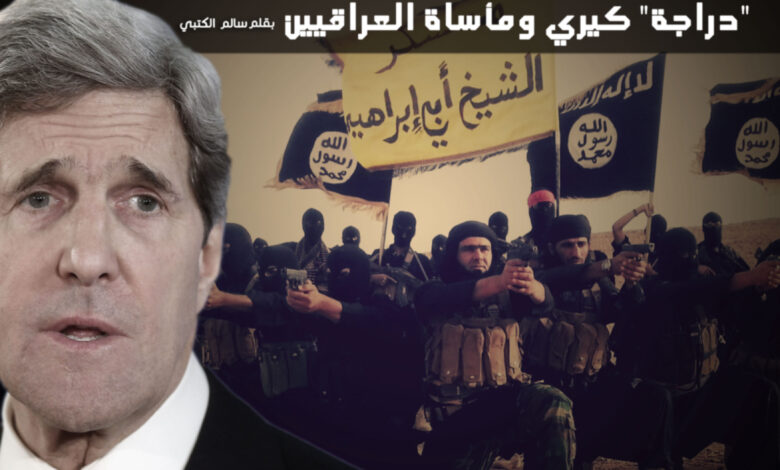
Petraeus, one of many former US official who are aware of the threat of Iran, has expressed more than once skepticism towards granting Iran a role in the fight against Daesh and insists that Iran remains a “revolutionary force” in the region. He considers that Iran took advantage of the chaos to make some progress, and even created chaos to dominate the region. Petraeus views still do not convince the Obama administration or its vision for a solution in Iraq. It is unfortunate that US Secretary of State John Kerry will not be able to participate in the Paris conference due to his injury as he fell from his bike. The conference thus lost a major influencer and decision-maker in this critical issue in the fate of the Middle East. Perhaps, Kerry’s bike has exacerbated the tragedy of Iraq and the Iraqis.