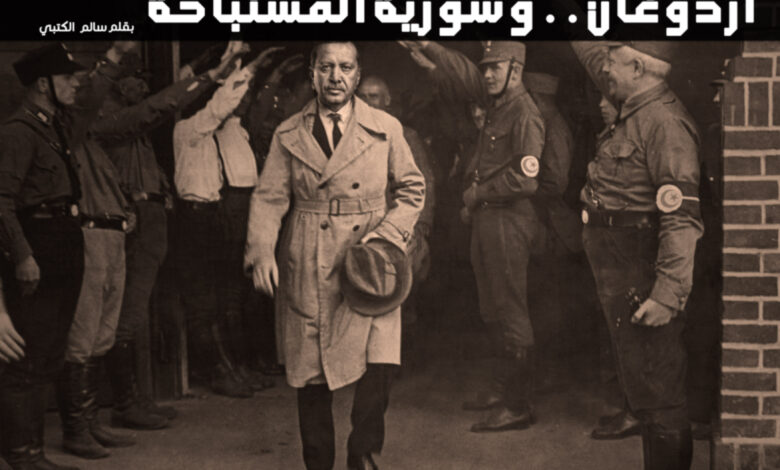
The international community kept – comfortably – quiet as Turkish President Recep Tayyip Erdogan launched a military operation in northern Syria, under the pretense of preventing the Kurds from establishing their own state there. In his speech last Friday, Erdogan vowed Turkey would block any move by the Syrian Kurds to establish their own state in Syria, in the wake of the Kurdish fighters’ gains against Daesh over the last weeks. The Turkish president accused the Syrian Kurds of ethnic cleansing in areas under their control in Syria. Later, Turkey reportedly sent troops to Syria, in a major step by the second-largest fighting force in the NATO (after the US military).
With Turkey intervening in Syria, the process of “partitioning” Syria into spheres of influence seems to be on the way. In line with the US interests and choice not to intervene directly in the Syrian crisis, Washington turned a blind eye to the Turkish move. Ankara’s concern is that the Kurds attempt to connect Kurdish areas in Syrian along the border with Turkey, declare their own state, and fuel Kurdish separatism in Turkey. Back in the mid-1980s, armed Turkish Kurds were demanding an independent state in southeast Turkey, home to about 15 million Kurdish Turkish people.
Erdogan’s military campaign reconciles the US and Turkish interests. Ankara wants to prevent control over the Turkish-Syrian border by the Democratic Union Party. Such a move requires the Turkish army to chase Daesh, along with the Kurds, from the border area. As the campaign targets Daesh, it has the US support. The campaign is also relevant inside Turkey. The AKP’s deceasing popularity led to a severe political crisis. Also, Erdogan has been concerned that any coming elections would bring unpredictable results. The decision concerning the elections is a warning from Erdogan to voters and parties that failing to form a Turkish government would bring “chaos”. Therefore, engaging in an external conflict, along with the fact that Turkish army commanders sense a real external threat in the growing Syrian-Kurdish influence on the Turkish border, could save Erdogan and his party for now.
Today, it is clear that the engine behind the regional powers’ policies is demography. Iran is making moves to alter the demographic scene in Iraq for the Shia interests. Turkey fears any changes in Syria’s population distribution could yield to the creation of a Kurdish independent state that would threaten its unity. Tehran’s position towards Turkey is complex. The Turkish move serves the interests of the Syrian opposition, which is at odds with the Iran-backed Syrian regime. However, Tehran shares Ankara’s fear of a Kurdish state extending across Syria, Iraq, Turkey and Iran, which could outweigh its fear for the fate of Assad’s regime. In such case, the Kurdish state is a direct threat to the territorial integrity of Iran itself, which justifies Iran’s backing to the Turkish position.
Given the status quo, the fate of Syria seems to be in the hands of the international powers and non-Arab regional powers. Turkey and Iran would have the upper hand in determining the fate of Syria. Any potential understandings in this context will not necessarily be in the interest of the Arab states, of course.
Three major crises are happening in the Arab region. Libya, attracting the attention and raising the concern of Egypt. Yemen, in which Saudi Arabia is involved with fears of a long-term attrition war. Syria and Iraq, two Arab countries open to various scenarios.
Turkey’s military intervention in Syria, according to some analysts, responds to the growing influence of Daesh and the Kurds along its border. This is true to a certain extent. Nonetheless, while keeping an eye on about 30,000 Iran-backed Shia fighters in Syria, Turkey, too, wants to maintain its interests in a country on the brink of breaking apart.
Certainly, the presence of the infamous Daesh is directly linked to what is going on now in the Middle East. The terrorist organization has provided a cover for regional and international powers to implement their expansionist policies. It has also contributed to weakening and disintegrating certain Arab states into failed states. Whether Daesh is a mere intelligence tool or a neo-terrorist ideological organization, the free services it offers the opponents of the Arabs suggest the organism may now be the Arabs’ number-one enemy. To conclude, history repeats itself and Arabs pay the price. A new Sykes-Pico scenario seems inevitable.