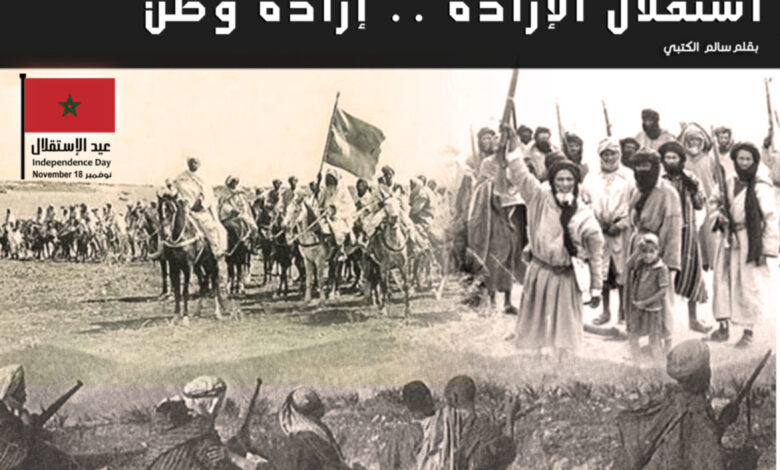
A nation’s timeline is marked by many dates in which the people celebrate important events. Days of independence are among the dates when the sacrifices made to end colonization are remembered. In one of our sister countries, this joyful event falls on November 18 of each year. The Kingdom of Morocco celebrates a glorious independence day where moral, political and national values intersect.
Independence is about the sacrifices of people. In Morocco, Independence Day is quite special. It stands for loyalty to role models of the past, who gave the best examples of patriotism and sense of belonging. Generally, no one nation could have achieved independence without the sacrifices turned victories of national heroes.
The day of independence in Morocco has a special flavor. It reminds the Moroccan people of the sacrifices made by their king. This historical occasion marks the strong bond between the people and the king that had a critical role in ending an era of colonial protectorate imposed since 1912.
Also exceptional was the nature of colonialism in Morocco. The colonial powers–France and Spain–had attempted constantly to divide the country, but the will of our Moroccan brothers and their king, late Mohammed V, led to their triumph over Franco-Spanish colonialist schemes.
The leaders of the liberation movement who stood in the face of colonial powers are, today, historical icons of patriotism inspiring generations to come. Willpower and determination define the struggle of the late Mohammed V and his family and sacrifices they gave for freedom. The exile and exclusion the Moroccan royal endured sparkled revolt in the mother land and protestations for independence. Moroccans stood behind the king, symbol of unity and independence, and the willpower of the people eventually overcame that of the colonial power.
The foreign power reckoned that exiling the king, symbol of unity, and his family, was sufficient to silence the national voice claiming independence. It was later disillusioned as late Mohammed V and his family returned home on November 1955 in a historic announcement of the victory of the Revolution of the King and the People. The homecoming announced the end of the protectorate and the opened a new chapter in the history of Morocco.
A quite special feature in this memorable course of events is in fact the ‘symbiosis’ between the people and its historical leadership. This trait is still nowadays representative of a Moroccan ‘exceptionalism’. The Moroccan royal family is not merely a manifestation of a political system, it also symbolizes a historical unity that preserved the national identity and territorial integrity of Morocco against the foreign invaders.
The ‘symbiosis’ behind the revolution of the king and his people, or the people and their king, highlights the ‘exceptionalism’ of the Moroccan liberation movement, among other movements of Third-World countries. This relationship between the people and their ruler has been a distinctive feature of the system of government in the Kingdom of Morocco through history.
Today, King Mohammed VI continues to maintain this tradition. Worth noticing is that the Moroccan leadership attempts continuously to spare the country the challenges other Middle-Eastern countries have been facing, putting first the interests of the people. He also demonstrates an ability to anticipate and assess impactful events and adopt the suitable policies and orientations for the benefit of the nation and the people.
The policy of King Mohammed VI stresses that independence is not an individual decision but the collective will of the people expressed by the king as a symbol of unity. The movement of independence and de-colonization of Morocco is in fact a lesson in history. Congratulations to the national leadership and to the people of such a country, deeply rooted in history and proud heir to a legacy of genuine sacrifices.