To deal with the Iranian elite and be able to approach their policies adequately, one must understand the principles and foundations of their ideology.
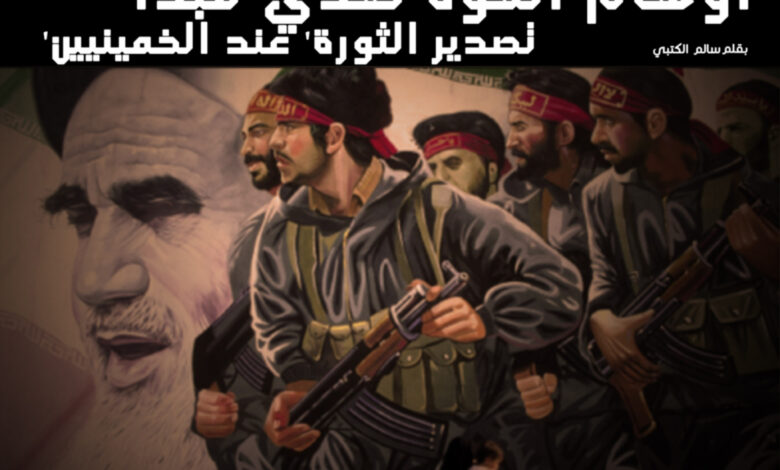
This ideology can be found in the books and statements of Khomeini, especially those published right after the revolution i.e. the eighties of the twentieth century. In a statement marking the start of the new Iranian year, at the end of March 1980, Khomeini said ‘We should seek to export our revolution to the world, and to abandon the idea of refraining from exporting the revolution (…) We should come to an end with the major powers, and show them that we are dealing with the international community as messengers despite all the dilemmas that we are experiencing’.
A statement issued on July 30, 1988 reads:
‘We will work with all our efforts to reduce the phenomenon of royalties and immunity for American officials, even if it takes to struggle valiantly. We will never surrender to or bargain with the US, Russia, or disbelief and polytheism in the Kaaba and the Hajj, this great platform through which the appeals of the oppressed should reach the whole world, and should be addressed the call for monotheism. We ask God to bless us with such ability, to knock the death knell to the US, Russia, not only from the Kaaba of Muslims, but also from the churches of the world.’
A statement issued on behalf of Khomeini on 23 March 1989 also reads ‘The Government of the Islamic Republic is called on to do everything it can to meet the needs of the masses in the proper way; but that does not mean abandoning the goals of the great revolution of the establishment of the Government of the Islamic World.’
These official extracts from the literature of the Khomeini revolution reflect several notions. First, the export of revolution and thought of Khomeini is one of the pillars of the Iranian state. The possibility of tactical or strategical renunciation is analytically and objectively non-conclusive. They are the backbone of the system, which cannot have ‘legitimacy’ in the eyes of its supporters without these principles and foundations.
Second, the idea of exporting the revolution does not just concern the Gulf Arab states neighboring Iran, but also the rest of the world. Mentioned in one of the statements referred to above is the term ‘Government of the Islamic World’. Here, ideological convergence seems clear between the ruling clerics in Iran on the one hand and the idea organizations such as the Muslim Brotherhood hold on the other hand.
For many years, Western researchers and politicians have treated the concept of ‘export of the revolution’, but in the recent years they forgot and ignored it. Instead, the focus of the research zeroed in on the idea of the ‘transition of Iran from the revolution to the state,’ especially with the rise of former President Mohammad Khatami to power in 1997 with his hidden propaganda of ‘the dialogue of civilizations’, through which he wanted to beautify the face of the Iranian revolution and market some slogans to convince the world that a change has occurred. This proved to be false later with the arrival of the hardliner Ahmadinejad to power, who served as a ‘political drug’ to deceit the world. Although many researchers specialized in Iranian affairs assert that the principle of ‘exporting the revolution’ is unenforceable, evidence confirms that Iran would not give up the idea of exporting its revolution.
The ‘renaissance’ of the principle of exporting the revolution is documented in Gen. Qassem Soleimani’s statements. He said last year during the celebration of the anniversary of the Iranian Revolution that ‘the indicators of the export of the Islamic revolution can be seen everywhere, from Bahrain to Syria and Yemen and even North Africa’.
Soleimani brought back ‘the export of the revolution’ to the limelight. His statement is not random or reactive, given he is a prominent associate of the current Supreme Leader Ali Khamenei. It can be said that he is also the first responsible for the dossier of Iran’s strategic expansion regionally.
To say that Western circles do not read well what Iranian leaders say is incorrect, but there is a kind of selectivity in dealing with this issue specifically. The United States was not absent when Iran was gaining influence in Iraq. The possibility of Shiite Iranian control over Iraq was not absent from the American strategic mind when the US ordered laying off Iraqi soldiers and policemen in the wake of the fall of Saddam Hussein’s regime. There was a synchronicity between those decisions and the emergence of the concept of ‘creative chaos’. Also, the secret understandings between Iran and the United States go beyond their public meetings and statements. It is also not correct to say that the United States offered human, and financial and military resources for the fall of Saddam Hussein just to see Iraq fall in the hands of Iran. The US’s strategic planning conforms necessarily with the accounts of the superpower.
The more dangerous problematic is that the American strategic mind ignores the danger of the Iranian regime and believes that it could be tamed or domesticated, depending on the invasion of the minds and thoughts of young Iranians with a flood of American cultural values. This is not an option, at least for the time being, and here lies the seriousness of the American game with Iran, of which Gulf and Arab countries are paying the price.