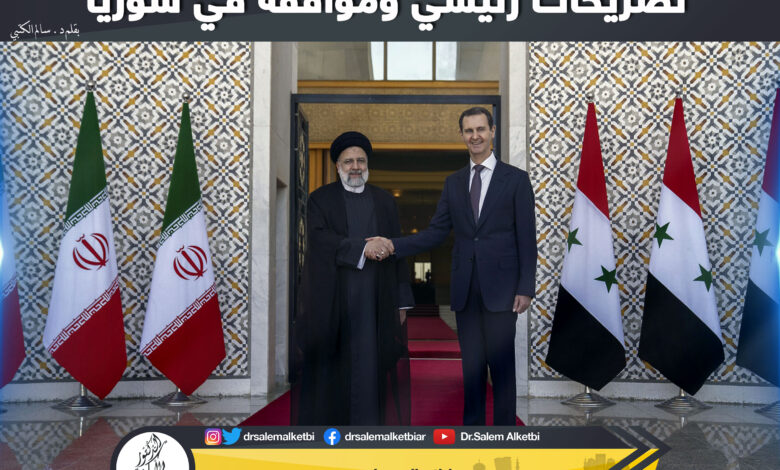
In the recent high-profile visit of Iranian President Ebrahim Raisi to Syria, some insights into Iran’s future relationship with this Arab country have emerged. This period is marked by extreme sensitivity, as Arab diplomatic efforts intensify to bring Damascus back into the Arab fold and rearrange the situation between Syria and its Arab neighbors.
It’s not surprising that Raisi visited Damascus before any Arab presidents did, especially from influential countries. The strong links and relationships between Syria and Iran are well-known. However, this doesn’t deny the fact that Syria is moving closer to its Arab position. Perhaps the visit is closely related to this expected return, as Tehran wants to secure its interests before it’s water under the bridge between Damascus and the rest of the Arab capitals.
Syria has always maintained a delicate balance in its relationships with its natural Arab surroundings and Iran, even before the start of the current crisis in 2011. Therefore, it’s considering reviving this “tried-and-true” formula after restoring its relations with Arab countries.
All of the above is not surprising, given previous experiences and expertise. However, what’s noteworthy is Raisi’s statement during his visit to Damascus, suggesting that the solution to Syria’s neighboring countries’ concerns is the return of all Syrian territories to the sovereignty of the state. This indicates the importance of not having any Turkish forces on any part of Syrian territory.
Deserving of analysis for the questions it raises is Raisi’s statement, particularly the first part that focuses on Syria’s neighboring countries. Most likely, Raisi refers to Israel, as the country has more significant concerns about what happens in Syria and the future of their interactions than others.
The reality is that the first part of the statement is entirely correct. The unity of Syrian territory and the guarantee of its sovereignty over its land is the solution to the fears of all countries in the region, not just Israel. However, the second part leaves to be desired.
It’s essential to ensure no foreign actors, not just Turkish forces, are present on any Syrian soil. The implication is that Iranian forces, militias, factions, or organizations under any name bring negative consequences and effects as Turkish military presence or any other foreign forces.
The sovereignty of states is indivisible and does not allow for any breach or violation, particularly if this presence brings crises with other regional parties, as in the case with Iran and Israel.
True, Syria cannot currently ask Iran to withdraw its militias from Syrian territory. It could be due to political sensitivity, operational reality balances, or the lack of a decisive military position internally. Terrorist and separatist militias still control parts of Syrian territory or are stationed within it. However, all of this doesn’t negate the importance of agreeing on the principle that foreign forces should leave Syrian territory sooner or later.
The Iranian system aims to keep Syria within the so-called “Axis of Resistance” and define its policies and role accordingly.
Iran’s aim is to make Syria’s reentry to the Arab world a mere formality, keeping Syria on its side as a linchpin for its regional project. Iran claims that Syria holds a “distinguished status” in its anti-Israel alliance, and emphasizes that the liberation of Jerusalem is its top priority. However, this statement appeals to emotions rather than reality, as Iran does not work for the benefit of Palestine and the Palestinians, unless it is solely based on slogans and chants.
Raisi’s statements put Iran and Syria in the same basket when it comes to confrontations with Israel, not in Syria’s best interest. Syria’s security and stability will not be achieved by the presence of Iranian militias or pro-Iranian forces on its soil. Everyone knows that such presence opens the door to Israeli attacks on Iranian military targets, which Israel sees as a threat to its national security.
Thus, Syria bears the cost of the proxy war that Iran is waging against Israel, which does not serve the Syrian people’s interests or attempts to restore security and stability or to allow the return of refugees and displaced persons to Syria. Therefore, demands for the withdrawal of foreign forces should include “all” and not just some, or specify one party without the other.
With its backing of Syria since 2011, Iran is unlikely to easily relinquish its military presence in the country, and may argue that it is there at the request of the Syrian government. It is difficult to anticipate Syria’s demand for the withdrawal of these militias, given the continuing security and political uncertainty.
However, it is crucial for Iran to understand that its presence in Syria is a major reason for the instability in the country. Arab capitals should support Syria in maintaining its national cohesion and sovereignty, and boosting its capabilities to prepare for exceptional security conditions. At the forefront of these challenges is the Iranian militia presence in Syria.