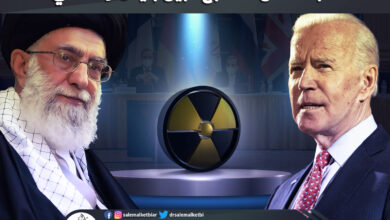
In the Gulf region and the Middle East, we may not care much for the dispute over Iran’s announcement that it has developed a hypersonic missile capable of penetrating all defense systems. The reason is simple: neighbor Iran already has already something to threaten regional stability before it announces the development of this advanced type of missile.
The Iranian announcement, which alarmed Western circles, came amid already existing concerns about the role of Iranian drones in the war in Ukraine, adding further complications to the West’s calculations about the Iranian dossier.
Amir Ali Haji, commander of the Islamic Revolutionary Guard Corps (IRGC) aerospace force, said the new missile has five times the speed of conventional ballistic missiles. Haji said he believes it will take decades to develop defense systems capable of intercepting the missile, which is a “big leap forward” in Iran’s missile arsenal.
Some Western military experts say that “the Iranians sometimes overestimate their military power.” This may have some degree of validity or be entirely true. But experience has taught us to be cautious, without exaggeration or trivialization, about what the Iranian side announces, and the issue of Iranian marches is not far off.
Western suspicions continued to surround this dossier, despite the involvement of these drones in bombing oil facilities in Saudi Arabia and the UAE, until the world was surprised that the aircraft played an influential role in the war in Ukraine and were used by Russia, the leading country in the weapons industry, regardless of the motives for this use, whether for economic, manufacturing or other reasons.
The reality is that there are Iranian planes fighting under the Russian flag in a war whose consequences constitute a crisis for the entire world. Interestingly, Iran’s announcement about the development of a hypersonic missile came just after Tehran confessed its involvement in the war in Ukraine. There is a message the Iranians want to send to whom it may concern.
In this case, it is several regional and international parties, and some of the purposes of this message have to do with trying to keep regional parties from thinking of targeting Iran militarily. Others have to do with maximizing pressure on Western countries that Tehran claims are behind encouraging internal protests against the Iranian regime.
Iran is playing a dangerous game of deliberate interference in the Ukraine crisis. A report published by the Washington Post on Oct. 16 indicates that Iran is preparing to send missiles to Russia. This has been denied by Tehran.
But experience has also taught us that Iranian denial does not mean much; a repeat of the drone issue is a tempting question for Iran before Russia.
Tehran definitely wants to flood Russia with the support it needs or doesn’t need, it doesn’t matter, giving the Iranians an implicit right to receive Russian support in exchange for other files (a recent CNN report stated that Iran asked Russia to help it develop its nuclear program), or at least to neutralize Russia’s position in any potential crises Iran might create regionally.
In addition, there is a rare opportunity to test Iranian weapons on real battlefields, learn about their operational capabilities, work on their development and address any gaps in their characteristics and combat effectiveness.
What interests me most in all of this, whether the announcement of the hypersonic missile development is real or just a primitive version of that model, is the Iranian thinking itself. Iran is not satisfied with all the equipment, the weapons, the underground missile cities, the drone arsenals, and the nuclear program, the extent of which or where it ended up.
A duplicate of North Korea in the Middle East. This level of threat escalation is mainly due to the disastrous strategic mistake of the US in ignoring Iran’s missile program as negotiations began to revive the Iran nuclear deal, following the approach or rather mistake of former US President Barack Obama’s administration, which ended with the signing of the agreement in 2015.
Ignoring Iran’s missile program was due to a lack of appreciation of the seriousness of this program, which Western countries believe poses no real threat to their security. According to the Obama administration’s assessment, Iran will not be able to build intercontinental ballistic missiles any time soon.
The main Iranian threat comes from its nuclear program, which has given Iran a valuable opportunity to continue its missile tests until it recently reached the point of announcing the development of a hypersonic missile, having now achieved qualitative breakthroughs in its strategy of moving the battle beyond its borders, whether through missiles or through a network of militias and sectarian arms spread throughout the region, or both.
As a result, everyone is now paying the bill for miscalculations, underestimation of the Iranian threat, and negligence in taking into account the views of Iran’s neighbors and their assessments of the consequences of what is happening.