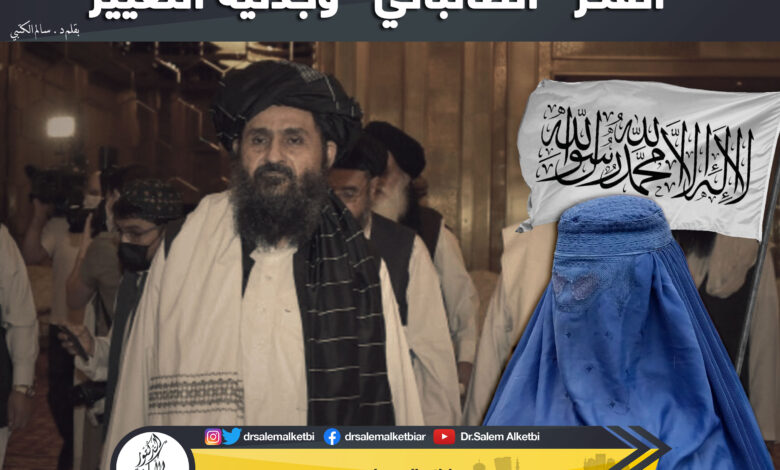
Despite the “catastrophic” state of the Afghan economy in a “death spiral,” as described by UN Secretary General António Guterres, who recently warned at a virtual international conference that “a million severely malnourished Afghan children are on the brink of death,” and despite the deteriorating security situation and the growing threat of Daesh, which has recently conducted numerous terrorist operations in Afghanistan, Afghan women dress are the topic of most concern that the Taliban rule the country.
In a rare interview with CNN, Taliban-appointed Interior Minister Sirajuddin Haqqani said there is, in his words, good news about girls returning to high school in Afghanistan. Work is continuing to find a mechanism to reopen high schools, he added. But his talk reflected the focus on a “girls dress” in line with the vision of the movement and its leaders.
There is ample evidence that today’s Taliban has changed little compared to yesterday’s Taliban, only trying to convince the world that it has changed. This attempt is not based on real evidence, but only on a declaration of intent or desire for change that is closer to deception than truth. Yesterday, women anchors appeared on the main television channels in Afghanistan.
They covered their faces by wearing the hijab in accordance with the Taliban’s decision, which gave the broadcasters a deadline, which expired last Sunday, to comply with “Islamic provisions on women’s dress.” The movement also warned civil servants that they would be fired if they did not adhere to the dress code, and announced that certain days would be set aside for women to visit public parks.
I don’t want to get into a religious debate about the direction of the movement here. But I discuss it in terms of politics, governance, and even political media and marketing. The movement probably deserves an award for its ability to destroy its own image.
That is its own business, as long as it follows a path that satisfies its leaders. But there is an angle that moves this discussion from the specific to the general — from the affairs of the Taliban itself to the general affairs of Islam. This movement is associated with the Muslim world and presents the world with a distorted view of the Islamic religion.
In this context, I don’t find much difference between those who distort Islam with murder and bloodshed and those who distort it with extremism and do nonsense in front of the world, claiming that this is what Islam is. No one disagrees that Taliban rule is a purely Afghan affair.
But here we are dealing with an aspect of the mental image of Islam reflected in the practices, behavior and orientation of the movement.
There is no denying that the world looks at the movement and evaluates its views based on its religious framework, regardless of the question of differences in vision and other doctrinal issues that do not seem to affect the perception of the world at large, shaped by the context of events in isolation from broader prevailing views in the Muslim world.
No one can change the behavior of the Taliban, who reduce the issue of governance to women’s fashion, clothing and education. We don’t hear about an economic plan for industrial development, agriculture, foreign policy, security, or even combating the terrorist organizations that threaten its rule, even to get the world’s attention and urge it to help it stand up to these organizations.
But we hear a lot about the veil and the head covering. This is a topic that I don’t think is as high a priority as the rest of the development, economic, health, education, and other problems of the Afghan people. The real dilemma in Taliban rule is their desire to rule based on their exclusive religious vision, while telling the world that things will change.
This is mainly the result of an internal conflict between those who want to adopt a more flexible and open approach to governing, although adopting a political approach similar to the Iranian Takia regime, and those who adopt a more rigid approach to governing, regardless of the internal and external clashes it causes.
So far, it is clear that the most radical visionaries have the last word in shaping the movement’s policies. This puts its fate at stake and opens questions about its ability to remain in power in the face of serious internal and external challenges.
In short, the full Taliban has not strayed far from its former version, except for some attempts at political marketing, which quickly evaporate as past decisions and positions are nullified. I believe that betting on the possibility of a radical or relative change in Taliban behavior seems fraught with uncertainty.
The Taliban has so far run the country from a purely religious rather than political perspective and has acted on that basis. All indications are that it is reproducing itself again; all it has learned over the past two decades are marketing and PR stunts similar to what the Iranian regime is doing.
Political and media discourse goes one way, and behavior and actions on the ground go in a completely different direction.