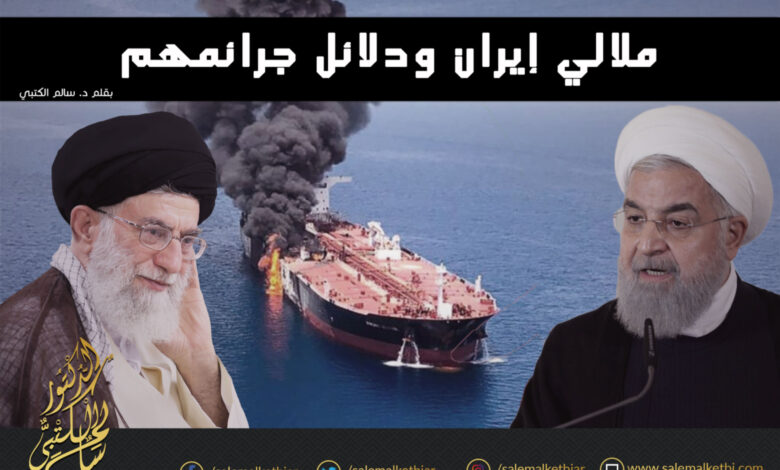
It is odd that some in the region and elsewhere expect the Iranian mullahs to admit to attacking oil tankers in the Gulf of Oman.
Do you expect the mullahs to make an official statement acknowledging their aggression? Has this despicable regime already confessed to one of its crimes, apart from boasting of the illegal support of its sectarian surrogates in Lebanon, Iraq, Syria and Yemen?
Stranger still, skeptics contest the accusations against the mullahs with more enthusiasm than Iranian leaders who refute the accusations and make false allegations that they helped save members of the carriers. However, they were unable to prove their allegations or provide proof that the videos released by the US side, which prove the involvement of the Revolutionary Guards in the bombing of tankers, were false.
Skeptics of the US accusations push two main points. The first is the false claims that the United States invoked to justify its 2003 invasion of Iraq.
As such, this does not constitute evidence that the current administration has lied. Having lied before does not necessarily mean that you will always lie every time.
Iran, for its part, has not provided what refutes the American narrative, nor even doubts its validity. The mullahs’ regime simply denied it.
The second point raised by the sceptics is a very strange one. It makes no sense, they argue, for the mullahs to target an oil tanker bound for Japan while Japanese Prime Minister Shinzo Abe was on a trip to Tehran. And so, a third party wants to cause a rift between Iran and the United States and thwart the Japanese mediation mission.
That might seem like a fair point, but it’s actually smoke and mirrors.
Such an analysis considers that the mullahs have good intentions and treats them as innocent, with the utmost naiveté. The arguments of the sceptics are the same as those that can prove the Iranian regime’s involvement.
The regime seems to have tried to pull off its classic stunt. It felt that targeting a Japan-linked oil tanker was proof of its innocence.
Such is the logic of the thief who wants to hide the traces of his crime, forgetting that no crime is perfect and that the thief always leaves behind incriminating evidence. That is exactly what happened.
The video proving the involvement of one of the Revolutionary Guard ships at the scene of the incident remains the most important evidence at this point.
Indeed, the mullahs have been exposed to one of their few remaining friends in the world. They embarrassed Japanese Prime Minister Shinzo Abe, who believed that he was dealing with a government with a minimum of common sense and rationality, only to find out that it has the same mindset as his neighbours in North Korea, an avanturist and reckless regime by its violations of the principles of world peace.
The Iranian regime claims to be in charge of the safety of international shipping in the Straits of Hormuz. The truth is that even if we assume, for the sake of argument, that it did not commit them, the regime is the main perpetrator of these crimes.
The intensive presence of Revolutionary Guards in Gulf waters does not allow us to speculate that a third party outside the region committed these crimes, with the aim of accelerating Iran’s military targeting.
These kinds of allegations are repeated every time and offer the Iranian regime a way out. If the international community remains silent on this recidivism, let us expect a more devastating disaster that would undermine the remaining foundations of security and stability in the Gulf region.
It goes without saying that the regime is betting on the division of the international position and on the differences between the Trump administration and other major international powers, such as China and Russia. Allowing the Iranian regime to manipulate global disputes and take advantage of them will have disastrous consequences for everyone.
Those who do not respect international law should not escape punishment.
The world must not normalize this type of crimes in the name of disagreement. Energy security is not only the responsibility of oil-producing states in the GCC, but also the shared responsibility of the international community; otherwise the world will one day wake up on a far greater and more serious catastrophe.