In politics, diplomacy is the other side of war; it is the language of weaponry. These visions are obsolete given the development of international relations and the emergence of modern concepts of power itself. Power is no longer defined as the conventional military power in the fourth and fifth generations of war; rather there are other tools and mechanisms to impose domination and control.
The conventional understanding of power did not vanish from the literature of researchers and specialists, but alternative concepts emerged. Soft power, a concept formulated by the American thinker Joseph Nye, is aimed at achieving strategic objectives without resorting to conventional military power, but through cultural and political tools. Nye has discussed this concept in his famous book Soft Power … Meanings of Success in International Politics, and defined it as “the ability to polarize and persuade”, which is the opposite of the hard power that relies on coercion. Joseph Nye drew Americans’ attention to the importance of soft power in dominating the world, and considered that the US could achieve this goal using soft power.
Nye did not mean by soft power the wars of the fourth generation and subsequent generations. For him soft power means the sense of the value and cultural model, it is the culture of Macdonaldization and Cocacolonization that ensures the continuous fascination of the world with the American model and the attempt to follow it. This culture makes the world follow the United States and meet its goals without wars. The idea of soft power relies on the power of information, ideas and the power of globalization, goods, services, gains and profits.
Nye does not believe in the hard power, and sees it as obsolete. The symbolic power can achieve the same goals. Nye Said: “In the contemporary world, it has become difficult to use the stick. Military power, despite the necessity of deterrence and coercion, has become extremely arduous. War has become very expensive in terms of costs”. The strategic weight of countries is no longer related to the resources of military power, but to soft power. Supporters of this school invoke the cold war, which ended by the collapse and disintegration of the Soviet Union through the methods of soft power, after the impossibility of using hard power because the two rival forces at that time had a sweeping nuclear weapon capable of a massive destruction.
In the first decade of the twenty-first century, American study centres considered the ideas of Joseph Nye. The Brookings Institute spoke of the end of a military era in American foreign policy. The concept of smart power was crystallized as a combination of soft and hard power. Obama administration has adopted this concept and tried to apply it, but the results were unsatisfactory. The US position has globally fallen, perhaps because Obama has actually failed to employ the second part of the concept of smart power – which is using the hard power. The world, which has been accustomed to 20 centuries of military conflicts, has failed to suddenly switch to soft power.
Culture and the model’s power are not enough to persuade rogue states such as Iran and North Korea to abandon their violent approach to international relations. It was not easy to convince regimes using military force against their own people to opt for sanity, so massacres took place and international law was violated with the use of chemical weapons. The United States did not react, and just adopted the strategy of red lines. After testing the strategy of red lines it was violated and the Obama administration did not make any retort.
Studies, researches, plans and strategies, which have sprung from these theories, have produced policies to reduce American arms expenditures and so on. US’ strategy has undergone remarkable shifts with the Americans voting for President Trump, with a completely different approach than the Obama administration.
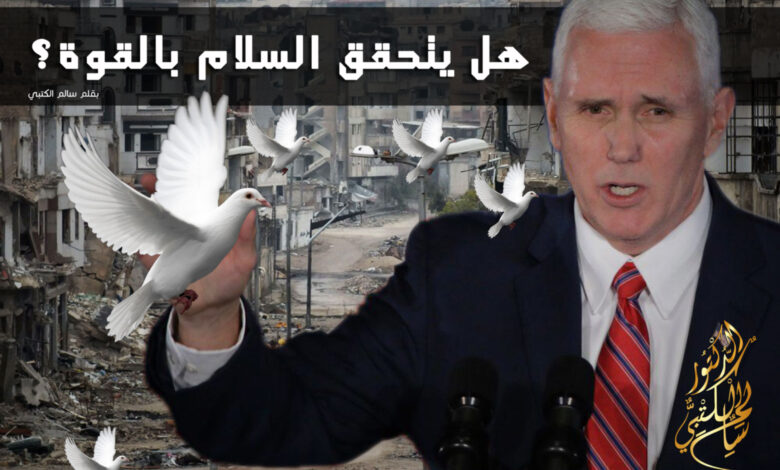
The motive behind the discussion of this issue here is an important statement made by US Vice President, Mike Pence, during a recent meeting with the Japanese Prime Minister Shinzō Abe, where he stressed that Washington and Tokyo are seeking a peaceful settlement in the region. Mike Pence added that peace is to be accomplished by force, which means a new tendency in US foreign policy, but it is too early to say that it is a new strategy. The Vice President’s statements have not been tested yet, especially as he said that his country’s strategic patience towards North Korea is running out. However, the expected war with North Korea did not take place.
Pence’s statement reveals a new discourse in dealing with North Korea, suggesting that there is a persistent American belief that peace can be forcibly achieved. The US understands what is relevant to this discourse, and we must consider its history during the Cold War and the Cuban missile crisis in order to understand that Trump administration undergoes an important stage in American history and which aims to restore US’ image and prestige.
What drives me to say that these are new features of American foreign policy, and not a new strategy, is that US media reports have confirmed that the US aircraft carrier and warships, which were said to have sailed towards North Korea, did not actually sail in this direction, but went in the opposite direction. Most of the world easily absorbs the content of the American media outlets, so everyone has believed that there might be a nuclear clash against this alleged step.
Trump administration has behaved wisely so far, and has implemented a sophisticated strategic plan to intimidate North Korea, a step that was fruitful in fact. What distinguishes Trump administration so far in its use of power is that it moves along unpredictable paths, opens itself to all options, and does not restrict itself to red lines, as Obama did. It is difficult to predict US’ actions, especially after the strike of Tomahawk. Trump is good at employing the tools of hard power but has not yet reached the extent of reckless use. So, he did not practically deviate from the essence of the smart power strategy, but he implements it as described in the books of theorists.
Trump is not as reckless as some analysts think, rather he has the skills of a smart businessman, waving and not rushing. He has long been accustomed to cope with the struggles of the business world, which is fiercest than the world of politics. Trump is good at dealing with reckless counterparts without falling into their traps, and he used to obtain billions of sound decisions that might have started with threats.
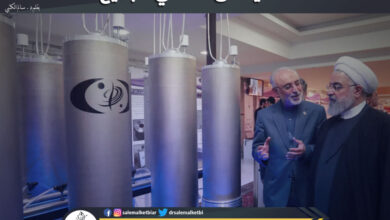
Trump is good at using the media rhetoric with unprecedented intelligence. For instance, he recently made a revision of the nuclear deal with Iran, and many thought of it as a step to strike Iran. This revision is legal and is usually implemented every 90 days, and this was the first revision in Trump’s era, with nothing new, but he seeks to employ it. This is the most important difference between Trump and Obama administrations so far: the political and media discourse that gave up flexibility and liquidity to replace them with rigor, threat, and the explicit and implicit waving of force.