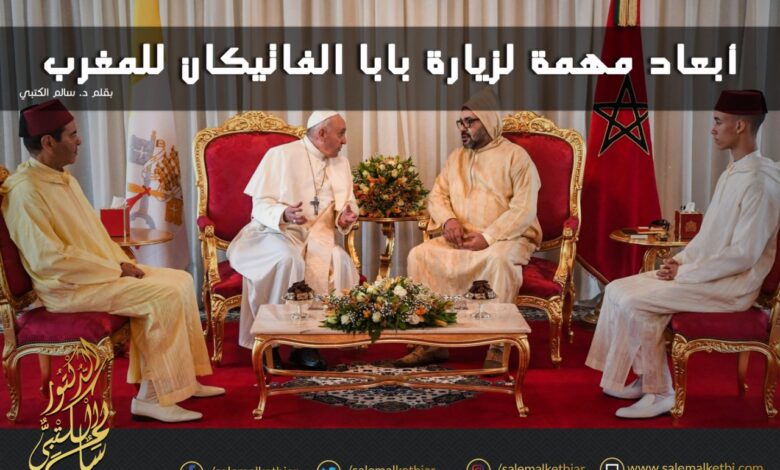
The visit of Pope Francis to Morocco from 30 to 31 March has particular importance. The visit will be focused on specific objectives, including the consolidation of interfaith dialogue.
The Pope has become one of the 21st century’s most prominent advocates of intercultural dialogue thanks to his high spiritual position as the voice of the 1.2 billion Catholics in the world.
On the other hand, Morocco is an oasis of tolerance, moderation and coexistence in our Arab and Islamic world.
King Mohammed VI is a leading advocate of the dialogue of civilizations. He has called for a new definition of interreligious relations to advance global peace and security. The Mohammed VI Institute for Imam Training is instrumental in the fight against terrorism and extremism and in spreading the Moroccan tradition of moderation.
The Pope’s visit to this prestigious institute shows the world the power of openness, tolerance and religious harmony rooted in human brotherhood. It counteracts the idea of interreligious and inter-civilizational conflict advocated by some modern-day merchants of religious intolerance.
The Holy See and the Kingdom of Morocco enjoy special relations based on communication and mutual understanding. Morocco inherited a rich legacy of moderate Islam and has long sought a positive interaction with other religions.
Pope John Paul II visited the country in the summer of 1985 at the invitation of the late King Hassan II, who was the first Arab leader to invite the Pope to visit his country. He addressed a large audience of about 80,000 young people, mainly Muslim, at a local stadium. The late King Hassan II himself visited the Vatican in November 1991.
Pope Francis ha been making great efforts to spread tolerance and coexistence. His visit to the Kingdom of Morocco comes only eight weeks after his visit to the United Arab Emirates. The two Arab countries share a strong desire to promote tolerance and coexistence, with the leaders of both countries playing active roles in this regard.
The late Pope John Paul II’s historic visit to Morocco was not about reaching out to Moroccan and African Christians, but about the two countries’ common will to communicate and understand one another. At the invitation of the late King Hassan II, the Pope addressed 80,000 people, mainly young Muslims. It was a remarkable show of openness at a time when Arab or Islamic countries were not that open.
What distinguishes the current Pope is his belief that forstering tolerance and solid interreligious relations can countervail the spread of conflict. Besides Morocco and the UAE, he visited several Arab and Muslim countries, including Egypt, Jordan, the Palestinian Territories, Turkey, Bosnia and Herzegovina and Azerbaijan.
The Pope’s visit to Morocco came at a time of growing concern about the new waves of terrorism—be it “neo-Kharijite” or far-right extremism—that treat immigrants and asylum seekers in a racist vein as was the case of the recent Christchurch mosques massacre. The attack on the two mosques proved that we need intense and sustained efforts to stamp out all kinds of radicalism and terror.
A strong global consensus must be established that terrorism has no religion, country or race and that religions are not to blame for this evil, as the Pope says in all his visits.
The Papal visit to Morocco is also historical given the country’s growing role as a dialogue mediator not only in religious affairs, but also in politics, culture and academia. Thanks to its tradition of moderate Islam, Morocco has been a land of coexistence and tolerance.