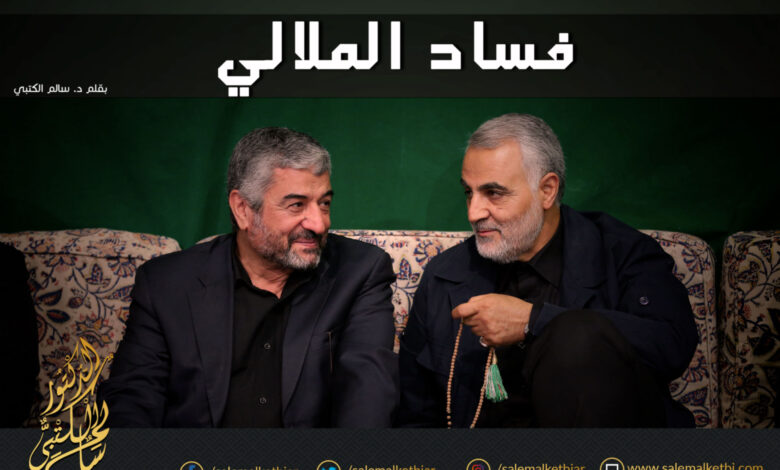
Iranian media outlets circulated information about the dismissal of Qasem Soleimani, commander of the Quds Force. Others reported that the Supreme Leader Ali Khamenei intends to inaugurate Soleimani as commander of the IRGC after tensions between Soleimani and Ali Jafari.
Reports stated that differences between the two are due to corruption in the Quds Force militias. Soleimani controls the Quds Force militias and has a word on the Iranian wealth, a wealth spent on Iran’s expansionist plans.
The Iranian news agencies that reported the leaks have strong ties with the regime. Arya published a report saying that Soleimani may be dismissed. The agency removed its report a few hours later. Tehran Times reported that the leader intends to appoint Soleimani as commander of the Revolutionary Guards instead of Jafari.
Corruption is, among other reasons, a source of differences but not an urgent one. Obviously, Iran is getting ready for the post-nuclear agreement and the probability of a military confrontation with Israel.
According to Arya, Gen. Jafari delivered a report on corruption in the Quds Force militias. Khamenei “took revolutionary measures,” wrote Arya. But certainly, the timing of these decisions is not due to corruption. The differences between Iranian leaders on corruption are frequent. Strategically, to make decisions to counter alleged corruption at this sensitive time is illogic.
The mullahs’ regime aims to avoid the assassination of Gen. Soleimani in Syria or Iraq, on the backdrop of escalation between Tel Aviv and Tehran. The potential killing of Soleimani will impose Iran to respond quickly to Israel. The mullahs won’t prefer to take this step. Tehran adopts the proxy war strategy and avoids engaging direct confrontations even on other territories. The direct confrontation will expose the fragility of their army and the weak Iranian strategy of war. The Iranian army cannot confront Israel’s modern and advanced army.
The mullahs’ regime uses corruption to hide the real reason behind keeping Gen. Soleimani away from the Syrian scene.
Media reports indicate that doubts about corruption have begun since Ahmadinejad’s era. There was information that Ahmadinejad and Soleimani exchanged messages on the need to explain the causes of corruption and embezzlement in the Quds Force. Thefts and corruption date back to an old period. Opening the file of corruption after these years has other reasons than the mullahs’ will to fight corruption and preserve the wealth of the Iranian people. If they wanted to do so they could have prosecuted Soleimani many years ago. But Tehran now boasts Soleimani’s expansionist and influential achievements in Syria.
Reports have revealed that Soleimani knew the mullahs sent the Iranian people’s money to militia leaders in several countries. Strangely enough, the top of the political power in Iran, like Ahmadinejad, had been receiving cash from Soleimani to impart them to those leaders.
This is not an economy that could bear sanctions after the withdrawal of the US from the nuclear deal as the mullahs’ regime claims.
The IRGC is the mainstay of the Iranian economy. It has a huge industrial and economic base of some 5,000 unregulated companies. The IRGC makes about $ 40 billion in annual profits from smuggling and circumventing sanctions. Revolutionary Guards commanders want to prolong sanctions for their own profits and interests.
Corruption in the IRGC annoys the mullahs’ regime. Commanders in the IRGC are out of control. Their ambitions endanger the regime. Revolutionary Guards Commanders want to militarily confront the West. Soleimani’s influence is maybe threatening that of the leaders, leading to the necessity to control it in any way.
Whatever the reasons, corruption is a confirmed issue in the mullahs’ system. Corruption and the uncontrolled distribution of funds will only produce a corrupt expansionist regime, a regime that fulfils the dreams of its leaders regardless of the interests of the Iranian people.